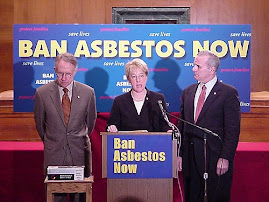
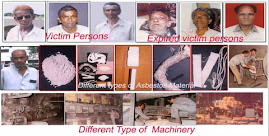
But countries like Russia, Canada, Kazakhstan and Brazil continue to produce, trade and promote this ticking time bomb in India. Instead of protecting the interest of their citizens,leaders like Sonia Gandhi and Kamal Nath(Congress leaders in the picture) remain callous towards asbestos victims. The Russian Federation has also been found to be exporting asbestos industry waste to India. Research is showing asbestos epidemics across the globe even in countries where it is currently banned, as the consequence of past exposure.

Stories of the toll asbestos takes on people are yet to hit the headlines in India as has been the case in US, Europe, Australia and Japan. The recent UN statistics indicates that India imported roughly 306,000 MT of asbestos in 2006. Out of which 152, 820 MT was imported from Russia, 63, 980 MT from Canada, 48, 807 MT from Kazakhstan and 34, 953 MT from Brazil.
It is noteworthy that International Conference on trade unions & chrysotile asbestos in Moscow (25-27 April, 2007) issued an appeal to World Health Organisation opposing the “WHO Policy on elimination of asbestos-related diseases” in favour of controlled use of chrysotile asbestos. The appeal concluded saying, “We are sure that chrysotile must not be banned for the sake of health and social welfare of hundreds of millions of people in the world (especially in developing countries), who suffer and prematurely die from having no shelter and clean water. A wide use of low-cost chrysotile-cement products is necessary to resolve this problem” ignoring the WHO finding that no safe level can be proposed for asbestos use because a threshold is not known to exist.
Asbestos production and marketing started in the Urals at the start of the 19th century. By the onset of World War I, Russia was the world’s second biggest asbestos producer, although well behind Canada. In 1975, Soviet Russia overtook Canada as the world’s leading asbestos producer. Russia remains the leading world asbestos producer. The country’s principal asbestos mine (Uralasbest) was privatized and was owned by new Russian capitalists. It was even declared bankrupt in 1997 but it resumed its activities afterwards.
There has virtually been no debate on asbestos either under the Soviet regime or since. Following the banning of asbestos in the European Union, the Vladimir Putin government did set up a panel of experts to give an opinion on a possible Russian asbestos ban.
The panel’s report is an impassioned defence of asbestos use. The pro-Russian asbestos lobby like their counterparts in Canada, Zimbabwe and Brazil too claim that it holds relatively little danger for health. The Russian authorities continue to deny the health havoc wrought by asbestos. Russian media, civil society and academia must sensitize the Russian citizens to desist from exporting asbestos to gullible Indians.
Currently mining of all kinds of asbestos (Blue, Brown and White [chrysotile] Asbestos) is banned in India. Trade in asbestos waste is also banned. Besides all other forms of asbestos other than chrysotile asbestos (White Asbestos) is prohibited in India. While white asbestos mining is currently banned in India, its import, export or use in manufacturing is permitted.
In September 2007, Independent Peoples Tribunal (IPT) on the World Bank Group (WBG) was presented with evidence of Bank officials suggesting how it finances huge infrastructure projects all over the world including India despite this there is no formal restrictions on the use of asbestos-cement (A-C) sheets and pipes in these projects. Over 90 percent of all asbestos used today is in A-C sheets and pipes, and this production is concentrated in poor countries. Ban Asbestos Network of India (BANI) called for urgent action in India and elsewhere to end the needless slaughter caused by this environmental and occupational health catastrophe. The 4-day IPT was held from 21 –24 September at Jawaharlal Nehru University, New Delhi.
It was demanded, “The World Bank should adopt a formal policy of forbidding asbestos in all of its projects and require the use of safer substitute construction materials. Such substitution is feasible as shown by the bans in more than 40 countries.. The World Bank should also adopt best practice guidelines for the minimization of asbestos exposures in projects where in-place asbestos materials are disturbed by renovation or demolition activities.” It has called upon the World Bank to support the asbestos action program just started by the WHO and use its influence and leverage to press for cessation of asbestos use all over world.
The report of World Bank environmental official Robert Goodland, "Sustainable Development Sourcebook for the World Bank Group's Extractive Industries Review: Examining the Social and Environmental Impacts of Oil, Gas, and Mining" (3 December, 2003). Policy options for asbestos (p. 141) included, "5. The WBG should work with the rest of the UN system to foster a global ban on asbestos."
The voice of asbestos victims has been totally disregarded by Indian political parties of all hues both in the states and at national level unlike US and Europe. Indian homes are often built of asbestos cement roofs, and people cut their own windows and doorways. The occurrence of asbestos-related diseases, including mesothelioma, lung cancer and asbestosis, is growing out of control. Studies estimate that during the next decade, in India victims will die of an asbestos related disease at the rate of 30 deaths per day.

Sixty-seven-year old Mangabhai Patel, a retired workers of Ahmedabad based Torrent Power Ahmedabad Electric Company (AEC)Limited is battling asbestosis. Patel has been diagnosed with asbestosis by the National Institute of Occupational Health (NIOH).
He got exposed while working at Torrent Power AEC where he had to pound asbestos and paste it along pipes as an insulator. Workers were given no protective gear while working and the result is showing on their body now.
Narayanprasad Mehra, another retired AEC worker worked for 25 years at the AEC power plant and he was diagnosed with asbestosis long before he retired.
A petition with the Gujarat High Court and the Supreme Court is pending. Following the directions of the High Court, NIOH was to examine the workers suspected to be suffering from asbestos related disease but even before the NIOH could start its work
Motiram and Manaji Rathod () died on 5 January 1996 and 2 February 1996 respectively. NIOH submitted its report to the Court on 22 June 1996. The High Court passed an interim order but Kishan Gopalani, died soon after the order. There are numerous such people who are suffering from both the disease and apathy of the government and the companies.
Indian government should disassociate itself from the Russian and Canadian asbestos lobby and take lessons from the nations that have banned this fiber to safeguard its workers and citizens.
P.S: Pascal Lamy, Director-General, WTO in a speech at the Yale University on 24 October 2007, said that the WTO has surprised critics by showing itself to be “capable of delivering not only trade justice, but some measure of environmental justice too,” citing as examples the dispute cases about asbestos and sea turtles.
Given below are the Press Releases of Ministry of Commerce & Industry, Government of India prior to the WTO order on asbestos. These Releases make its position on asbestos quite clear. So far there has been no change in the Indian government's stance in the matter.
-------------------------------------------------------------------------------------
INDIA PROTESTS AT WTO APPELLATE BODY MOVE INVITING AMICUS BRIEFS
Date : 23 Nov 2000
Location : New Delhi
At a special meeting of the General Council of the World Trade Organisation (WTO) held in Geneva, on 22nd November, India joined a vast majority of WTO members in protesting against the Appellate Body’s decision to invite amicus curiae (literally meaning "friends of the court") briefs* in the case relating to "European Communities -- Measures affecting Asbestos and Products Containing Asbestos ".
India's statement at the meeting by India's Ambassador to the WTO, Shri S Narayanan, made it clear that India did not regard this issue as a procedural one, as viewed by the Appellate Body, but a substantive matter in which the Appellate Body's approach was totally unjustified. In his statement Shri Narayanan dwelt at length on how the Appellate Body's approach to accept unsolicited briefs as well as to invite submissions from any source on the most sensitive of all issues in the WTO, namely dispute cases, amounts to changing the inter-governmental character of the WTO.
For one thing, the ultimate compliance is to be done by Governments, not by others. Furthermore, Governmental position in disputes are arrived after consultations with all domestic stake holders. If Governments know that their non-governmental agencies have a further chance to influence the dispute settlement mechanism, then, they would pay less attention to finalising their positions and even worse, there may be implications for compliance by the Governments themselves, he said.
Shri Narayanan also said that the Appellate Body's approach would also have the implication of putting the developing countries at an even greater disadvantage in view of the relative unpreparedness of their own non-governmental agencies who have much less resources and wherewithal either to send briefs without being asked for or to respond to invitations for sending such briefs. Looking at the record of the WTO Appellate Body, Shri Narayanan said that the Appellate Body was at its best when it confined itself to its mandate i.e. deal with issues of law and legal interpretation.
When it went beyond its mandate and started making rules or amending rules and thus encroached into what was admittedly Members' territory, it created a problem for itself and the entire membership. In conclusion, Shri Narayanan said that the Appellate Body should show deference to the conviction of almost the entire Membership that in accepting unsolicited amicus curiae briefs and seeking amicus curiae briefs, the Appellate Body was acting without mandate and to take appropriate measures to remedy the situation.
-------------------------------------------------------------------------------------