Make India Asbestos Free

Make India Asbestos Free
For Asbestos Free India

Journal of Ban Asbestos Network of India(BANI) and India Asbestos Victims Association(IAVA). Asbestos Free India campaign of BANI is inspired by trade union movement and right to health campaign. BANI has been working since 2000. It works with peoples movements, doctors, researcher-activists besides trade unions, human rights, environmental, consumer and public health groups. BANI-IAVA demand criminal liability for companies and medico-legal remedy for victims. Editor: Dr. G. Krishna, Advocate

Friday, February 8, 2008

Asbestos tamper dust on govt


Credibility of National Institute of Occupational Health (NIOH) under shadow

Note: Asbestos Roofs deteriorate, the asbestos surface accumulates Lichen. Over the period of time the Lichen affects the Asbestos Sheets, causing the surface to be unstable, allowing asbestos fibres to become airbourne. Government, industry and now the institutions like NIOH, Ahmedabad and Industrial Toxicology Research Centre, Lucknow will have citizens believe that these airborne fibers can be controlled and used safely in India although 45 countries have failed to do so and have banned it.

New Delhi, Feb. 6: The ministry of chemicals and fertilisers is attempting to tamper with a study on the safety of white asbestos, a material widely used in India but banned by 40 countries because of health hazards, environmental groups have alleged.

Using documents retrieved under the Right to Information Act, the Ban Asbestos Network of India (BANI) and other groups have claimed that the ministry is trying to influence the study to maintain its position that asbestos should continue to be used in India.

Over 90 per cent of the material is used in asbestos-cement pipes, flat sheets and corrugated roofing sheets. The rest goes into brake linings, pads and industrial gloves. India has about 30 companies producing asbestos materials.

“The ministry of chemicals and fertilisers is colluding with the asbestos industry to influence the findings of safety studies,” said Madhumita Dutta, an environmental activist based in Chennai who had filed the application under RTI seeking study documents.

A senior official in the ministry involved in a review of the study declined to respond to the allegations.

The ministry had asked the National Institute of Occupational Health (NIOH), Ahmedabad, to conduct a study on the health hazards of asbestos by examining workers in the asbestos industry.

But the findings are being vetted by the ministry as well as industry representatives before they are either peer-reviewed by independent scientists or made public, Dutta said.

In an asbestos company in Calcutta, the NIOH reported 32 per cent lung abnormalities among a set of workers. But the institute was asked to justify the abnormalities and indicate whether they are because of asbestos or from other factors.

At a meeting on April 14, 2007, a review committee set up by the ministry had decided the report “will be finalised after due discussions with the asbestos industry”.

The committee also said the report “will specifically indicate as to how technology has made working conditions better... and include relevant photographs showing protective measures undertaken”.

“The ministry wants to influence the findings of this study to shape domestic policy on asbestos,” said Gopal Krishna, an activist with the Ban Asbestos Network of India.

India uses tens of thousands of tonnes of asbestos annually, most of it imported from Canada or Russia. Medical studies suggest that many years of exposure to asbestos dust can cause life-threatening lung disease. Public health organisations have long been urging the government to ban asbestos.

But industry organisations have been campaigning to highlight the advantages of asbestos products and asserting that well-managed use of asbestos does not pose health hazards.

G.S. MUDUR
The Telegraph

Tuesday, February 5, 2008

NGOs allege nexus between Govt, asbestos industry


Kumaresh Chandra Mishra, Joint Secretary, Ministry of Chemical and Fertilizers was a member of the Indian delegation at the third Conference of the Parties (COP-3) in October 2006 to the Rotterdam Convention on the Prior Informed Consent (PIC) Procedure for Certain Hazardous Chemicals and Pesticides in International Trade that opposed the inclusion of chrysotile asbestos. Next Conference of the Parties (COP-4)


Naresh Dayal, Special Secretary, Ministry of Environment & Forests (currently Union Health Secretary)led this delegation that played a significant role along with a few other countries including Russia, Canada, Ukraine and Kazakhstan to stop the listing of chrysotile asbestos, a highly toxic material, into the Prior Informed Consent (PIC) List of the Convention. Inspite of 95 per cent of the countries demanding that this material be included, and the Chemical Review Committee (CRC) of the Convention going through a detailed scientific review process, to recommend its inclusion, the COP-3 failed to list this and deferred the decision to the next COP-4 in October, 2008 in Rome. This was dicated by economic motives of white asbestos industry. This was an unprecedented setback to this much-regarded global environmental regulatory initiative.

"Govt, industry under fire for fudging data ," according to LiveMint, the Wallstreet Journal.

Brig. A.K. Sethi, executive director of Asbestos Cement Products Manufacturers Association (ACPMA) and Asbestos Information Centre denied its contribution. Sethi is also a member of ASBESTOS FIBRE REINFORCED CEMENT PRODUCTS SUBCOMMITTEE of Bureau of Indian Standards, Union Consumer Affairs Ministry. This committee is dominated by asbestos industry including A Infrastructure Limited, All India Asbestos Cement Pressure Pipe Manufacturers Association, Eternit Everest Limited, Gujarat Composite Limited, Hyderabad Industries Limited, National Council for Cement and Building Materials, National Institute of Occupational Health (NIOH), Ramco Industries Limited and Sri Venkateswara Pipes Limited along with gullible and docile government agencies.

"NIOH is an autonomous body. Their credibility is well established. Studies by Central Labour Institute say clearly that there is no link between asbestos and lung impairment," insisted Sethi. This is far from the truth.

Though there are alternatives to white asbestos, such as cellulose fibres, carbon fibres and polyvinyl alcohol, or PVA, it is not used much in India.

"The countries which have banned asbestos use the alternatives," said Ashim Roy of New Trade Union Initiative.

Sethi, however, said that the same qualities cannot be found in other substances.


NGOs allege nexus between Govt, asbestos industry

Indian Express, 5th Feb 2008

NEW DELHI, FEBRUARY 5: Labour unions and NGOs on Tuesday alleged that a government study on better working conditions in asbestos factories was partially funded by the asbestos industry itself. Addressing a press conference here, activist Madhumita Dutta said the documents obtained by her through the Right to Information Act reveals that the asbestos industry in the country added Rs 16 lakh to the government's allocation of Rs 44 lakh for a study by the National Institute of Occupational Health (NIOH) to "specifically indicate how technology has made working conditions (in asbestos factories) better."

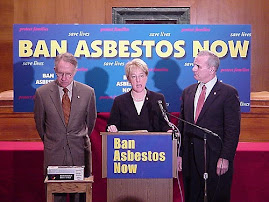
Demanding a ban on asbestos including chrysotile asbestos, like the one imposed by 40 countries across the world, the 13 labour unions and NGOs released a dossier, "A Fox in the Hen House: Made-to-Order Science and India's Asbestos Policy".

"The Government is conducting the study merely to justify its position that asbestos does not pose an unmanageable risk," said Dutta, adding that the industry was trying to use "manufacturing science to back its pre-determined position to fight global regulation on the hazardous fibre."

The group quoted a WHO study which estimates that 125 million people are exposed globally to all forms of asbestos. "The made-to-order study, partly funded by the asbestos industry, is being tweaked by a review committee some of whose members are representatives of asbestos industry," the activist alleged.

The unions alleged that the industry was being consulted by the Government at every step and the study would be presented at the next meeting of the Chemical Review Committee of the Rotterdam Convention in March 2008 to rationalise its third veto against the UN action on white asbestos.

The minutes of the Review Committee dated December 19, 2006 reads: "The report will be finalised after due discussions with the asbestos industry." Another meeting minutes dated April 18, 2007 reports that "...the results of the study which was underway could not be shared (with public) till the same was finalised."
"Clearly, a scientific study that is finalised after discussion with the corporate interests is grossly conflict of interest ridden and deserves to be scrapped," said Gopal Krishna of Ban Asbestos Network of India.

http://www.indianexpress.com/story/269547.html

India, Canada and Russia are the three countries opposing the ban and restriction on asbestos trade at the Rotterdam Convention, a multilateral agreement promoting open exchange of information on hazardous chemical trade, including proper labelling and informing buyers of any known restrictions or bans.

According to the documents, a letter from the department of chemicals and petrochemicals to the director of the National Institute of Occupational Health (NIOH) in 2006 states that the study should include "generation of data, which would justify the safe standards of its usage as also the reasons/rationale justifying its non-inclusion/or otherwise in the Prior Informed Consent (PIC)".

Under the Rotterdam Convention, an item in the PIC list would require the exporting country to inform its clients on the hazardous nature of the commodity.

Ministry officials were not available for comment.

The ministry commissioned NIOH to conduct the study in 2004 in light of the proposed inclusion of chrysotile asbestos, the so-called white asbestos, in the PIC list of the convention, which was recommended in 2005 and 2006.

Labour unions and NGOs demand a ban on “toxic” asbestos

As many as 13 labour unions and NGOs released a report alleging nexus between the government and the industry.

Addressing a news conference, Ban Asbestos Network of India (BANI), Corporate Accountability Desk, Centre of Indian Trade Unions and All India Trade Union Congress said “There are alternatives to asbestos, it should be banned.”

“The World Health Organisation has got the reports. The reports say that all sorts of asbestos, including the white type called Chrysotile asbestos is one of the most toxic and widely used in India and some other developing countries,”they said.

Environment watchdogs have long been up in arms against the use of asbestos in the country, considering that all forms of asbestos, including chrysotile, have been classified as carcinogens by the International Agency for Research on Cancer.
Alarmed that an estimated 100,000 workers die every year due to the diseases caused because of exposure to asbestos, environmental groups demanded that a complete ban be placed on the use of asbestos in India.

More than 40 countries have banned the use of chrysotile asbestos in any form, owing to the occupational health hazards.

India and six other countries alone are opposing the inclusion of chrysotile asbestos in the list of hazardous chemicals. Chrysotile accounts for 95 percent of asbestos usage worldwide.

India’s ship breaking industry is the most vulnerable when it comes to asbestos exposure. The labourers, a majority working on daily wages, are often exposed to toxic wastes in the process of dismantling of ships.

As per the latest data released by the UN Statistics Division, India imported about 306,000 metric tones of asbestos in 2006, of which 152,820 metric tones was imported from Russia and 63,980 metric tones from Canada.

States of denial: Why asbestos in India is a Canadian problem


By Katie Daubs

OTTAWA — In the Indian state of Jharkhand, hills emerge sporadically from the rural jungle. In the middle of the lush green setting, children grab makeshift toboggans and head to the surprisingly snow-capped Roro Hills. They slide down a fluffy hilltop to squeals of delight.

Twenty years ago, they mined chrysotile asbestos here - a “soft” form of asbestos that some say can be mined safely, with proper regulation. When workers started getting sick, they shut the mine down. In the company’s rush to leave, they forgot the toxic playground they left behind.

Two decades have passed, many people have died, even more are sick. The large pile of asbestos has seeped into everything, poisoning the water, the ground and the people in the tribal hamlets. There’s no way of knowing how many are sick because there aren’t any statistics.

“People are exposed everyday from childhood to death. What happens to these people, what do they die of? The government is not bothered, the company is not bothered. No one is bothered.”

This is a rural area. The doctors here are not trained to diagnose occupational health diseases and cannot access electricity, let alone X-ray machines. Asbestos-caused cancers like mesothelioma and asbestosis go by a different name here. Tuberculosis.

Canadian & Indian Right to Information Act exposes asbestos truths

Indian Ministry of Chemicals and Fertilisers commissioned the National Insti-tute of Occupational Health (NIOH), a premier research institute under the Indian Council of Medical Research (ICMR), to conduct a study titled Implementation of Rotterdam Convention on Prior Informed Consent Procedures- Study of Health Hazards / Environment Hazards resulting from use of Chrysotile Variety of Asbestos in the country.

The study was commissioned in 2004 in the light of the proposed inclusion of chrysotile (popularly known as white asbestos) in the Prior Informed Consent (PIC) list of the Rotterdam Convention, which was recommended in 2005 and 2006 by the Chemical Review Committee of the Convention. On the face of it, the Government’s decision to base its position on science is laud-able.

However, documents obtained through the Right to Information (RTI) Act reveal that the Government is conducting the study merely to justify its position that white asbestos does not pose an unmanageable risk. The made-to-order study, partly funded by the asbestos industry, is being tweaked by a review committee some of whose members are representatives of the asbestos industry. At no point in the study will members of public, workers’ organizations or in-dependent physicians be allowed to comment.

Information gained using Canadian Right to Information corroborates the same. The Information Commissioner of Canada informed, “Canada is working with other countries to promote chrysotile asbestos. The Indian government has worked diligently in cooperation with the Indian Asbestos Information Centre (AIC) and the Canadian
Asbestos Institute.” Canadian High Commission in India says, “A ruling which states that subjecting a worker to asbestos is a violation of human rights could have far reaching consequences whether or not it is binding". It also notes, “AIC is of the belief that problems with safe use of asbestos will arise in the unorganised sector.

These include small manufacturers who cannot afford to either install the equipment necessary to safely use asbestos or invest in the health needs of their workers.” AIC accepts that “unorganised sector does use imported products that they acquire through agents.” It is noteworthy that Indian Government consults and trusts this very AIC in matters related to continued use of chrysotile.

The information is dated March 4, 2003, from Natural Resources Ministry of Canada. It was given under Access to Information Act

Information made available shows that Second Secretary (Commercial), Canadian High Commission in India has been in correspondence with Ministry of Environment, Labour, Commerce on asbestos issue. He has arranged bilateral meetings between the Ministers too in the past specifically "to discuss[tongue]romotion of the safe-use of chrysotile asbestos and confirm India's continued market access and policy approach (controlled-use) re chrysotle asbestos".

Second Secretary (Commercial) Canadian High Commission in India is quoted as saying, "I realise that Kolkota looks like .....(blackned) but as Kolkota is the real centre of mining in India this where the private participation will be greatest. Equipment manufacturers will be welcomed in Eastern India and getting an audience out will not be a problem. The State of Jharkhand has asked the delegation to stop in Ranchi. I have adivised that this is unlikely but we will be in Kolkata. They seemed keen to travel to this city if this is what will take to meet the delegation. The coal companies can make site visits and the asbestos producers may want to meet with the local infrastructure groups as the use of AC cement is controversial in this state."

The High Commission suggested that the minerals/mining group go to Hyderabad before Calcutta. If the use of AC cement is controversial , it may be worthwhile looking as something similar there.

In one letter written by Second Secretary (Commercial) Canadian High Commission in India, he informs, " I met with Brigadier Sethi of Asbestos Information Centre (AIC)..."

He was informed the outcome of the April 11, 2002 meeting where Ban Asbestos Network of India (BANI) was formed. It reads, "Most of the articles have headlines similar to the Times of India story saying that Experts are calling for the banning of asbestos in manufacturing, mining, etc"

"Be advised that the Courts in India are much more interventionist than in Canada. It is entirely possible that the High Court could issue the injunction and stop the use of asbestos. Eventually the matter would reach the Supreme Court but there is no predicting the outcome."

The Brigadier also told me that a similar petition has been with the National Human Rights Commission. He does not seem concerned about this because the NHRC is a non-binding body. I advised that a finding stating that subjecting a worker to asbestos is a violation of human rights could have far reaching consequences whether or not the ruling is binding. I think that it may be necessary at some point to prepare an advocacy campaign to counter the arguments of the NGOs"

Doctoring asbestos study to promote its use

Documents unearthed under the Right to Information Act reveals how the industry added Rs. 16 lakhs to the Government's Rs. 44 lakhs to commission a study by National Institute of Occupational Health (NIOH) to "specifically indicate how technology has made working conditions [in asbestos factories] better." The Industry-Ministry study is titled Implementation of Rotterdam Convention on Prior Informed Consent Procedures - Study of Health Hazards/ Environment Hazards Resulting from the Use of Chrysotile Variety of Asbestos in the Country. Chrysotile is popularly known as white asbestos. These documents were shared with the media today at the Press Club, Delhi.

It is noteworthy that the information gained using Canadian Right to Information corroborates the same. The Information Commissioner of Canada informed, “Canada is working with other countries to promote chrysotile asbestos. The Indian government has worked diligently in cooperation with the Indian Asbestos Information Centre (AIC) and the Canadian Asbestos Institute.” Canadian High Commission in India says, “A ruling which states that subjecting a worker to asbestos is a violation of human rights could have far reaching consequences whether or not it is binding". It also notes, “AIC is of the belief that problems with safe use of asbestos will arise in the unorganised sector.

These include small manufacturers who cannot afford to either install the equipment necessary to safely use asbestos or invest in the health needs of their workers.” AIC accepts that “unorganised sector does use imported products that they acquire through agents.” It is noteworthy that Indian Government consults and trusts this very AIC in matters related to continued use of chrysotile.

Acknowledging the hazards from asbestos, Anbumani Ramadoss, Union Health Minister informed the parliament saying, "…regarding asbestos, a lot of poor people use it. As regards the issue pertaining to banning of asbestos, as a health issue, the Government certainly has not taken it up. It is an occupational hazard and people working in the asbestos factories are prone to lung cancer, but we are taking the enormity of the usage of asbestos. Mostly, poor people in the villages use it. Hence, I cannot take a decision on this issue." The enormity of usage is no excuse to expose Indian workers and citizens to this deadly fiber. Without amendment in the existing Import Policy by the Union Ministry of Commerce & Industry for white asbestos, the asbestos consumption pattern is unlikely to change.

The study that has now been exposed through the Right to Information is supposed to be presented at the next meeting of the Chemical Review Committee of the Rotterdam Convention in March 2008 to rationalize its third veto against the UN action on white asbestos. It will also form the basis for India's domestic policy on continued use of asbestos.

The next conference of the Parties to the Rotterdam Convention will be held from 27 to 31 October 2008 in Rome. Chrysotile asbestos will be on the agenda of Fourth Conference of Parties (COP-4) as was agreed at COP-3. This treaty that is a result the efforts of United Nations came into force in February 2004. The text of the Convention was adopted in Rotterdam, the Netherlands. Indian government irrespective of the ruling party has consistently colluded with asbestos interests.

The COP-3 of Rotterdam Convention held in Geneva, Switzerland in October 2006 failed to bring Prior Informed Consent (PIC) Treaty to apply to chrysotile (white asbestos), a known human carcinogen that represents 94 per cent of world’s asbestos. The Indian delegation comprised of Brig. A K Sethi, Executive Director of the Asbestos Cement Products Manufacturers Association making Indian delegation, the only one with industry representatives sitting with the official delegation.

Although 95 per cent of the countries sought its inclusion, the COP-3 failed to list this and the decision to include it has been proposed in COP-4 in 2008. The Indian delegation has consistently argued that the science behind the recommendation to list chrysotile asbestos was not categorical. It claimed that India was in the process of studying on the hazards of pure chrysotile.

The minutes of the Review Committee obtained recently through Right to Information Act dated 19 December, 2006 reads: "The report will be finalised after due discussions with the asbestos industry." Another meeting minutes dated 18 April, 2007 reports that "...the results of the study which was underway could not be shared [with public] till the same was finalised." Clearly, a scientific study that is finalised after discussion with the corporate interests is grossly conflict of interest ridden and deserves to be scrapped.

As per data released by UN Statistics Division, India imported about 306,000 MT of asbestos in 2006. Of which 152, 820 MT was imported from Russia and 63, 980 MT from Canada. This trend got a boost from Union Finance Minister, P Chidambaram who announced a 15% reduction on custom duties for asbestos in his Budget speech. The rising consumption is a result of a Made-to-order science that gets exposed by the documents that shows how the Union Ministry of Chemicals, acting in collusion with the asbestos industry, is manufacturing science to back its pre-determined position to fight global regulation on the killer fibre by reiterating that 'controlled and safe use' of white asbestos is acceptable both to the white asbestos industry and the Indian government.

Meanwhile, Dr Barry Castleman, an internationally respected expert on asbestos who was in India in December 2007 commented: “Anyone who says there's a controlled use of asbestos in the Third World is either a liar or a fool.” Dr Castleman is well known for his role in the passage of Ban Asbestos America Act 2007.

Monday, February 4, 2008

CII survey shows asbestos cement in high growth category

A Confederation of Indian Industry (CII) survey which tracks the performance of the manufacturing sector, today said that the sector is looking for positive triggers to attain excellent growth rate.

The survey done for the nine month period beginning April 2007, as against the same period in 2006, found that although the sectors showing excellent growth has slightly declined, the number of sectors showing high growth has increased in the given period.

Of the total 100 sectors reporting production, 15 sectors reported excellent growth rate of more than 20%, a slight decline from the last survey done for the six month period beginning April 2006.

Around 30 sectors recorded high growth rate of 10-20%, an increase of 6% from the last survey.

Those in the high growth category include asbestos cement, industrial valves, abrasives among others.

The percentage of sectors in negative category also declined for the same period. However, percentage of ones showing moderate growth remained unchanged from the last survey.

According to the survey automobile industry including motorcycles, three wheelers, continued to remain in the negative sales growth category like the previous survey.

Blog Archive