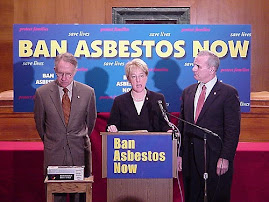
Deaths from asbestos still rising in Quebec
Hiding in the lungs of people for up to 40 years before they start developing symptoms, asbestos killed more Canadians this year than ever before.
According to a new report from the Alberta government, deaths from asbestos will continue to rise until they peak between 2015 and 2019.
Deaths from mesothelioma will plateau at 269 per year before beginning to slowly fall off, according to report. A substantial increase from the 127 mesothelioma deaths recorded over the 1980s.
“We have had the same results for the general population in Quebec,” said Louise De Guire, the director of biological, environmental and occupational risks for the Institut national de santé publique du Québec.
“We are in a mesothelioma epidemic right now,” she said. De Guire’s department estimated that cases will peak in Quebec in 2010.
“The rates of mesothelioma among men in Quebec has risen by 3.6 per cent annually between 1980 and 2002,” explained De Guire.
“Asbestos is the biggest killer of workers in Quebec, by far,” said Kathleen Ruff, a senior human rights advisor to the Rideau Institute. According to the Commission de la santé et de la sécurité du travail, nearly 60 per cent of worker deaths in Quebec so far in 2009 have been caused by asbestos-related diseases.
“From 1950 to 1970 there was a boom in construction in downtown Montreal. This was an era when asbestos was often used to insulate buildings and it was an era where the dangers were not well-known,” continued De Guire. “Nearly 50 per cent of people who ask for compensation from the CSST today were in the construction industry.
“The people who put asbestos in buildings in the 1970s are only showing their symptoms now.”
Asbestos miners represent only 30 per cent of mesothelioma deaths; an additional 10 per cent of cases are found in factory workers who used asbestos in products. The cost for the CSST, Quebec’s worker safety board, has already topped $66 million, which doesn’t include health care costs or the loss of work hours.
“[Asbestos is] not treated like a health issue in Canada, it’s a political issue and that is a huge tragedy,” said Ruff. “The Canadian government has betrayed public health to win a few votes in the asbestos mining region of Quebec.”
The Quebec government adopted a policy in 2002 that allowed for what it called the “safe use of asbestos.” This policy allowed for Quebec’s only existing asbestos project, in Thetford Mines, to continue exporting the fibrous material to the developing world.
“There were a series of newspaper articles that came from mining organizations at the time saying that the use of asbestos was not dangerous and that there was no asbestos problem in Quebec,” said De Guire. “We wrote a paper for [then-Minister of Health and Social Services Philippe Couillard] in 2005 to tell him that it was not a good idea to encourage the ‘safe’ use of asbestos in Quebec.”
After the report was written some positive steps were taken by the government, explained De Guire, including the removal of asbestos from all public buildings.
The Link, Concordia University, Montreal
by Justin Giovannetti
http://www.thelinknewspaper.ca/articles/1820
Tuesday, November 17, 2009

Saturday, November 14, 2009
Asbestos Notes
"REPORT OF THE TASK FORCE ON GREENING INDIA FOR LIVELIHOOD SECURITY AND SUSTAINABLE DEVELOPMENT", PLANNING COMMISSION, GOVERNMENT OF INDIA, JULY-2001 notes, "Bamboo Mat Corrugated Sheet is a very high potential material for roofing as a substitute for Asbestos Cement Corrugated Sheets (ACCS), which are considered to be carcinogenic and have been banned in many countries. It promises to revolutionize roofing system in the country as also in several other counties." This 254 page report takes cognisance of the cancer causing nature of asbestos cement sheets at page no. 111.
The 16 member Task Force was headed by Dr.D.N.Tewari, who was member, Planning Commission. Other members of the Task Force were: Dr.N.C.Saxena, Secretary, Planning Commission, Secretary, Department of Land Resources, New Delhi, Dr.P.L. Sanjeev Reddy, Principal Adviser, Planning Commission, Dr. (Mrs.) Manju Sharma, Secretary, Deptt. of Biotechnology, Bhaskar Baruan, Secretary, Agriculture & Co-operation, Secretary, Ministry of Environment & Forests, N.K. Sinha, Secretary, Animal Husbandry & Dairy Development, Secretary, Ministry of Food Processing Industries, Devi Dayal, Special Secretary, Banking, C.P. Oberoi, Special Secretary & Inspector General,MoEF, Director General, ICAR, New Delhi, Director General, ICFRE, Dehradun , Mrs J. Khanna, Pr Adviser (E&F),Planning Commission, Dr. A.P. Dikshit, General Manager, AFC Mumbai and Dr P.S. Pathak, Director. IGFRI, Jhansi. Mrs J. Khanna was the member secretary of the Task Force.
Asbestos is currently found in three states only- Andhra Pradesh, Jharkhand and Rajasthan. While Andhra Pradesh has the Chrysolite variety of asbestos, Rajasthan produces the Amphibolite variety.
The ban on mining of asbestos was imposed in phases in 1986 and 1993 but not on its use, manufacture, export and import. But despite the ban on mining, illegal mines are operating in Jharkhand, Rajasthan and Andhra Pradesh. Most asbestos-cement is using imported asbestos, but some of it is being sourced from the illegal mining though that is a relatively small proportion.
While the whole world is banning asbestos, Visaka Asbestos Industries is setting up new asbestos cement plant in Orissa. It is setting up a 100,000-tonne capacity asbestos cement sheet plant at Sambalpur in Orissa at an estimated cost of Rs 400 million to meet the rural demand, according to vice-chairman G Vivekanand. This apart, the company is ramping up the capacity of its Pune plant from 65,000 tonne to 100,000 tonne with Rs 150 million investment. This is expected to be ready in a year.
Rajasthan has 54 per cent of India’s asbestos resources. It has five to six operational mines. In the absence of formal lifting of ban on mining of asbestos, mining operations are on hold.
Rajasthan has approached the Centre against the ban on granting lease to asbestos mines in the state. The state's plea for granting lease to mining of asbestos is based on a study underaken by Indian Bureau of Mines that recommends lifting of the ban on mining of chrysotile asbestos.
In a proposal, the directorate of mines argues that on May 26, 1997, nine years after ministry of steel, mines and coal had issued directives for a ban on renewal or granting of new leases for mining asbestos, a fresh study was conducted on the impact of environment due to asbestos mining.
The mines department, quoting the Indian Bureau of Mines, which conducted the study, said that there was no adverse effect on environment or on the health of workers due to asbestos mining in Rajasthan.
The report also mentions that all safety measures like sprinkling of water, wet drilling, use of dust masks along with a periodic health check up of workers are done in the state. The report adds that despite the fact that asbestos is being mined in Rajasthan since the past 40 years, no report of illness has been reported from any of its workers.
Moreover, the proposal says that in a meeting held on January 22, 2007, the joint secretary, mines had advocated the lifting of ban on the Chrysolite variety of asbestos found in Andhra following which the additional director had opined on lifting of the ban on the Amphibolite variety too.
The state has also argued that the lifting of the ban would not only generate employment but will also bring in revenue for the state government.
Studies have shown that asbestos mining has deleterious effect on the health of workers and exposes them to diseases like asbestosis which can cause death.
In fact, it was in view of the adverse effects of asbestos mining on the health of the workers that the Central government directed the state governments in 1986 not to grant any new mining lease for asbestos (including chrysotile variety) in the country. In June 1993, the central government stopped the renewal of existing mining leases of asbestos.
ASBESTOS IN RAJYA SABHA
Question asked in Rajya Sabha on 13/05/2005 by SHRI EKANATH K. THAKUR
Relevant to ENVIRONMENT AND FORESTS
Subject: SHIP FOR SCRAP CARRYING CARCINOGENIC ASBESTOS INSULATION
Will the Minister of ENVIRONMENT AND FORESTS be pleased to state:-
(a) whether it is a fact that the Danish Government have alerted India about a toxic ship-for-scrap carrying carcinogenic asbestos insulation headed for Alang yard in Gujarat;
(b) whether it is also a fact that the Danish Government have requested Indian Government to declare the ship as illegal traffic and refuse to allow it to be dumped in India; and
(c) if so, the action proposed?
ANSWERED BY NAMO NARAIN MEENA, STAE ENVIRONMENT MINISTER
OVERNMENT OF INDIA MINISTRY OF HEALTH AND FAMILY WELFARE UNSTARRED QUESTION NO 1840 ANSWERED ON 11.08.2006 ASBETOS RELATED DISEASES 1840.
SHRI PENUMALLI MADHU: Will the Minister of HEALTH AND FAMILY WELFARE be pleased to state:
(a) whether the Government are aware of the recent finding of epidemiological study on asbestos related diseases conducted in Quebec, Canada; (b) the total number of asbestos manufacturing units in India with State-wise figures;
(c) whether Government would undertake a study to find out the prevalence of asbestosis and mesothelioma, the dreaded diseases caused by asbestos particles in the air;
(d) if so, the details thereof; and
(e) if not, the reasons therefor?
ANSWER MINISTER OF HEALTH AND FAMILY WELFARE (DR. ANBUMANI RAMADOSS)
(a): According to Indian Council of Medical Research (ICMR), a book ‘Asbestos: Selected Cancers’ (2006) has been published by Board on Population Health and Public Health Practice, wherein one of the chapters is devoted to description of epidemiological studies. This chapter refers to studies on Quebec Chrysotile Miners by McDonald et al 1997.
(b): The State-wise number of asbestos manufacturing units in India are detailed as under:
State Andhra Pradesh Assam Gujarat Haryana Jharkhand Karnataka Kerala Madhyha Pradesh Maharashtra Orissa Punjab Rajasthan Tamil Nadu U.P. UT of D& N West Bengal
No. of Units 3 1 1 1 1 1 1 2 6 1 1 1 4 3 1 3
(c) to (e): ICMR`s National Institute of Occupational Health (NIOH), Ahmedabad, is currently engaged in the following three studies related to asbestos:
i) Study of Health Hazards/Environmental hazards resulting from use of Chrysotile variety of asbestos in the country,
ii) Epidemiological study in ship breaking workers at Alang (Gujarat),
iii)Environmental-cum-epidemiological study in Chrysotile and tremolite illing/mining units in Pulivendla (A.P.) and Bhim (Rajasthan). These studies have been recently initiated and results are expected to be available in the next few years.
Rajya Sabha on 15/12/2008 by Prabha Thakur Relevant to Mines Subject: Health Hazardous in Asbestos
Will the Minister of MINES be pleased to state:-
(a) whether it is a fact that Indian Bureau of Mines has conducted a study on the effect on the health of labourers engaged in asbestos mining;
(b) if so, whether this study has made any suggestions;
(c) whether the study group has suggested doing away with the restrictions on asbestos mining;
(d) whether Government proposes to implement them;
(e) whether Government would lift the ban on new leases for asbestos mining and their renewal; and
(f) if so, by when?
Answered by Sis Ram Ola
OVERNMENT OF INDIA MINISTRY OF MINES RAJYA SABHA STARRED QUESTION NO 101 ANSWERED ON 31.07.2006 HEALTH HAZARDS OF ASBESTOS MINING 101.
DR. NARAYAN SINGH MANAKLAO SHRI HARISH RAWAT:
Will the Minister of MINES be pleased to state:
(a) whether it is a fact that Indian Bureau of Mines has conducted study on the health hazards of asbestos mines workers of Rajasthan;
(b) if so, the recommendations thereof;
(c) whether the study recommended for lifting of ban on asbestos leasing; and
(d) if so, the details of action taken/proposed to be taken to implement these recommendations including the time-frame for implementation?
ANSWER MINISTER OF MINES (SHRI SIS RAM OLA)
(a): Yes Sir.
(b) & (c): The study recommended that the ban imposed on grant and renewal of mining leases and expansion of mining may be lifted subject to control of pollution level in work environment of various operations and other remedial measures.
(d): The proposal of amending Regulation 124 of Metalliferous Mines Regulations, 1961 by way of reducing permissible limit of airborne respirable asbestos fibre dust from 2 to 0.1- 0.5 per millilitre of air is under consideration in consultation with Directorate General, Mines Safety (DGMS).
ASBESTOS IN LOK SABHA
GOVERNMENT OF INDIA MINISTRY OF ENVIRONMENT AND FORESTS LOK SABHA UNSTARRED QUESTION NO 768 TO BE ANSWERED ON 31.07.2006 ENVIRONMENTAL EFFECTS OF ASBESTOS 768.
SHRI MOHAN PONNUSWAMY
Will the Minister of ENVIRONMENT AND FORESTS be pleased to state:
(a) whether any epidemiological study on asbestos related diseases has been conducted recently; (b) if so, the details thereof;
and (c) the total number of asbestos manufacturing units in the country, State-wise?
ANSWER
MINISTER OF STATE IN THE MINISTRY OF ENVIRONMENT AND FORESTS (SHRI NAMO NARAIN MEENA) (a) to (c): The information is being collected and will be placed on the Table of the House.
EXHIBIT NO.53
PRESS NOTE NO.1 (1996 Series)
MANUFACTURE OF ASBESTOS & ASBESTOS BASED PRODUCTS
The Government had set up a Technical (iii) The BIS Standards prescribed for use of Committee to undertake a comprehensive study, asbestos under controlled and regulated
covering all aspects relating to asbestos and asbestos conditions, which are listed at Annexure1
based products. After examining the matter in depth, must be followed compulsorily by the
the Technical Committee has given its report to the Company;
Government. The Government, after considering the
(iv) The Company shall provide medical health
report, has accepted the recommendation of the
care facilities regularly at the workplace
Technical Committee.
and if cases of harmful effect of asbestos
2. Keeping in view the recommendations of the have been noticed on any worker,
Technical Committee, the Government has interalia necessary compensation shall be arranged
decided that the applications for the manufacture of under the existing laws; and
asbestos and asbestos based products, for the grant
(v) The Company shall adhere to all other
of LOI/IL shall be considered subject to the following
existing laws regarding safety of labourers,
conditions:
employment of child labour, Factories
(i) The Company shall obtain necessary Act, ptr
central environmental clearance before
3. In order to ensure speedy disposal of applications
converting LOI into licence, as stipulated
for grant of Letter of Intent/Industrial Licence, for
in GOI Notification No.S.0.60(E), dated
manufacture of asbestos and asbestosbased products
27th January, 1994 of Ministry of
and to obviate the need of back reference to the
Environment & Forests;
entrepreneurs, it has been decided that all applications
(ii) The discharge of asbestos fibre in the for grant of industrial license in the asbestos sector
factory premises shall be so controlled would be considered in the Approval Committee(s)
that it does not exceed the limit of 2 fibre/ only after these have been examined in depth by the
cc. Continuous measurement of its Administrative Ministry/ Desk concerned vyith respect
pollutants in the area may be taken and to the prescribed standards/safeguards as mentioned
record must be maintained. above.
F. No.10(6)/96-L.P. New Delhi, the 8th March, 1996.
Forwarded to Press Information Bureau for giving wide publicity to the contents of the above Press Note.
Sd/-
(Aditi S. Ray)
Deputy Economic Adviser
Principal Information Officer
Press Information Bureau
New Delhi.
120 Industrial Policy Highlights
EXHIBIT NO.53 (Contd.)
PRESS NOTE NO.1 (1996 Series)
MANUFACTURE OF ASBESTOS & ASBESTOS BASED PRODUCTS
ANNEX-I
LIST OF BIS STANDARDS
1. IS:11450-1986 Method for determination of airborne asbestos fibre concentration in work environment
by light microscopy (membrane filter method)
2. IS:11451-1986 Recommendations for safety and health requirements relating to occupational exposure
to asbestos.
3. IS:11767-1986 Recommendations for cleaning of premises and plants using asbestos fibres.
4. IS:11768-1986 Recommendations for disposal of asbestos waste material.
5. IS:11769 (Part-1)-1987 Guidelines for safe use of products containing asbestos : Asbestos Cement
products.
6. IS:11769 (Part-2)-1986 Guidelines for safe use of products containing asbestos : Friction material.
7. IS:11769 (Part-3)-1986 Guidelines for safe use of products containing asbestos : Non-cement asbestos
products other than friction material.
8. IS:11770 (Part 1)-1987 Recommendations for control of emission of asbestos dust in premises
manufacturing products containing asbestos dust in premises manufacturing products containing
asbestos : Asbestos Cement Products.
9. IS:11770 (Part 2)-1987 Recommendations for control of emission of asbestos dust in premises
manufacturing products containing asbestos : Friction materials.
10. IS:11770(Part 3)-1987 Recommendations for control of emission of asbestos dust in premises
manufacturing products containing asbestos : Non-cement asbestos products other than friction
material.
11. IS:12078-1987 Recommendatios for personal protection of workers engaged in handling asbestos.
12. IS:12079-1987 Recommendations for packaging transport and storage of asbestos.
13. IS:12080-1987 Recommendations for local exhaust ventilation systems in premises manufacturing
products containing asbestos.
14. IS:12081 (Part-1)-1987 Recommendations for pictorial warning signs and precautionary notices for
asbestos and products containing asbestos : Workplaces.
15. IS:12081 (Part 2)-1987 Recommendations for pictorial warning signs and precautionary notices for
asbestos and products containing asbestos : Asbestos and its products.
16. IS:12082 (Part 1)-1987 Recommendations for control of asbestos emission : Mining of asbestos ore.
121
CHAPTER - I
EXHIBIT NO.54
PRESS NOTE NO.2 (1996 Series)
MANUFACTURE OF CELLULOSE FIBRE CEMENT BASED ON ASBESTOS FREE AND NON-WOOD PULP MATERIAL
Meinoranda(IEM), it has been decided that the licensing
Subject: Exemption from obtaining Industrial
discipline, hence forth, would not apply to
Licence for the Manufacture of Cellulose
manufacture of "articles of cellulose fibre cement
Fibre Cement based on Asbestos free and
based on asbestos-free and nonwood pulp raw
non-wood pulp material.
material." The entrepreneurs, therefore, who intend
Under the New Industrial Policy announced on
to manufacture "articles of cellulose fibre
24th July, 1991, asbestos and asbestos based products
cement(asbestos free), not using wood pulp", under
had been retained under compulsory licensing. Articles
ITC Code 68.11 need not apply for Industrial License.
of asbestos cement and cellulose fibre cement have
They may now file an Industrial Entrepreneurs
a common ITC Code 68.11 included under
Memoranda(IEM) as prescribed in Para 6 of Press
compulsory licensing. Though manufacture of
Note NO.9(1991 Series) dated 2nd August, 1991,
asbestos is considered process hazardous, the same
with the Secretariat for Industrial Approvals(SIA) in
is not true of cellulose fibre cement as it is considered
the Department of Industrial Policy and Promotion,
asbestos free.
and obtain the acknowledgement. The location of the
2. To simplify and streamline the Policy and undertaking will, of course, be subject to Local land
Procedure for filing Industrial Entrepreneur use and Zoning Laws and Regulations.
F. No.10(43)/91-LP New Delhi, the 31st July, 1996.
Forwarded to Press Information Bureau for giving wide publicity to the contents of the above Press Note.
Sd/-
(Aditi S. Ray)
Deputy Economic Adviser
Principal Information Officer
Press Information Bureau
New Delhi.
The 16 member Task Force was headed by Dr.D.N.Tewari, who was member, Planning Commission. Other members of the Task Force were: Dr.N.C.Saxena, Secretary, Planning Commission, Secretary, Department of Land Resources, New Delhi, Dr.P.L. Sanjeev Reddy, Principal Adviser, Planning Commission, Dr. (Mrs.) Manju Sharma, Secretary, Deptt. of Biotechnology, Bhaskar Baruan, Secretary, Agriculture & Co-operation, Secretary, Ministry of Environment & Forests, N.K. Sinha, Secretary, Animal Husbandry & Dairy Development, Secretary, Ministry of Food Processing Industries, Devi Dayal, Special Secretary, Banking, C.P. Oberoi, Special Secretary & Inspector General,MoEF, Director General, ICAR, New Delhi, Director General, ICFRE, Dehradun , Mrs J. Khanna, Pr Adviser (E&F),Planning Commission, Dr. A.P. Dikshit, General Manager, AFC Mumbai and Dr P.S. Pathak, Director. IGFRI, Jhansi. Mrs J. Khanna was the member secretary of the Task Force.
Asbestos is currently found in three states only- Andhra Pradesh, Jharkhand and Rajasthan. While Andhra Pradesh has the Chrysolite variety of asbestos, Rajasthan produces the Amphibolite variety.
The ban on mining of asbestos was imposed in phases in 1986 and 1993 but not on its use, manufacture, export and import. But despite the ban on mining, illegal mines are operating in Jharkhand, Rajasthan and Andhra Pradesh. Most asbestos-cement is using imported asbestos, but some of it is being sourced from the illegal mining though that is a relatively small proportion.
While the whole world is banning asbestos, Visaka Asbestos Industries is setting up new asbestos cement plant in Orissa. It is setting up a 100,000-tonne capacity asbestos cement sheet plant at Sambalpur in Orissa at an estimated cost of Rs 400 million to meet the rural demand, according to vice-chairman G Vivekanand. This apart, the company is ramping up the capacity of its Pune plant from 65,000 tonne to 100,000 tonne with Rs 150 million investment. This is expected to be ready in a year.
Rajasthan has 54 per cent of India’s asbestos resources. It has five to six operational mines. In the absence of formal lifting of ban on mining of asbestos, mining operations are on hold.
Rajasthan has approached the Centre against the ban on granting lease to asbestos mines in the state. The state's plea for granting lease to mining of asbestos is based on a study underaken by Indian Bureau of Mines that recommends lifting of the ban on mining of chrysotile asbestos.
In a proposal, the directorate of mines argues that on May 26, 1997, nine years after ministry of steel, mines and coal had issued directives for a ban on renewal or granting of new leases for mining asbestos, a fresh study was conducted on the impact of environment due to asbestos mining.
The mines department, quoting the Indian Bureau of Mines, which conducted the study, said that there was no adverse effect on environment or on the health of workers due to asbestos mining in Rajasthan.
The report also mentions that all safety measures like sprinkling of water, wet drilling, use of dust masks along with a periodic health check up of workers are done in the state. The report adds that despite the fact that asbestos is being mined in Rajasthan since the past 40 years, no report of illness has been reported from any of its workers.
Moreover, the proposal says that in a meeting held on January 22, 2007, the joint secretary, mines had advocated the lifting of ban on the Chrysolite variety of asbestos found in Andhra following which the additional director had opined on lifting of the ban on the Amphibolite variety too.
The state has also argued that the lifting of the ban would not only generate employment but will also bring in revenue for the state government.
Studies have shown that asbestos mining has deleterious effect on the health of workers and exposes them to diseases like asbestosis which can cause death.
In fact, it was in view of the adverse effects of asbestos mining on the health of the workers that the Central government directed the state governments in 1986 not to grant any new mining lease for asbestos (including chrysotile variety) in the country. In June 1993, the central government stopped the renewal of existing mining leases of asbestos.
ASBESTOS IN RAJYA SABHA
Question asked in Rajya Sabha on 13/05/2005 by SHRI EKANATH K. THAKUR
Relevant to ENVIRONMENT AND FORESTS
Subject: SHIP FOR SCRAP CARRYING CARCINOGENIC ASBESTOS INSULATION
Will the Minister of ENVIRONMENT AND FORESTS be pleased to state:-
(a) whether it is a fact that the Danish Government have alerted India about a toxic ship-for-scrap carrying carcinogenic asbestos insulation headed for Alang yard in Gujarat;
(b) whether it is also a fact that the Danish Government have requested Indian Government to declare the ship as illegal traffic and refuse to allow it to be dumped in India; and
(c) if so, the action proposed?
ANSWERED BY NAMO NARAIN MEENA, STAE ENVIRONMENT MINISTER
OVERNMENT OF INDIA MINISTRY OF HEALTH AND FAMILY WELFARE UNSTARRED QUESTION NO 1840 ANSWERED ON 11.08.2006 ASBETOS RELATED DISEASES 1840.
SHRI PENUMALLI MADHU: Will the Minister of HEALTH AND FAMILY WELFARE be pleased to state:
(a) whether the Government are aware of the recent finding of epidemiological study on asbestos related diseases conducted in Quebec, Canada; (b) the total number of asbestos manufacturing units in India with State-wise figures;
(c) whether Government would undertake a study to find out the prevalence of asbestosis and mesothelioma, the dreaded diseases caused by asbestos particles in the air;
(d) if so, the details thereof; and
(e) if not, the reasons therefor?
ANSWER MINISTER OF HEALTH AND FAMILY WELFARE (DR. ANBUMANI RAMADOSS)
(a): According to Indian Council of Medical Research (ICMR), a book ‘Asbestos: Selected Cancers’ (2006) has been published by Board on Population Health and Public Health Practice, wherein one of the chapters is devoted to description of epidemiological studies. This chapter refers to studies on Quebec Chrysotile Miners by McDonald et al 1997.
(b): The State-wise number of asbestos manufacturing units in India are detailed as under:
State Andhra Pradesh Assam Gujarat Haryana Jharkhand Karnataka Kerala Madhyha Pradesh Maharashtra Orissa Punjab Rajasthan Tamil Nadu U.P. UT of D& N West Bengal
No. of Units 3 1 1 1 1 1 1 2 6 1 1 1 4 3 1 3
(c) to (e): ICMR`s National Institute of Occupational Health (NIOH), Ahmedabad, is currently engaged in the following three studies related to asbestos:
i) Study of Health Hazards/Environmental hazards resulting from use of Chrysotile variety of asbestos in the country,
ii) Epidemiological study in ship breaking workers at Alang (Gujarat),
iii)Environmental-cum-epidemiological study in Chrysotile and tremolite illing/mining units in Pulivendla (A.P.) and Bhim (Rajasthan). These studies have been recently initiated and results are expected to be available in the next few years.
Rajya Sabha on 15/12/2008 by Prabha Thakur Relevant to Mines Subject: Health Hazardous in Asbestos
Will the Minister of MINES be pleased to state:-
(a) whether it is a fact that Indian Bureau of Mines has conducted a study on the effect on the health of labourers engaged in asbestos mining;
(b) if so, whether this study has made any suggestions;
(c) whether the study group has suggested doing away with the restrictions on asbestos mining;
(d) whether Government proposes to implement them;
(e) whether Government would lift the ban on new leases for asbestos mining and their renewal; and
(f) if so, by when?
Answered by Sis Ram Ola
OVERNMENT OF INDIA MINISTRY OF MINES RAJYA SABHA STARRED QUESTION NO 101 ANSWERED ON 31.07.2006 HEALTH HAZARDS OF ASBESTOS MINING 101.
DR. NARAYAN SINGH MANAKLAO SHRI HARISH RAWAT:
Will the Minister of MINES be pleased to state:
(a) whether it is a fact that Indian Bureau of Mines has conducted study on the health hazards of asbestos mines workers of Rajasthan;
(b) if so, the recommendations thereof;
(c) whether the study recommended for lifting of ban on asbestos leasing; and
(d) if so, the details of action taken/proposed to be taken to implement these recommendations including the time-frame for implementation?
ANSWER MINISTER OF MINES (SHRI SIS RAM OLA)
(a): Yes Sir.
(b) & (c): The study recommended that the ban imposed on grant and renewal of mining leases and expansion of mining may be lifted subject to control of pollution level in work environment of various operations and other remedial measures.
(d): The proposal of amending Regulation 124 of Metalliferous Mines Regulations, 1961 by way of reducing permissible limit of airborne respirable asbestos fibre dust from 2 to 0.1- 0.5 per millilitre of air is under consideration in consultation with Directorate General, Mines Safety (DGMS).
ASBESTOS IN LOK SABHA
GOVERNMENT OF INDIA MINISTRY OF ENVIRONMENT AND FORESTS LOK SABHA UNSTARRED QUESTION NO 768 TO BE ANSWERED ON 31.07.2006 ENVIRONMENTAL EFFECTS OF ASBESTOS 768.
SHRI MOHAN PONNUSWAMY
Will the Minister of ENVIRONMENT AND FORESTS be pleased to state:
(a) whether any epidemiological study on asbestos related diseases has been conducted recently; (b) if so, the details thereof;
and (c) the total number of asbestos manufacturing units in the country, State-wise?
ANSWER
MINISTER OF STATE IN THE MINISTRY OF ENVIRONMENT AND FORESTS (SHRI NAMO NARAIN MEENA) (a) to (c): The information is being collected and will be placed on the Table of the House.
EXHIBIT NO.53
PRESS NOTE NO.1 (1996 Series)
MANUFACTURE OF ASBESTOS & ASBESTOS BASED PRODUCTS
The Government had set up a Technical (iii) The BIS Standards prescribed for use of Committee to undertake a comprehensive study, asbestos under controlled and regulated
covering all aspects relating to asbestos and asbestos conditions, which are listed at Annexure1
based products. After examining the matter in depth, must be followed compulsorily by the
the Technical Committee has given its report to the Company;
Government. The Government, after considering the
(iv) The Company shall provide medical health
report, has accepted the recommendation of the
care facilities regularly at the workplace
Technical Committee.
and if cases of harmful effect of asbestos
2. Keeping in view the recommendations of the have been noticed on any worker,
Technical Committee, the Government has interalia necessary compensation shall be arranged
decided that the applications for the manufacture of under the existing laws; and
asbestos and asbestos based products, for the grant
(v) The Company shall adhere to all other
of LOI/IL shall be considered subject to the following
existing laws regarding safety of labourers,
conditions:
employment of child labour, Factories
(i) The Company shall obtain necessary Act, ptr
central environmental clearance before
3. In order to ensure speedy disposal of applications
converting LOI into licence, as stipulated
for grant of Letter of Intent/Industrial Licence, for
in GOI Notification No.S.0.60(E), dated
manufacture of asbestos and asbestosbased products
27th January, 1994 of Ministry of
and to obviate the need of back reference to the
Environment & Forests;
entrepreneurs, it has been decided that all applications
(ii) The discharge of asbestos fibre in the for grant of industrial license in the asbestos sector
factory premises shall be so controlled would be considered in the Approval Committee(s)
that it does not exceed the limit of 2 fibre/ only after these have been examined in depth by the
cc. Continuous measurement of its Administrative Ministry/ Desk concerned vyith respect
pollutants in the area may be taken and to the prescribed standards/safeguards as mentioned
record must be maintained. above.
F. No.10(6)/96-L.P. New Delhi, the 8th March, 1996.
Forwarded to Press Information Bureau for giving wide publicity to the contents of the above Press Note.
Sd/-
(Aditi S. Ray)
Deputy Economic Adviser
Principal Information Officer
Press Information Bureau
New Delhi.
120 Industrial Policy Highlights
EXHIBIT NO.53 (Contd.)
PRESS NOTE NO.1 (1996 Series)
MANUFACTURE OF ASBESTOS & ASBESTOS BASED PRODUCTS
ANNEX-I
LIST OF BIS STANDARDS
1. IS:11450-1986 Method for determination of airborne asbestos fibre concentration in work environment
by light microscopy (membrane filter method)
2. IS:11451-1986 Recommendations for safety and health requirements relating to occupational exposure
to asbestos.
3. IS:11767-1986 Recommendations for cleaning of premises and plants using asbestos fibres.
4. IS:11768-1986 Recommendations for disposal of asbestos waste material.
5. IS:11769 (Part-1)-1987 Guidelines for safe use of products containing asbestos : Asbestos Cement
products.
6. IS:11769 (Part-2)-1986 Guidelines for safe use of products containing asbestos : Friction material.
7. IS:11769 (Part-3)-1986 Guidelines for safe use of products containing asbestos : Non-cement asbestos
products other than friction material.
8. IS:11770 (Part 1)-1987 Recommendations for control of emission of asbestos dust in premises
manufacturing products containing asbestos dust in premises manufacturing products containing
asbestos : Asbestos Cement Products.
9. IS:11770 (Part 2)-1987 Recommendations for control of emission of asbestos dust in premises
manufacturing products containing asbestos : Friction materials.
10. IS:11770(Part 3)-1987 Recommendations for control of emission of asbestos dust in premises
manufacturing products containing asbestos : Non-cement asbestos products other than friction
material.
11. IS:12078-1987 Recommendatios for personal protection of workers engaged in handling asbestos.
12. IS:12079-1987 Recommendations for packaging transport and storage of asbestos.
13. IS:12080-1987 Recommendations for local exhaust ventilation systems in premises manufacturing
products containing asbestos.
14. IS:12081 (Part-1)-1987 Recommendations for pictorial warning signs and precautionary notices for
asbestos and products containing asbestos : Workplaces.
15. IS:12081 (Part 2)-1987 Recommendations for pictorial warning signs and precautionary notices for
asbestos and products containing asbestos : Asbestos and its products.
16. IS:12082 (Part 1)-1987 Recommendations for control of asbestos emission : Mining of asbestos ore.
121
CHAPTER - I
EXHIBIT NO.54
PRESS NOTE NO.2 (1996 Series)
MANUFACTURE OF CELLULOSE FIBRE CEMENT BASED ON ASBESTOS FREE AND NON-WOOD PULP MATERIAL
Meinoranda(IEM), it has been decided that the licensing
Subject: Exemption from obtaining Industrial
discipline, hence forth, would not apply to
Licence for the Manufacture of Cellulose
manufacture of "articles of cellulose fibre cement
Fibre Cement based on Asbestos free and
based on asbestos-free and nonwood pulp raw
non-wood pulp material.
material." The entrepreneurs, therefore, who intend
Under the New Industrial Policy announced on
to manufacture "articles of cellulose fibre
24th July, 1991, asbestos and asbestos based products
cement(asbestos free), not using wood pulp", under
had been retained under compulsory licensing. Articles
ITC Code 68.11 need not apply for Industrial License.
of asbestos cement and cellulose fibre cement have
They may now file an Industrial Entrepreneurs
a common ITC Code 68.11 included under
Memoranda(IEM) as prescribed in Para 6 of Press
compulsory licensing. Though manufacture of
Note NO.9(1991 Series) dated 2nd August, 1991,
asbestos is considered process hazardous, the same
with the Secretariat for Industrial Approvals(SIA) in
is not true of cellulose fibre cement as it is considered
the Department of Industrial Policy and Promotion,
asbestos free.
and obtain the acknowledgement. The location of the
2. To simplify and streamline the Policy and undertaking will, of course, be subject to Local land
Procedure for filing Industrial Entrepreneur use and Zoning Laws and Regulations.
F. No.10(43)/91-LP New Delhi, the 31st July, 1996.
Forwarded to Press Information Bureau for giving wide publicity to the contents of the above Press Note.
Sd/-
(Aditi S. Ray)
Deputy Economic Adviser
Principal Information Officer
Press Information Bureau
New Delhi.
Thursday, November 12, 2009
India Bans Asbestos laden US ship
Jairam Ramesh, union environment minister of India has advised the Gujarat government and other agencies not to allow the beaching and dismantling of the controversial Platinum II ship at Alang.
An office memorandum sent from the Union ministry states that “In keeping with the Precautionary Principle, the ministry is of the view that granting permission for beaching and breaking purposes of the ship will not be advisable."
The memorandum said that "It has been brought to the notice of the ministry of environment and forests that the ship violated United States Toxic Substances Control Act and an order has been passed by the US Environment Protection Authority against the owners of the ship."
It also pointed out that there have also been allegations that the ship has been brought into India with a falsified flag and registry. It asked the Gujarat Maritime Board to look into the case of falsified ownership of the ship that had come under the scanner of the government and the civil society recently.
The ministry's decision came after the Gujarat Pollution Control Board had confirmed that the ship was laden with toxic materials. Consequent to the GPCB report, the Centre had sent its own team which reported that the ship did contain asbestos and cancer causing Poly Chlorinated Biphenyls though not in loose form but as part of the components in the ship. Documents had also surfaced showing that the ship had been brought in under false pretences to Indian waters and its ownership was not clear. Its Kiribati flag registration is thought to be false.
The Asbestos Disease Awareness Organization Applauds American Public Health Association's Call for Ban on Asbestos, Annual Warnings for Workers in High-Risk Occupations
ADAO & APHA Urge Congress to Pass Legislation Banning Asbestos
Note point 10 of their resolution. For once, we have to hope our government is influenced by the U.S.
"APHA urges the US Administration to use its diplomatic influence with Canada, Russia and other countries to stop their dangerous practice of exporting asbestos." APHA Resolution: http://preview.tinyurl.com/yehk53o
Philadelphia, PA ...November 11, 2009 --- The Asbestos Disease Awareness Organization (ADAO) applauds the American Public Health Association (APHA), the largest and most diverse public health organization in the world. APHA adopted a resolution calling on Congress to pass legislation banning the manufacture, sale, export, or import of asbestos containing products including products in which asbestos is a contaminant. Asbestos, a known carcinogen, annually claims the lives of more than 10,000 Americans.
"With this new policy, APHA is joining the World Federation of Public Health Associations and other international organizations calling for a global ban on asbestos mining, and manufacturing, and the dangerous practice of exporting asbestos containing products," said Celeste Monforton, DrPH, MPH, Chair of APHA's Occupational Health and Safety section. "As the World Health Organization noted in 2006, the most efficient way to eliminate asbestos related diseases is to stop using all types of asbestos."
"ADAO applauds APHA for passage of the landmark Elimination of Asbestos Resolution," said Linda Reinstein, Executive Director and Co-founder of the Asbestos Disease Awareness Organization. "APHA set a precedent with strong language aimed at preventing asbestos exposure to eliminate deadly diseases. Ambler, Pennsylvania - now a superfund site - is still plagued from asbestos piles left behind from the once profitable asbestos businesses. We can't let history repeat itself - it is time to ban asbestos and fund educational and research programs. APHA renews our optimism that a federal asbestos ban is eminent."
# # #
About the Asbestos Disease Awareness Organization (ADAO)
Asbestos Disease Awareness Organization (ADAO) was founded by asbestos victims and their families in 2004. ADAO seeks to give asbestos victims and concerned citizens a united voice to help ensure that their rights are fairly represented and protected, while raising public awareness about the dangers of asbestos exposure and often deadly asbestos related diseases. ADAO is an independent volunteer organization. For more information visit www.asbestosdiseaseawareness.org
About the American Public Health Association (APHA)
Founded in 1872, the APHA is the oldest, largest and most diverse organization of public health professionals in the world. The association aims to protect all Americans and their communities from preventable, serious health threats and strives to assure community-based health promotion and disease prevention activities and preventive health services are universally accessible in the United States. APHA represents a broad array of health providers, educators, environmentalists, policy-makers and health officials at all levels working both within and outside governmental organizations and educational institutions. More information is available at www.apha.org
Media Contacts:
Doug Larkin
Director of Communications
Asbestos Disease Awareness Organization (ADAO)
Phone: (202) 391-1546
doug@asbestosdiseaseawareness.org
Celeste Monforton, DrPH, MPH
Chair, Occupational Health & Safety Section
American Public Health Association
Phone: (202) 994-0774
celeste.monforton@gwumc.edu
An office memorandum sent from the Union ministry states that “In keeping with the Precautionary Principle, the ministry is of the view that granting permission for beaching and breaking purposes of the ship will not be advisable."
The memorandum said that "It has been brought to the notice of the ministry of environment and forests that the ship violated United States Toxic Substances Control Act and an order has been passed by the US Environment Protection Authority against the owners of the ship."
It also pointed out that there have also been allegations that the ship has been brought into India with a falsified flag and registry. It asked the Gujarat Maritime Board to look into the case of falsified ownership of the ship that had come under the scanner of the government and the civil society recently.
The ministry's decision came after the Gujarat Pollution Control Board had confirmed that the ship was laden with toxic materials. Consequent to the GPCB report, the Centre had sent its own team which reported that the ship did contain asbestos and cancer causing Poly Chlorinated Biphenyls though not in loose form but as part of the components in the ship. Documents had also surfaced showing that the ship had been brought in under false pretences to Indian waters and its ownership was not clear. Its Kiribati flag registration is thought to be false.
The Asbestos Disease Awareness Organization Applauds American Public Health Association's Call for Ban on Asbestos, Annual Warnings for Workers in High-Risk Occupations
ADAO & APHA Urge Congress to Pass Legislation Banning Asbestos
Note point 10 of their resolution. For once, we have to hope our government is influenced by the U.S.
"APHA urges the US Administration to use its diplomatic influence with Canada, Russia and other countries to stop their dangerous practice of exporting asbestos." APHA Resolution: http://preview.tinyurl.com/yehk53o
Philadelphia, PA ...November 11, 2009 --- The Asbestos Disease Awareness Organization (ADAO) applauds the American Public Health Association (APHA), the largest and most diverse public health organization in the world. APHA adopted a resolution calling on Congress to pass legislation banning the manufacture, sale, export, or import of asbestos containing products including products in which asbestos is a contaminant. Asbestos, a known carcinogen, annually claims the lives of more than 10,000 Americans.
"With this new policy, APHA is joining the World Federation of Public Health Associations and other international organizations calling for a global ban on asbestos mining, and manufacturing, and the dangerous practice of exporting asbestos containing products," said Celeste Monforton, DrPH, MPH, Chair of APHA's Occupational Health and Safety section. "As the World Health Organization noted in 2006, the most efficient way to eliminate asbestos related diseases is to stop using all types of asbestos."
"ADAO applauds APHA for passage of the landmark Elimination of Asbestos Resolution," said Linda Reinstein, Executive Director and Co-founder of the Asbestos Disease Awareness Organization. "APHA set a precedent with strong language aimed at preventing asbestos exposure to eliminate deadly diseases. Ambler, Pennsylvania - now a superfund site - is still plagued from asbestos piles left behind from the once profitable asbestos businesses. We can't let history repeat itself - it is time to ban asbestos and fund educational and research programs. APHA renews our optimism that a federal asbestos ban is eminent."
# # #
About the Asbestos Disease Awareness Organization (ADAO)
Asbestos Disease Awareness Organization (ADAO) was founded by asbestos victims and their families in 2004. ADAO seeks to give asbestos victims and concerned citizens a united voice to help ensure that their rights are fairly represented and protected, while raising public awareness about the dangers of asbestos exposure and often deadly asbestos related diseases. ADAO is an independent volunteer organization. For more information visit www.asbestosdiseaseawareness.org
About the American Public Health Association (APHA)
Founded in 1872, the APHA is the oldest, largest and most diverse organization of public health professionals in the world. The association aims to protect all Americans and their communities from preventable, serious health threats and strives to assure community-based health promotion and disease prevention activities and preventive health services are universally accessible in the United States. APHA represents a broad array of health providers, educators, environmentalists, policy-makers and health officials at all levels working both within and outside governmental organizations and educational institutions. More information is available at www.apha.org
Media Contacts:
Doug Larkin
Director of Communications
Asbestos Disease Awareness Organization (ADAO)
Phone: (202) 391-1546
doug@asbestosdiseaseawareness.org
Celeste Monforton, DrPH, MPH
Chair, Occupational Health & Safety Section
American Public Health Association
Phone: (202) 994-0774
celeste.monforton@gwumc.edu
Wednesday, November 4, 2009
Unpardonable Pro-Asbestos Act of Ministry of MInes

To
Shri Bijoy Krishna Handique
Union Ministry of Mines
3rd Floor, A wing,
Shastri Bhawan,
New Delhi
Tel:91-11-23073233
Sir,
This is to draw your attention towards your Ministry's Press Release (No.3/1/2005-MVI) dated 17th August, 2009 wherein amphibole asbestos and chrysotile asbestos are mentioned implying that the ban on mining of these killer fibers which is banned in over 50 countries has been lifted unmindful of the toll it takes on human life.
The above press release of ministry of mines reiterates what Ban Asbestos Network of India (BANI) had noted on 13th April, 2008 based on its reading of the National Mineral Policy that India continues to use both Amphibole and Chrysotile varieties of Asbestos ignoring the toll it takes on national health. BANI is engaged in research, advocacy and awareness raising to ensure ban on manufacture, use, and import of all forms of asbestos. It seeks immediate legal and legislative remedy for asbestos victims in partnership with global efforts.
World over, asbestos-based multinational corporations are all in bankruptcy proceedings and/or shifting to other businesses but this policy shows how Indian government has adopted a considered Ostrich policy in face of indisputable evidence about the havoc from asbestos consumption. Unmindful of the ongoing to global momentum to ban this mineral, asbestos cancer epidemic in India is a story of monumental failure to protect the public health. The callousness that is manifest
in the National Mineral Policy towards occupational and public health is unpardonable.
BANI finds such governmental patronage to asbestos mining and manufacturing industry of all ilk quite alarming in view of its obstinate refusal of the government to prevent even preventable
cancers from this killer mineral fiber. This tantamounts to policymaking that is manifestly anti-national in character since it illustrates complete disregard for citizen's health. The government is pretending ignorance about the disturbing developments in countries like France where asbestos had been a "health catastrophe" as it is responsible for an estimated 2,000 deaths annually. In US, the death rate due to past expsoure to asbestos fibers is 10, 000 per annum.
Similar trends have been reported from Europe, Australia, Japan and other countries which have banned asbestos.
Clearly, besides asbestos product manufacturers like Visaka Industries, Hyderabad Industries Limited, Ramco Industries Limited, Utkal Industries Ltd, Everest Industries Ltd, New Sahyadri Industries Ltd, U P Asbestos Ltd, Tamil Nadu Cements Corporation Limited, Kerala Asbestos Cement pipe Factory Limited, and others, the Indian asbestos producers too have successful in their lobbying efforts in face of glaring human cost asbestos consumption in some 50 countries that have
banned asbestos.
Asbestos is one of the most pervasive environmental hazards in the world, present in more than 3,000 manufactured products. The asbestos cancer epidemic is largely preventable if the Ministry of Mines & Minerals, Commerce Ministry and Health Ministry act urgently, early and responsibly by acknowledging that in addition to other asbestos related diseases, 5-7% of all lung cancers can be attributed to occupational exposures to asbestos. All forms of asbestos including amphibole and chrysotile variety cause four health disorders.
Asbestos exposure affects not only asbestos workers but also their families, users of asbestos products, and the public as it is exposed to building materials and asbestos in heating and ventilating systems. In India, where protection of workers and communities is scant or nonexistent, the asbestos cancer epidemic may be even more devastating than it has been in developed countries like US, Europe, Australia, Japan & others. The battle against asbestos is in danger of being lost where the human costs may be greatest, in countries like India that is
desperate for industry.
According to a paper "Monitoring and identification of airborne asbestos in unorganized sectors, India" (Qamar Rahman et al Volume 68, Chemosphere journal), unorganized asbestos units particularly mills showed unhealthy occupational. In another recent paper in Environmental Health Perspectives, a US journal published by National Institute of Environmental Health Sciences notes that besides workers and consumers, "Family members of asbestos workers are at increased risk of malignant mesothelioma." Dr Qamar Rahman, a senior scientist formerly with ITRC, and Dean, Research & Development, Integral University, Lucknow who did the research says that on the basis of the report and recent studies conducted in the milling units, the ban on asbestos mining should not be lifted. Dr Rahman said in her comments to the central government on a report regarding lifting the ban on asbestos mining.
In choosing to lift the ban on asbestos mining it ignores sane suggestions in the same way as it has ignored the plight of victims of white asbestos mines in Roro Hills, Chaibasa, Jharkhand abandoned by Hyderabad Asbestos Cement Products Limited (now known as Hyderabad Industries Limited). It is noteworthy that Rajasthan produces asbestos in the country despite repeated statements in the parliament stating that asbestos mining remains banned in India so far. The asbestos that is mined is processed there in unorganized sectors including milling and manufacturing of asbestos-based products.
BANI condemns the decision of the Ministry of MInes to lift the existing ban on asbestos mining by ignoring the views of exposure victims, trade unions and citizen groups besides the informed
recommendations of public sector medical experts, and mounting evidence of an asbestos disease epidemic.
We appeal to you to reconsider your decision with regard to asbestos mining in public interest.
Yours Sincerely
Gopal Krishna
Ban Asbestos Network of India (BANI)
New Delhi
Mb: 9818089660
Skype id: witnesskrishna
E-mail: krishnagreen@gmail.com
Tuesday, October 27, 2009
Protect Canadians from asbestos harm, PM Harper urged
October 27, 2009
FOR IMMEDIATE RELEASE
Protect Canadians from asbestos harm, PM Harper urged
“Asbestos is the number one cause of death due to occupational disease for Canadian workers,” says Larry Stoffman, Canadian Labour Congress, Lead, Workplace Hazardous Materials Current Issues Committee, “and it’s time for the Canadian government to stop ignoring this ongoing and preventable tragedy.”
Reports show that occupational cancers caused by exposure to asbestos account for 70% of all fatal occupational disease. In Quebec, the figure is 84%. Fatalities due to asbestos exposure are rising in all provinces.
“Asbestos goes on killing for decades,” says Dr Fernand Turcotte, Professor Emeritus of Public Health, Faculty of Medicine, Laval University. “It is urgent that the government take action on this critical public health hazard.”
Last spring, experts from UBC and Toronto confirmed that, in BC alone, there may be up to 500 excess cancer cases annually due to workers being exposed to asbestos.
Unions and environmental organizations have asked Prime Minister Harper to support the World Health Organization’s plan of action which calls on Canada to create a national audit and registry of where asbestos-containing materials are located and to remove those that represent a hazard. This would help protect construction workers and occupants of buildings where asbestos-containing materials are present.
“We have requested a meeting with PM Harper’s representatives on the urgent need for the government to take action to protect Canadians from this continuing tragedy of exposure to asbestos” said Wayne Peppard, Executive Director, BC & Yukon Building Trades Council.
Canada is the only country in the developed world continuing to support use of asbestos. PM Harper is the last national political leader supporting Canada’s asbestos trade. The last asbestos mine is located at Thetford Mines in Quebec.
“It’s time for the government to put the health of Canadians ahead of political games around asbestos,” said Kathleen Ruff of the Rideau Institute on International Affairs.
FOR IMMEDIATE RELEASE
Protect Canadians from asbestos harm, PM Harper urged
“Asbestos is the number one cause of death due to occupational disease for Canadian workers,” says Larry Stoffman, Canadian Labour Congress, Lead, Workplace Hazardous Materials Current Issues Committee, “and it’s time for the Canadian government to stop ignoring this ongoing and preventable tragedy.”
Reports show that occupational cancers caused by exposure to asbestos account for 70% of all fatal occupational disease. In Quebec, the figure is 84%. Fatalities due to asbestos exposure are rising in all provinces.
“Asbestos goes on killing for decades,” says Dr Fernand Turcotte, Professor Emeritus of Public Health, Faculty of Medicine, Laval University. “It is urgent that the government take action on this critical public health hazard.”
Last spring, experts from UBC and Toronto confirmed that, in BC alone, there may be up to 500 excess cancer cases annually due to workers being exposed to asbestos.
Unions and environmental organizations have asked Prime Minister Harper to support the World Health Organization’s plan of action which calls on Canada to create a national audit and registry of where asbestos-containing materials are located and to remove those that represent a hazard. This would help protect construction workers and occupants of buildings where asbestos-containing materials are present.
“We have requested a meeting with PM Harper’s representatives on the urgent need for the government to take action to protect Canadians from this continuing tragedy of exposure to asbestos” said Wayne Peppard, Executive Director, BC & Yukon Building Trades Council.
Canada is the only country in the developed world continuing to support use of asbestos. PM Harper is the last national political leader supporting Canada’s asbestos trade. The last asbestos mine is located at Thetford Mines in Quebec.
“It’s time for the government to put the health of Canadians ahead of political games around asbestos,” said Kathleen Ruff of the Rideau Institute on International Affairs.
Tuesday, October 20, 2009
Asbestos case in Delhi High Court
On 21st October, 2009, Delhi High Court would hear the matter concerning the proposal for the Asbestos Cement Products (1,50,000 MTPA) and Fibre Reinforced Plastic Products (FRP 3,60,000 Metre, FRP Pipes and/other products) at Village Akbarpur Urd, Tehsil Laksar, District Haridwar, Uttranchal by M/s Aqua Infra Projects Ltd. Total land acquired for phase-I is 6.6110 ha. and 6 ha. land for phase II is yet to be acquired. Total project cost is Rs. 92.00 Crores. The palletized compact bags of asbestos fibres will be emptied in an enclosed automatic debagger. The shredded bags will be sent to fibre mill. The boiler will be coal fired and dust control devices will be installed. Bag filters will be provided to cement and ash silos and a dust collector will be attached to the fibre bag opening machine to arrest dust during loading and unloading. Total water requirement will be 140 m3/day. Tanks/ponds of adequate capacity will be developed for the collection and settlement of liquid effluent. Supernatant liquid will be recycled for making fresh slurry. ?Zero? discharge will be adopted. Domestic wastewater after treatment in septic tank will be used for green belt development. Solid waste will be ground/pulverized and recycled in the process as raw material. The Public Hearing / Consultation was held on 10th June 2008.
The Ministry of Environment and Forests hereby accords environmental clearance to the above unit under the EIA Notification dated 14th September, 2006 subject to the compliance of the terms and conditions
Project No: J-11011/1150/2007.-IA.II(I)
Project Name: Asbestos Cement Sheet Product
District:Hardwar
Village:Akbarpur Urd
Company:M/s Aqua Infra Projects Ltd
Project received on 19/06/2008 and approved on 09/04/2009 by Experts Appraisal Committee for environmental clearnce (EC)on industrial projects
Projects Granted EC (Projects received upto 30th April 2009)
Earlier, the project of a company named M/s Everest Industries Ltd.received on 05/09/2006 and approved on 22/02/2007 by Experts Appraisal Committee for environmental clearnce (EC)on industrial projects. Project No: J-11011/310/2006-IA.II(I), Project Name: Asbestos Cement Sheet Project District:Haridwar, Village:at Lakesari, Roorkee.
Notably, as of August 27, 2009, according to IBAS in the following countries there are National Asbestos Bans:1
Argentina
Australia
Austria
Belgium
Bulgaria
Chile
Croatia2
Cyprus*
Czech Republic*
Denmark
Egypt
Estonia*
Finland
France
Gabon
Germany
Greece*
Honduras
Hungary*
Iceland
Ireland
Italy
Japan [Major restrictions on asbestos use were introduced in October, 2004;
Japanese asbestos consumption has fallen by more than 90%.]3
Jordan4
South Korea
Kuwait
Latvia
Lithuania*
Luxembourg
Malta*
Netherlands
New Caledonia
Norway
Oman
Poland
Portugal*
Romania
Saudi Arabia
Seychelles
Slovakia*
Slovenia
South Africa
Spain
Sweden
Switzerland
United Kingdom (including England, Scotland, Wales and Northern Ireland)
Uruguay
_______
1 Exemptions for minor uses are permitted in some countries.
2Croatia banned asbestos as of January 1, 2006. Six weeks later, the Ministry of Economy, under political and commercial pressure, forced the Ministry of Health to reverse its position with the result that the manufacture of asbestos-containing products for export was permitted again.
3In July, 2005, the Japanese Government announced implementation of a total asbestos ban within 3 years.
4An immediate ban on amosite and crocidolite was imposed on August 16, 2005; a grace period of one year was allowed for the phasing out of the use of tremolite, chrysotile, anthophyllite and actinolite in friction products, brake linings and clutch pads. After August 16, 2006, all forms of asbestos will be banned for all uses.
* January 1, 2005 was the deadline for prohibiting the new use of chrysotile, other forms of asbestos having been banned previously, in all 25 Member States of the European Union; compliance with this directive has not been verified in countries with an asterisk (*). As of May 2009 there are 27 Member States, with Romania and Bulgaria joining the EU in 2007.
The Ministry of Environment and Forests hereby accords environmental clearance to the above unit under the EIA Notification dated 14th September, 2006 subject to the compliance of the terms and conditions
Project No: J-11011/1150/2007.-IA.II(I)
Project Name: Asbestos Cement Sheet Product
District:Hardwar
Village:Akbarpur Urd
Company:M/s Aqua Infra Projects Ltd
Project received on 19/06/2008 and approved on 09/04/2009 by Experts Appraisal Committee for environmental clearnce (EC)on industrial projects
Projects Granted EC (Projects received upto 30th April 2009)
Earlier, the project of a company named M/s Everest Industries Ltd.received on 05/09/2006 and approved on 22/02/2007 by Experts Appraisal Committee for environmental clearnce (EC)on industrial projects. Project No: J-11011/310/2006-IA.II(I), Project Name: Asbestos Cement Sheet Project District:Haridwar, Village:at Lakesari, Roorkee.
Notably, as of August 27, 2009, according to IBAS in the following countries there are National Asbestos Bans:1
Argentina
Australia
Austria
Belgium
Bulgaria
Chile
Croatia2
Cyprus*
Czech Republic*
Denmark
Egypt
Estonia*
Finland
France
Gabon
Germany
Greece*
Honduras
Hungary*
Iceland
Ireland
Italy
Japan [Major restrictions on asbestos use were introduced in October, 2004;
Japanese asbestos consumption has fallen by more than 90%.]3
Jordan4
South Korea
Kuwait
Latvia
Lithuania*
Luxembourg
Malta*
Netherlands
New Caledonia
Norway
Oman
Poland
Portugal*
Romania
Saudi Arabia
Seychelles
Slovakia*
Slovenia
South Africa
Spain
Sweden
Switzerland
United Kingdom (including England, Scotland, Wales and Northern Ireland)
Uruguay
_______
1 Exemptions for minor uses are permitted in some countries.
2Croatia banned asbestos as of January 1, 2006. Six weeks later, the Ministry of Economy, under political and commercial pressure, forced the Ministry of Health to reverse its position with the result that the manufacture of asbestos-containing products for export was permitted again.
3In July, 2005, the Japanese Government announced implementation of a total asbestos ban within 3 years.
4An immediate ban on amosite and crocidolite was imposed on August 16, 2005; a grace period of one year was allowed for the phasing out of the use of tremolite, chrysotile, anthophyllite and actinolite in friction products, brake linings and clutch pads. After August 16, 2006, all forms of asbestos will be banned for all uses.
* January 1, 2005 was the deadline for prohibiting the new use of chrysotile, other forms of asbestos having been banned previously, in all 25 Member States of the European Union; compliance with this directive has not been verified in countries with an asterisk (*). As of May 2009 there are 27 Member States, with Romania and Bulgaria joining the EU in 2007.
Thursday, October 15, 2009
Asbestos Cement Pipes, a Health Hazard?

Rajen Gohain, a Lok Sabha MP of Nawgong, Assam from Bhartiya Janta Party raised the issue of Use of Asbestos Cemented Pipes in Drinking Water Projects in the Lok Sabha saying, "Will the Minister of Health and Family Welfare be pleased to state: (a) whether the Asbestos Cemented (AC) pipes used for Drinking water projects is a health hazard; (b) if so, the details thereof and the reasons therefor; and (c) the corrective action taken by the Government in this regard? Mr Gohain raised the matter on July 15, 2009.
Subscribe to:
Posts (Atom)