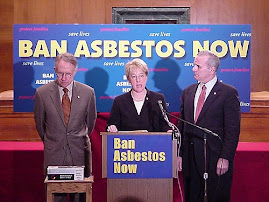
As part of the season of programmes Dangers in the Dust: inside the Global Asbestos Trade, Steve Bradshaw meets scientists on both sides of the debate.
http://www.bbc.co.uk/worldservice/news/2010/07/100720_asbestos_discovery.shtml?bw=nb&mp=wm&news=1&ms3=2&ms_javascript=true&bbcws=2
Dangers in the Dust: Inside the Global Asbestos Trade
Some experts warn that by 2030 asbestos could be linked to millions of deaths.
Yet, despite an international outcry, its use continues across much of the world.
The industry says it now uses only a less hazardous form of the mineral called white asbestos or chrysotile, which can be safely controlled and that lives lost should be blamed on varieties now banned .
Many scientists however, insist all forms of asbestos may cause cancer, and continuing exports could seriously prolong the epidemic.
In an exclusive worldwide investigation, the BBC and the International Consortium of Investigative Journalists (ICIJ) reveal the truth about asbestos use across four continents.
The investigation shows that a global network of industry groups has spent millions of dollars in public and private money since the mid-1980s to keep asbestos in commerce internationally.
Dangers in the Dust is being rolled out in a series of stories across the BBC's international services, and through ICIJ’s partner publications worldwide.
Listen again to BBC World Service programming:
Dangers in the Dust
Discovery
Subscribe to the podcast
Canada mines and exports white asbestos or chrysotile to developing countries such as India.
The industry says that white asbestos can be used safely.
But a scientific controversy rages around the continued use of white asbestos, and the World Health Organisation says the most efficient way to eliminate asbestos-related diseases, such as lung cancer and asbestosis, is to stop using all types of asbestos.
India's $850m asbestos industry
One Planet
Subscribe to the podcast
The use of white asbestos has been banned - or is subject to stringent restrictions in more than 50 countries - amid fears that it is too dangerous to public health. But in many parts of the developing world, its use is growing.
Lauded for its cheap and durable qualities, white asbestos is a popular product in places like India, where there is a strong demand for affordable housing.
One Planet comes from Ahmedabad in western India, a city where asbestos is commonplace.
Presenter Mike Williams visits a shanty town made of broken bits of asbestos sheeting, and meets the factory workers suffering breathing problems.
He hears state government officials boast there is no asbestos in the region, before changing their mind, and he tries to speak with the boss of one of the city's biggest asbestos product manufacturers.
Suffering with mesothelioma
Health Check
Subscribe to the podcast
Steve Lee is living with the incurable cancer, mesothelioma. It is caused by exposure to asbestos. Despite his illness, Steve has continued to run and he has lived for longer than his doctors expected.
Professor Julian Peto, of the London School of Hygiene and Tropical Medicine, tells Claudia Hammond how it was discovered that asbestos is so dangerous to health. He explains why currently the UK has more deaths from asbestos-related diseases than any other country.
Asbestos: the first cases
Witness
Subscribe to the podcast
In the early 20th Century, Turner Brothers Asbestos was the largest asbestos producer in the world.
It owned mines in Canada and southern Africa, as well as factories in the north of England which processed the mineral into a spun yarn.
The company boasted that 'new uses for asbestos are constantly being discovered, the industry may be regarded as having touched only the fringe of its immense possibilities.'
Then, in 1924, an asbestos spinner named Nellie Kershaw died and things began to change.
http://www.bbc.co.uk/worldservice/lg/news/2010/07/000000_asbestos.shtml
Tuesday, July 20, 2010

India's expanding use of asbestos brings dire warnings

India's expanding use of asbestos brings dire warnings
Murali Krishnan and Shantanu Guha Ray | International Consortium of Investigative Journalists
last updated: July 21, 2010 12:09:26 AM
NEW DELHI — Every day, the swirling waters of the Arabian Sea bring misery to Alang, the world's largest shipbreaking yard, in western India's Gujarat state.
An estimated 55,000 workers, unmindful of the lethal effects of asbestos-laden material in the vessels, slave for long hours taking apart old ships and, in the process, are exposed to deadly fibers.
The Indian government is aware of the risks but loath to interfere: The men need jobs, and India's economy, among the world's fastest-growing, needs secondary steel from the beached vessels.
"Reclamation and recycling," said Pravin Nagarsheth, the president of the Iron Steel Scrap and Shipbreakers Association of India, "is a highly lucrative business."
One hundred-twenty miles north of Alang, workers at hundreds of dusty asbestos factories in the city of Ahmedabad face similar hazards in the name of economic development: lung cancer, asbestosis and a rapacious malignancy called mesothelioma, usually found in the chest cavity. In this case the end product is asbestos sheet, widely used in construction.
The two locales are centers of an emerging epidemic of asbestos-related disease in India.
Valued for its heat and fire resistance, asbestos was once widely used worldwide, but 52 countries ban or restrict it now. The use of the mineral is banned entirely in the European Union. In the United States — where it's blamed for some 200,000 deaths and has cost the industry $70 billion in damages and litigation expenses — asbestos use is limited to a handful of products, such as automobile brakes and gaskets, and rarely used even in those.
In India, however, asbestos use is booming.
The country is now the world's second largest asbestos market, behind only China, consuming nearly 386,000 tons in 2008. The industry generates more than $850 million a year in revenue, and it directly employs 300,000 people; indirectly, it supports as many as 3 million more. Backed by a powerful lobby, asbestos use in India has risen by 83 percent since 2004, according to government figures. Given evidence of poor workplace safety and weak regulations, such widespread use could prove disastrous, health experts said.
One study by two New Delhi researchers suggests that deaths from asbestos-related cancers could reach 1 million in developing nations by 2020.
"The industry is using its economic and political power in a way that's allowing it totally unrestrained growth," said Barry Castleman, a U.S. environmental consultant who advises the World Health Organization. "We can only expect untold numbers of preventable deaths to occur as a result."
According to recent estimates by the Asbestos Cement Products Manufacturers Association, a New Delhi-based industry organization, the Indian asbestos market grew by more than 30 percent just in the past year, primarily because of demands in the country's rural sector.
"The asbestos market — despite being a health hazard — has grown because it serves the market for the poor," said Gopal Krishna of the Ban Asbestos Network of India. "And that market is growing at a tremendous pace. So nobody has the time for complaints."
In India, asbestos products carry no health warning labels and trade unions have no mandate to prevent asbestos-related disease at workplaces. Although researchers around the world have linked lung cancer and other diseases with exposure to the widely used white, or chrysotile, asbestos, the powerful Asbestos Cement Products Manufacturers Association — funded by 12 asbestos companies, as well as by the Canada-based Chrysotile Institute — concedes nothing.
"That lung cancer deaths have been caused by inhaling asbestos fiber has not been conclusively proved in India," said John Nicodemus, the association's executive director. "This is the handiwork of groups like BANI. The government's stand on asbestos is very clear. It has yet to receive proof of the product being a health hazard."
The manufacturers association and others contend that chrysotile asbestos is less toxic than blue or brown forms of the mineral, which no longer are used. Nonetheless, many health experts say chrysotile asbestos can be deadly.
Nicodemus refused to divulge details of the association's funding, but senior government officials say it's received $50 million since it was founded in 1985.
A. Modi, the president of an asbestos manufacturing company that's affiliated with the association, told the International Consortium of Investigative Journalists that association member companies contribute 2 to 3 percent of their revenue to the lobby group for "promotional activities in India that revolve around advertising promotions to counter baseless allegations by Ban Asbestos Network India (and) legal and promotional activities that (are) mostly in rural India."
This means that at current exchange rates, the association receives the equivalent of $8 million to $13 million per year.
It spends some of this money on "advertorials," at up to $34,000 apiece, in mass-circulation Indian daily newspapers, ostensibly to counter what it terms disinformation about the effects of asbestos. Government officials say the association also spends significant amounts on lobbying and training — mostly in Canada and Russia — for its staffers. Its already sizable budget is expected to increase as industry output grows — possibly to 600,000 tons a year — to meet the demand for asbestos-sheet roofing in India's villages.
The manufacturers association's lobbying activities were part of a detailed discussion on hazardous minerals during a spirited meeting at the Ministry of Mines in April, when a host of scientific and public interest groups opposed demands for the increased use of asbestos.
At the meeting, officials told the International Consortium of Investigative Journalists, representatives of BANI and the National Institute of Miners' Health argued for an asbestos ban. Representatives of asbestos companies, in turn, demanded proof that asbestos causes lung diseases and dismissed the idea of a ban.
When public health advocates produced global figures to argue their case, the industry officials replied that such figures reflected deaths in other countries and not in India, where they say chrysotile use under "controlled conditions" poses little risk. The companies, however, rarely provide the working conditions and safety equipment to protect their employees from the dangers of asbestos, experts say.
Most of the asbestos used in India comes from Russia or Canada. Despite the rapid increase in usage across India, little mention is made of the potential health effects. For example, a newly released environmental impact assessment guidance manual for asbestos-based industries — with a foreword by Indian Environment Minister Jairam Ramesh — has no details about the alarming rise in asbestos-related diseases worldwide or countries that have banned the product.
Those who follow the industry aren't surprised.
The first official records on the dangers of asbestos became public in India only in 2008, when BANI's Krishna, who was then a young, unknown activist, demanded documents under the Right to Information Act, India's freedom of information law.
For the Indian public, reporting on asbestos remains scarce, however. Experts say this is primarily because the states and union territories have no mechanism to prove that lung cancer deaths and other skin diseases are being caused by asbestos exposures. As a result, the Indian asbestos industry is insulated from the movement to ban asbestos globally.
The lack of official attention has dire consequences for tens of thousands of workers likely to succumb to asbestos-related diseases, health experts warn.
At one company in Ahmedabad — Gujarat Composite Ltd. — at least 75 workers have been diagnosed with lung cancer in the past 10 years, out of a work force of about 1,000, according to nongovernmental activists in Ahmedabad who are working on asbestos-related diseases. At least 20 of those have died, they said.
"No one listened to our repeated complaints of breathing troubles and skin irritation," said Rues Muthuswami Munian, who's suffered from the disease for nearly a decade. He and other sick workers say the company fired them and offered virtually no compensation, prompting them to file a complaint with the local police over conditions at the company. Shorn of money, they're dependent on monthly handouts from a few aid organizations.
Representatives of Gujarat Composite are the target of four criminal complaints that the state Labour and Employment Department filed in March. The complaints accuse the company of lacking safety records, failing to conduct medical exams of workers and refusing to provide inspectors with a registry of its workers.
"There were no records kept of the fibers floating in the atmosphere," one complaint reads.
Gujarat Composite officials declined repeated requests for an interview.
The U.S.-based company Johns Manville held a stake in the 48-year-old factory when it was called Shree Digvijay Cement Co. and expressed dismay about its hygiene decades ago, according to documents obtained by the International Consortium of Investigative Journalists.
In a confidential 1977 memorandum, for example, a Johns Manville official wrote, "The Indian Government Environmental Division has been recently tightening dust emissions and Shree has been told to either shape up or close down with their management liable for jail sentences. Their present operation is just indescribably poor. The wet end of the pipe machines is like 'London fog' with fiber floating all over from the fiber bins." Johns Manville held 10 percent of Shree Digvijay's stock until at least 1983.
In 1997, about a year after it acquired the factory, Gujarat Composite began subcontracting with two privately owned companies. In January, responses to requests by a nongovernmental organization filed under the Right to Information Act suggested that more than 1,000 workers at the two firms toiled under dangerous conditions.
"The saddest part of the story is this: The state government knows what is happening, yet no action has been taken on these two companies," said Raghunath Manwar of the Ahmedabad-based Occupational Health and Safety Association, which advocates for asbestos victims.
"The environment is lethal," said Dheemant Badia, an Occupational Health and Safety Association trustee. "These workers work in a death zone because there is no practice of measurement of airborne asbestos-fiber dust." Gujarat's Directorate of Industrial Safety and Health has routinely received complaints about Gujarat Composite but, critics charge, has turned a blind eye.
In the majority of Indian states and territories, asbestos is considered an essential ingredient of growth.
In the southern state of Andhra Pradesh, a pro-asbestos agenda is being pushed by one of its members of Parliament, Gaddam Vivekanand, who reportedly controls 25 percent of India's asbestos production through his ownership of seven factories across the country. An eighth will open this year in eastern Orissa state.
The ubiquitous nature of the fiber is best demonstrated in western Maharashtra state, which is filled with asbestos factories in places such as Mumbai, Pune and Kolhapur.
The Maharashtra Pollution Control Board acknowledges the mounting number of lung diseases in the state in its annual reports, but it's taken no action to make the state asbestos-free.
Beneath the growing debate, some experts note, lies the fact that India remains a country in which an estimated 450 million people live below a government-stipulated poverty line.
In such an environment, the chances of factories maintaining the proper safety and health standards may be dim indeed. Castleman, the environmental consultant, said it was reasonable to expect hundreds of thousands of asbestos-related deaths before India would react.
"I'm hard-pressed to point to any sign of success that activists and public health people have had over there," he said.
Asha Gupta, a lawyer who represents asbestos victims in Gujarat, said that companies at least needed to provide safety gear to those who were working in such hazardous conditions. "Otherwise, workers will continue to fall sick and, eventually, die a slow, painful death."
(International Consortium of Investigative Journalists associate Abhishek Upadhyay contributed to this report from India.)
(This story is part of "Dangers in the Dust," a joint investigation by the BBC's International News Services and the International Consortium of Investigative Journalists. The consortium is a collaboration of some of the world's top investigative reporters. Launched in 1997 as a project of The Center for Public Integrity, the consortium globally extends the center's style of watchdog journalism, working with 100 journalists in 50 countries to produce long-term, transnational investigations.)
Source: http://www.mcclatchydc.com/2010/07/21/v-print/97621/indias-expanding-use-of-asbestos.html
Lobbyists push use of asbestos in developing nations

‘IT KILLS PEOPLE’
Lobbyists push use of asbestos in developing nations
By Jim Morris
WASHINGTON — A global network of lobby groups has spent nearly $100 million since the mid-1980s to preserve the international market for asbestos, a known carcinogen that’s taken millions of lives and is banned or restricted in 52 countries, the International Consortium of Investigative Journalists found in a nine-month investigation.
Backed by public and private money and aided by scientists and friendly governments, the groups helped facilitate the sale of 2.2 million tons of asbestos last year, mostly in developing nations. Anchored by the Montreal-based Chrysotile Institute, the network stretches from New Delhi to Mexico City to the city of Asbest in Russia’s Ural Mountains. Its message is that asbestos can be used safely under “controlled” conditions.
As a result, asbestos use is growing rapidly in countries such as China and India, prompting health experts to warn of future epidemics of lung cancer, asbestosis and mesothelioma, an aggressive malignancy that usually attacks the lining of the lungs.
The World Health Organization says that 125 million people still encounter asbestos in the workplace, and the United Nations’ International Labor Organization estimates that 100,000 workers die each year from asbestos-related diseases. Thousands more perish from exposures outside the workplace.
Dr. James Leigh, the retired director of the Centre for Occupational and Environmental Health at the Sydney School of Public Health in Australia, has forecast a total of 5 million to 10 million deaths from asbestos-related cancers by 2030, an estimate he considers conservative.
“It’s totally unethical,” Jukka Takala, the director of the European Agency for Safety and Health at Work and a former International Labor Organization official, said of the pro-asbestos campaign. “It’s almost criminal. Asbestos cannot be used safely. It is clearly a carcinogen. It kills people.”
Indeed, a panel of 27 experts convened by the WHO’s International Agency for Research on Cancer reported last year: “Epidemiological evidence has increasingly shown an association of all forms of asbestos ... with an increased risk of lung cancer and mesothelioma.”
The asbestos industry, however, has signaled that it will fight to protect sales of raw fiber and finished products such as asbestos cement roofing and water pipes. Among its allies are industry-funded researchers who have contributed hundreds of articles to the scientific literature claiming that chrysotile — white asbestos, the only kind sold today — is orders of magnitude less hazardous than brown or blue asbestos. Russia is the world’s biggest chrysotile producer, China the biggest consumer.
“It’s an extremely valuable material,” argued Dr. J. Corbett McDonald, an emeritus professor of epidemiology at McGill University in Montreal who began studying chrysotile-exposed workers in the mid-1960s with the support of the Quebec Asbestos Mining Association. “It’s very cheap. If they try to rebuild Haiti and use no asbestos it will cost them much more. Any health effects (from chrysotile) will be trivial, if any.”
McDonald’s sanguine view of chrysotile assumes that employers provide proper dust controls, ventilation and protective equipment for workers, but public health experts say that such measures are uncommon in the developing world.
“Anybody who talks about controlled asbestos use is either a liar or a fool,” said Barry Castleman, an environmental consultant based near Washington who advises the WHO on asbestos matters.
Fire- and heat-resistant, strong and inexpensive, asbestos — a naturally occurring fibrous mineral — once was seen as a construction material with near-magical properties. For decades, industrialized countries from the United States to Australia relied on it for countless products, including pipe and ceiling insulation, shipbuilding materials, brake shoes and pads, bricks, roofing and flooring.
In the early 20th century, reports of the mineral’s lung-ravaging properties began to surface. By the century’s end, millions of people were sick or had died from asbestos exposure, and billions of dollars in compensation had been paid to claimants.
Ninety-five percent of all the asbestos ever used has been chrysotile.
This sordid history, however, hasn’t deterred the asbestos lobby, whose longtime leader is Canada. The federal government and the government of Quebec, where chrysotile has been mined for decades, collectively have given 35 million Canadian dollars to the Chrysotile Institute, formerly known as the Asbestos Institute.
Canada uses little asbestos domestically but it sent 168,000 tons abroad last year; more than half of that went to India. Canada has fought to keep chrysotile from being listed under Annex III of the Rotterdam Convention, a treaty that requires exporters of hazardous substances to use clear labeling and warn importers of any restrictions or bans.
Despite mounting pressure from public health officials to stop asbestos exports, Canadian officials continue to defend the industry.
“Since 1979, the government of Canada has promoted the safe and controlled use of chrysotile and our position remains the same,” Christian Paradis, the natural resources minister in Canada’s conservative government and a former president of the Asbestos Chamber of Commerce and Industry, told the International Consortium of Investigative Journalists in a written statement.
Amir Attaran, an associate professor of law and medicine at the University of Ottawa, calls the government’s position unconscionable. “It’s absolutely clear that (Prime Minister) Stephen Harper and his government have accepted the reality that the present course of action kills people, and they find that tolerable,” Attaran said.
The Chrysotile Institute’s president, Clement Godbout, said his organization’s message had been misinterpreted.
“We never said that chrysotile was not dangerous,” he said. “We said that chrysotile is a product with potential risk and it has to be controlled. It’s not something that you put in your coffee every morning.”
The institute is a purveyor of information, Godbout emphasized, not an international police agency.
“We don’t have the power to interfere in any countries that have their own powers, their own sovereignty,” he said.
Godbout said he was convinced that large asbestos cement factories in Indian cities had good dust controls and medical surveillance, though he acknowledged there might be smaller operations “where the rules are not really followed. But it’s not an accurate picture of the industry. If you have someone on a highway in the U.S. driving at 200 miles per hour, it doesn’t mean everybody’s doing it.”
Source: The Keene Sentinel, International Consortium of Investigative Journalists
Published: July 20, 2010
Friday, June 25, 2010
BANI Supports WTO Challenge against Subsidy for Deadly Asbestos Fibers
Press Release
BANI Supports WTO Challenge against Subsidy for Deadly Asbestos Fibers
New Delhi: Ban Asbestos Network of India (BANI) appeals to the imminent G-20 and G-8 summit during June 26-27 in Toronto to persuade Canadian and Russian government to stop promoting export of asbestos which is an exercise in trade distortion. Dr Manmohan Singh is also attending the summit.
While fifty-two countries have banned all forms of asbestos, India continues to use it under the seemingly insurmountable influence of countries like Canada and Russia, the major asbestos producers of the world.
BANI support EU Parliamentarian’s call for WTO Challenge of $58 Million Loan Guarantee Subsidy for Deadly Export of White Asbestos (Chrysotile asbestos).
The open-pit Jeffrey Mine in Asbestos, Quebec province, Canada has exported huge amounts of asbestos for the past century. Now, its surface asbestos supply exhausted, the company is under bankruptcy protection. After not being able to find financing on the private market, the mine's owners have sought a $58 million loan guarantee from the Quebec government to open a new underground mine so that it can export asbestos to developing countries for the next 25 years. Under World Trade Organization (WTO) rules, a loan guarantee that facilitates financing on terms more favorable than otherwise available in the market is considered a subsidy. The subsidy is expected to be approved by July 1.
BANI appeals to Dr Manmohan Singh, the Indian Prime Minister to take cognisance of the asbestos that would be mined at the Jeffrey Mine which would ultimately take toll in India would not enter commerce in Canada. Canada has trade obligations under WTO that forbids export subsidization. While WTO rules generally discipline government subsidies, export subsidies are explicitly forbidden.
Canadian Prime Minister Stephen Harper's minister of Natural Resources, Christian Paradis, is a leading advocate of this major subsidy to boost Canadian exports despite trade pacts rules that forbid export subsidy trade distortions.
BANI endorses Stephen Hughes, European parliamentarian (UK) call for an inquiry seeking a WTO challenge of the proposed Canadian subsidy. The European Union has banned all use of asbestos and extraction, manufacture and processing of asbestos products in 2005.
Public Citizen, a nonprofit public interest organization based in Washington, D.C, is right in saying that a new WTO challenge of a new Canadian export subsidy certainly would make a mockery of the Canadian government's pre-summit briefings that have criticized other countries' purported slide toward protectionism and trade distortions.
Notably, Quebec and the rest of Canada, like other industrialized countries, refuse to use asbestos and are experiencing an epidemic of asbestos-related disease from past use. The world's leading health authorities have called for asbestos to be banned.
BANI endorses Public Citizen's statement underlining the hypocrisy of Canadian government which is violating human rights of workers and consumers in developing countries like India by knowingly exposing them to cancer causing asbestos fibers.
For Details: Gopal Krishna, Ban Asbestos Network of India (BANI)-ToxicsWatch Alliance, New Delhi, Mb: 9818089660, Blog: banasbestosindia.blogspot.com
Public Citizen’s website: www.citizen.org
EU Parliamentarian Calls for WTO Challenge of $58 Million Loan Guarantee Subsidy for Deadly Exports
For Immediate Release:
June 24, 2010
Contact: Bryan Buchanan (202) 454-5108
On Eve of G-20 Summit, Canadian Government Bashes Others for Trade Distortions While Poised to OK Huge Subsidy for Asbestos Exports
EU Parliamentarian Calls for WTO Challenge of $58 Million Loan Guarantee Subsidy for Deadly Exports
WASHINGTON, D.C. - "Hypocrisy!" may be the leading headline coming out of the imminent G-20 and G-8 summits as news of host country Canada's pending $58 million loan guarantee subsidy to restart Canadian asbestos exports slams into the government's recent pre-summit lectures about the need for participating countries to avoid trade distortions, Public Citizen said today.
"The Canadian government endlessly chastises other countries' purported trade distortions but apparently the Harper administration's fealty to free trade does not apply to Canada creating a massive new subsidy that would boost exports of a deadly substance, asbestos," said Lori Wallach, director of Public Citizen's Global Trade Watch division.
The open-pit Jeffrey Mine in Asbestos, Quebec, has exported huge amounts of asbestos for the past century. Now, its surface asbestos supply exhausted, the company is under bankruptcy protection. After not being able to find financing on the private market, the mine's owners have sought a $58 million loan guarantee from the Quebec government to open a new underground mine so that it can export asbestos to developing countries for the next 25 years. Under World Trade Organization (WTO) rules, a loan guarantee that facilitates financing on terms more favorable than otherwise available in the market is considered a subsidy. The subsidy is expected to be approved by July 1.
Very little of the asbestos that would be mined at the Jeffrey Mine would enter commerce in Canada. Almost all of it would be exported - with much going to WTO-member nations to whom Canada has trade obligations that forbid export subsidization. While WTO rules generally discipline government subsidies, export subsidies are explicitly forbidden.
The Harper government attacked U.S. Buy America provisions in the 2009 Economic Stimulus bill that fully complied with U.S., WTO and North American Free Trade Agreement (NAFTA) obligations. Yet, Prime Minister Stephen Harper's minister of Natural Resources, Christian Paradis, is a leading advocate of this major subsidy to boost Canadian exports despite trade pacts rules that forbid export subsidy trade distortions.
"You do not have to be a fan of the current trade rules to be outraged by the stunning hypocrisy of the Canadian government supporting a massive government subsidy to resume operations at an asbestos mine whose deadly product will mainly be exported to developing countries," Wallach said.
European parliamentarian Stephen Hughes (U.K.) recently tabled an inquiry calling for a WTO challenge of the proposed Canadian subsidy. The European Union has banned all use of asbestos and extraction, manufacture and processing of asbestos products in 2005.
"A new WTO challenge of a new Canadian export subsidy certainly would make a mockery of the Canadian government's pre-summit briefings that have criticized other countries' purported slide toward protectionism and trade distortions," Wallach said.
Quebec and the rest of Canada, like other industrialized countries, refuse to use asbestos and are experiencing an epidemic of asbestos-related disease from past use. The world's leading health authorities have called for asbestos to be banned. Fifty-two countries have banned all forms of asbestos.
###
Public Citizen is a national, nonprofit public interest organization based in Washington, D.C. For more information, please visit www.citizen.org
Saturday, June 19, 2010
Stop subsidy to asbestos mining industry & health disaster
Stop the subsidy to asbestos mining industry & health disaster
To
Mr Pierre Arcand
Minister of International Relations
Québec Government Office in Mumbai
Consulate General of Canada
6th floor Fort House
221, Dr. D.N. Road
Mumbai – 400 001
Maharashtra, India
Phone : 91-22-6749-4444
Fax : 91-22-6749-4454
Sub-Stop the subsidy to asbestos mining industry & health disaster
Dear Mr Pierre Arcand,
The purpose of this letter is to protest against the Quebec government (Canada) which is all set to provide a large subsidy to save the asbestos mining industry in Canada unmindful of its health consequences in developing countries like India. We are aware that Quebec has only one asbestos mine left, which is nearly exhausted and employs 340. The asbestos cement sheeting industry is growing at a healthy 10-12 per cent a year in India.
We are deeply saddened and disturbed by Quebec government’s double standard on asbestos trade which illustrates Canada's utter callousness towards human rights of asbestos workers and consumers in India. It is unbecoming of Canada to put profits before people unmindful of incurable diseases and preventable deaths .
It is deeply immoral to support an industrial activity which is leading to yet another industrial disaster due to criminal corporate negligence and governmental patronage.
Canada exports the cancer causing fiber to India but prefers not to use it domestically. In India, it is imported without any restriction. Canada and Russia are the biggest exporters of white asbestos. In 2007, Canada exported almost Ninety five percent of the white asbestos it mined and out of it forty-three percent was shipped to India.
I am writing to you on behalf of Ban Asbestos Network of India (BANI), which is working to make India asbestos free to save workers and citizens from cancer causing fibers of death.
In the face massive asbestos exposure underway in India, the recent ban on asbestos laden US ship, The White Asbestos (Ban on Use and Import) Bill, 2009 introduced in Rajya Sabha (Upper House) and the ban asbestos order of the Kerala State Human Rights Commission, environment, labour, human rights and health groups appeal to the Prime Minister and to all the parliamentarians to ensure that manufacture, use and trade of asbestos is banned in India. Details of the bill here.
The chrysotile asbestos (white asbestos) industry is acting as merchants of death even as workers and consumers are routinely being exposed to deadly asbestos fibers. Notably, worker protections and enviro-occupational health infrastructure are weak or non-existent in India. The silence of the government in the face of workers and consumers who are sick and dying from asbestos-caused cancer is deafening. The Indian parliament and Canadian House of Commons must act to stop the governments from protecting the companies that knowingly commit corporate crimes as is the case with the asbestos industry which is hiding behind manifest immoral patronage of the governments.
It is noteworthy that a US corporation Dow Chemicals Company which is liable for Union Carbide Corporation’s legacy issues such as Bhopal's industrial disaster, held itself liable for asbestos issues and put aside $2.2 billion as “potential cost of resolving pending and future claims against Carbide”, such corporate crimes have become the order of the day because of government's connivance.
We appreciate the civil society in Canada that has called for the, end of asbestos mining, consistent with the position of the World Health Organization (WHO) and over 50 countries that have banned asbestos. A letter addressed to Premier Charest, and jointly endorsed by numerous organizations, was handed over.
We have called upon Prime Minister of India and Quebec’s Premier to stand up to the powerful asbestos industry in both countries which is spending millions of dollars to intimidate and silence workers, doctors, scientists and activists who are all for banning asbestos. Victims of asbestos related diseases, who are dying a slow death with no legal and medical remedy in sight.
We understand that if the new mining operation opens, it will export asbestos to poor countries for the next 25 years. The Quebec propaganda machine using Canadian embassies has consistently worked to thwart public health efforts around the world by promoting killer fibers of Canadian asbestos. Earlier on March 23, 2010 Canadian Prime Minister Stephen Harper deemed it fit to give $250,000 of taxpayer money to the Chrysotile Institute (formerly called the Asbestos Institute), a group that promotes the use of asbestos in developing countries. Parliamentary Standing Committee on Natural Resources meeting on 22 March dealt with the $250,000 funding for the Chrysotile Institute.
The Economic Development Agency of Canada and the Department of Natural Resources have given the Chrysotile Institute (formerly called the Asbestos Institute) more than $20 million over the past 25 years. In February 2008, Harper government had announced gnt of $750,000 to the Chrysotile Institute for the next three years. We are shocked to note that your government is feigning ignorance about WHO estimates at least 100,000 deaths from asbestos every year and the total may eventually be 5-10 million.
Public health researchers are deeply concerned about the alarming rate of consumption. In 2008, the use of 348,538 tonnes of asbestos made India the world's 3rd largest asbestos market; since 2004, consumption has risen by 83%. Cumulative asbestos usage in India has been estimated at 7,343,612 tonnes. In the UK consumption of 6 million tonnes has produced the country's worst epidemic of occupational disease and death. The condition in India due to asbestos is already an unacknowledged public health disaster with no medical infrastructure to deal with such enviro-occupational diseases.
The safe use of any form of asbestos is “impossible anywhere in the world”.
On behalf of BANI, we appeal to your government and Canadian government through you to adopt safer alternatives of fibers of death instead of promoting it.
Warm Regards
Gopal Krishna
Ban Asbestos Network of India (BANI)-ToxicsWatch Alliance
New Delhi
Mb: 9818089660
Blog: banasbestosindia.blogspot.com
Cc
Prime Minister of Canada
Prime Minister of India
Premier of Quebec
Union Environment & Forests Minister
Union Ministry of Mines
Union Commerce Ministry
Union Finance Ministry
Union Chemicals Ministry
Cabinet Secretary, Government of India
Union Environment Secretary
Saturday, May 15, 2010
Funding for Lung Cancer Promotion
Brazil is the fifth largest producer after Russia, Canada, Kazakstan, China, and one of the major consumers of asbestos in the world.
On March 23, 2010 Canadian Prime Minister Stephen Harper deemed it fit to give $250,000 of taxpayer money to the Chrysotile Institute (formerly called the Asbestos Institute), a group that promotes the use of asbestos in developing countries. Canada's Parliamentary Standing Committee on Natural Resources meeting on 22 March dealt with the $250,000 funding for the Chrysotile Institute.
The Economic Development Agency of Canada and the Department of Natural Resources have given the Chrysotile Institute (formerly called the Asbestos Institute) more than $20 million over the past 25 years. In February 2008, Harper government announced another grant of $750,000 to the Chrysotile Institute for the next three years.
The statistics for overall incidence of/prevalence of environmental and occupational disease and injuries for India is not available and would not be available in near future as well.
As to data no asbestos related diseases in death, mo such data exists and there would not be any such data in future as well because no such data is being collected. There are just six occupational health institutes in the entire country that too in a decaying condition or are grappling with infrastructural problems.
With regard to occupational diseases in particular the only academic estimate available and which has been taken cognizance of (in 2004) by India's National Institute of Occupational Health is the WHO paper by James Leigh et al titled "Global Burden of Disease and Injury Due to Occupational Factors". It noted the "tendency to underreport work-related injuries and traumatic fatalities" in India which is "illustrated by the number reported by it. He has estimated an annual incidence of occupational disease between 924, 700 and 1, 902, 300 and 121, 000 deaths in India. The ILO-reported figures for India (200,000 nonfatal injuries per year, 687 fatal injuries per year) are so low that they are not believable.
Another estimate of occupational fatality rates in India has been made by Takala and Obadia based on Malaysian rates, giving a figure of 36,500 deaths per year. The paper by James Leigh et al used a mean of 45,000 deaths per year for India and 17 million injuries per year. There is no way to dig out data on asbestos disease out of such estimations.
Subscribe to:
Posts (Atom)