Chemotherapy treatments which aim to prolong patients' lives and reduce suffering from asbestos-related cancer do not work, UK researchers suggest.
Mesothelioma, caused by asbestos exposure, is usually incurable, but some specialists hope chemo could delay death and improve quality of life.
The study in the Lancet found hundreds of patients saw no benefit.
However, a US expert said other combinations of chemotherapy drugs could work better.
Despite legislation controlling the use of asbestos, there are approximately 2,000 deaths from mesothelioma in the UK every year.
Any treatment can have serious side effects for patients and these findings highlight that people should not have treatment that is not of proven benefit
Kate Law Cancer Research UK
The decades-long delay between exposure and the onset of the disease, means numbers are expected to keep rising for at least half a decade.
Treatment for mesothelioma is aimed principally at reducing its symptoms, and hopefully slowing down the progression of the illness.
It is generally recommended that patients are given steroid drugs and radiotherapy sessions.
No proof
The latest study looked at 409 patients, mainly from the UK, who were all given these standard treatments.
Some were additionally given doses of chemotherapy, and the effect on their disease compared.
While the chemotherapy patients did live slightly longer on average than those given just standard treatment, the researchers said the finding did not represent statistical proof, and could be misleading.
There was no improvement in quality of life among the chemotherapy patients.
One of the authors of the study, Dr Richard Stephens from the Medical Research Council Clinical Trials Unit, said: "While thousands are and will be affected by this deadly disease, our trial, which is one of the few large trials ever conducted in this disease, emphasises how difficult mesothelioma is to treat.
"This is mainly because mesothelioma forms in the lining of the lung. This makes it hard to target."
Kate Law, Cancer Research UK's director of clinical trials, added: "These results showed no real benefit from adding these chemotherapy drugs compared with just treating the symptoms of the disease.
"Any treatment can have serious side effects for patients and these findings highlight that people should not have treatment that is not of proven benefit."
However, one US-based expert said that results from other trials into chemotherapy had been more positive.
Dr Nicholas Vogelzang, from the Nevada Cancer Institute, also writing in The Lancet, said that different combinations of drugs had, in one study, meant that half the patients involved survived a year or more.
Source: http://news.bbc.co.uk/1/hi/health/7402650.stm
Friday, May 16, 2008

Thursday, May 8, 2008
Asbestos hotzone
Petrochemical heartland home to vigilant MDs
The Sarnia area is home to several large industrial plants. According to a report by Ecojustice, evidence suggests the local environment— and the health of its residents—has been severely compromised.
In Sarnia, Ontario, caregivers are constantly on guard for workplace-related health problems, while advocating for a cleaner community
SARNIA, ONTARIO. | It isn’t very often that a small medical clinic gets credit in a high-profile report by an influential environmental group.
But then few clinics are as focused on the health impact of a specific area’s environmental and workplace pollutants as the Occupational Health Clinic for Ontario Workers (OHCOW) office in Sarnia, Canada’s petrochemical heartland.
Sarnia’s roughly 75,000 residents contend with arguably the worst air pollution in the country, according to the report published in October by Toronto-based Ecojustice (formerly the Sierra Legal Defence Fund).
To whit: According to industry data compiled by Environment Canada and cited by Ecojustice, there are 46 large effluence-emitting industrial plants in Ontario within 25 km of Sarnia. On the U.S. side of the St. Clair River, the body of water on which Sarnia sits, there are 16 similar facilities. In 2005, the Canadian smokestacks alone emitted more than 5 million kg of pollutants deemed to be toxic, Ecojustice said.
“The toll these emissions are taking is dramatic and there is growing evidence that the health of the residents of Sarnia and the Aamjiwnaang First Nation (a Sarnia-area reserve), and the local environment has been severely compromised,” said Ecojustice.
Yet while that report focused on the air pollution, all elements of Sarnia’s natural surroundings are affected by the region’s concentration of heavy industry. As a result, the OHCOW clinicians “see no distinction between the ambient environment and the workplace,” when they contemplate the health of the region’s population, said Dr. James Brophy, (PhD), executive director of the Sarnia office.
It is because of that lack of distinction that Dr. Brophy, who is also an occupational and environmental cancer researcher, and his physician colleagues decided to work with Ecojustice, he explained in an interview.
“We believe Ecojustice has performed an important public health role in alerting the community about the extent of environmental exposures emanating from the petrochemical industry,” said Dr. Brophy.
OHCOW is a six-city clinic, born of the provincial labour movement in the late 1980s, and specializes in handling workplace-related health problems. Its physician services and office overhead are largely funded by the Ontario Workplace Safety and Insurance Board.
While OCHOW’s core patient population is current and past workers of the major industries, its Sarnia health professionals worry about the risks the wider Sarnia population faces, including outdoor workers such as construction crews, landscapers and home remodellers, people “who are out there in this environment every day,” said Dr. Brophy.
Despite clear and ample evidence that much of Sarnia’s population faces a frightening day-to-day reality as a result of the pollution, the doctors must nevertheless keep their medical objectivity.
Dr. Abe Reinhartz, a general practitioner here, explained “patients often come to us with undifferentiated health complaints, and they are interested in exploring whether or not there is a workplace connection.”
A worker memorial stands guard in Sarnia.
He continued, “Often, we can make a diagnosis here of some other ailment that is not work-related, and get patients to communicate with their primary-care physician or initiate a referral ourselves to get a problem sorted out.”
Dr. Reinhartz noted that despite their concerns about Sarnia’s pollution, for physicians such as himself, “it is not so easy to clinically tease out the environmental exposures in terms of health effects in an individual.”
He said wider, epidemiological studies are better suited to revealing those negative health implications of pollution than individual patient investigations.
Dr. Reinhartz, for one, doesn’t see himself and his colleagues as environmental activists as the term is popularly understood, despite their involvement with Ecojustice and an Aamjiwnaang environmental committee, but more as “patient advocates for their medical-legal rights.”
The OHCOW doctors said their public profile has led to occasional negative feedback from other doctors, ones who to Dr. Reinhartz “are paid by corporate entities to provide medical services and are very willing to toe the party line.”
“We should be aiming for zero emissions or zero releases, and supporting industry in that way.”
—Dr. John Howard
Real-world laboratory
For Dr. John Howard, a professor of pediatrics and medicine at the University of Western Ontario Schulich School of Medicine in London, Ont., Sarnia, in Ontario’s extreme southwest, offers an unintentionally perfect real-world laboratory for bringing home the lessons of the ecosystem health courses he teaches to his school’s medical students.
Dr. Howard, who has been to Sarnia many times and works closely with Sarnia’s OHCOW clinic, recalled grimly an image that to him typifies the plight of the area. On the Aamjiwnaang reserve, “right by the river . . . there is this sign that says, ‘Doing anything in this water is toxic.’ ”
Ecosystem health is geared toward training doctors to “think of (a patient’s) health in a very broad sense . . . to try to think of the sickness in the human as a symptom of the environment.”
In February, the governing federal Conservatives, a party critics say is not given to especially sensitive views on the environment, called the St. Clair River “severely contaminated,” especially immediately downstream of Sarnia, and would spend up to $3.3 million to clean it up.
Dr. Howard said he believed the river clean up would have a benefit for Sarnia, but “we should be aiming for zero emissions or zero releases, and supporting industry in that way.”
The Sarnia OCHOW clinic spends a lot of time dealing with what Dr. Brophy called the largest documented cohort of asbestos diseases—patients with pleural plaques, asbestosis, lung cancer and mesothelioma—in Canada. Asbestos, a high-profile pollutant in the 1970s and 1980s, remains a major environment-related killer in Sarnia. “There is barely a blue-collar family that hasn’t been directly affected or doesn’t know somebody who has.”
Asbestos is so prevalent in some parts of the city that the soil is toxic. Dr. Reinhartz’s colleague, Dr. James Mackenzie, recounted how several years ago the province proposed a new offramp of Highway 402 in an asbestos hotzone. The clinic’s doctors took part in a community (and government) awareness-raising campaign about the soil’s toxicity.
The offramp was eventually built, but the ground was treated like the toxic waste site it was: The area needed to be decontaminated by construction crews who had to don hazmat gear, while their equipment—even their trucks and tractors—needed to be constantly scrubbed down, recalled the doctors.
They physicians have also taken other high-visibility roles, such as after a news release in 2000 in Sarnia, “publicly indicating what the risks of benzene exposure are,” among other things.
Matthew Sylvain
May 06, 2008
www.medicalpost.com
Canadian PM's residence needs $10 million to remove Asbestos
Note: The official residence of the Canadian Prime Minister is riddled with asbestos. Some people think it should be removed, I think he should be locked in there 24 hours a day, 7 days a week until he agrees to ban the use of asbestos in Canada and the export of asbestos from Canada!
---------------------------------------------------------------Laurie Kazan-Allen
PM's residence needs $10 million in repairs
Updated Wed. May. 7 2008
CTV.ca News
The prime minister and his family may have to pack up and find a new temporary home if they heed the advice of Canada's auditor general.
A report released by Sheila Fraser on Tuesday states that "24 Sussex Drive (is) showing signs of fatigue and wear, and (requires) extensive repair work."
The repairs are estimated to cost about $10 million, and the report notes that "prolonged access to 24 Sussex Drive will be required for rehabilitation of the residence." That would require the prime minister and his family to move out for up to 15 months.
On CTV's Mike Duffy Live, Fraser listed off a number of repairs that need to be made. She said:
The windows are extremely old
There is a lot of asbestos in the house
The residence does not have a sprinkler system
"The list goes on and on," Fraser said.
"We note in the report that there have been no repairs to 24 Sussex in 50 years. I think we can all appreciate in our own homes that you have to do this regular upgrading and maintenance on a very frequent basis," she said.
John Williamson of the Canadian Taxpayers Federation says he doesn't believe most people will have a problem with making the repairs. But he said what politicians should be concerned about is going over budget, as has been the case with similar public projects in the past. He also said the $10 million price tag for repairs may baffle some taxpayers.
"You see this cost and Canadians think, 'What on Earth will they be putting in to 24 Sussex that it would cost so much,'" Williams said on Mike Duffy Live.
Fraser said that 24 Sussex and Rideau Hall -- which Fraser's report said needs some repairs to its exterior -- are not like regular homes.
"They also have official functions and so require very particular facilities ... There are systems that go in there that would not go into an ordinary home," Fraser said.
Harper has said he thinks 24 Sussex is in adequate condition for now and that he has no plans to move out before the next election.
Some facts on 24 Sussex:
Built in 1866 by a private owner who was also a member of parliament
Called "Gorffwysta" or "place of rest" by its original owner
Purchased by the government in 1943
Situated on 4 acres of property along the Ottawa River
The building has 34 rooms
Pierre Trudeau added a swimming pool
Kim Campbell has been the only prime minister not to live in the residence since Ottawa purchased the home
Thursday, May 1, 2008
Stop exporting asbestos
While Canadians take great care to ensure its own safety against dangerous asbestos, Canada remains a leading exporter of this killer substance to places like India and Pakistan.
I humbly request you solidity with workers in India and the global south. I appeal to you to stop exporting asbestos; 95 per cent of Canada's asbestos is exported to India and other countries where it is handled by desperately poor workers under dangerous conditions. It is creating a public health tragedy of diseases and death.
More than 100,000 workers are exposed to asbestos daily in India and are falling sick and dying from Canadian chrysotile asbestos. It is not just the workers who suffer, their families bear the burden of disease, too, by losing their sole breadwinner and are left destitute.
Mr. Prime Minister, I appeal to you to listen to their plea and support the health and lives of workers in India and the global south. They have few protections and they need your help. On Feb. 5, all the major trade unions of India and labour support groups called for a ban on asbestos. Please listen to the voices of those workers in India.
The government of South Africa, which was a major supplier of the chrysotile asbestos, has just stopped doing so. If the government of South Africa can put the lives of people ahead of the interest of the asbestos industry why cannot the Canadian government do the same?
On Feb. 20, despite pressure from Canadians, the Canadian Labour Congress put a hold on banning asbestos mining. Roughly 700 people work in Quebec's asbestos industry. Canada is the only developed nation still producing the mineral chrysolite which is unacceptable. A call for a total ban is long overdue.
Dr. T. M. Abraham
Welland Tribune
Monday, April 28, 2008
Canadian Trade Unions call for ban asbestos
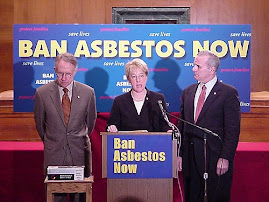
Building Trades unions urge federal Conservatives, Liberals to support New Democratic Party call for total ban on use and export of deadly asbestos from Canada, citing expected 1,500 BC workers' deaths over next 5 years
VANCOUVER, April 27 /CNW/ - BC's Building Trades unions are urging
Members of Parliament from the federal Conservative, Liberal and Bloc
Quebecois parties to support a New Democratic Party call for a total ban on
the use or export of deadly asbestos mined in Canada.
Mesothelioma and other asbestos exposure illnesses are expected to kill
1,500 BC workers over the next five years, according to medical experts, with
the overwhelming majority from the construction industry, says Wayne Peppard,
Executive Director of the BC and Yukon Territory Building and Construction
Trades Council (BCYT).
The new NDP policy calls on the federal government to adopt a
comprehensive policy on asbestos including the phasing out of its use and
export to other countries, as well as a transition strategy to assist asbestos
miners in Quebec, Peppard said.
"The current Conservative and past Liberal governments have failed to
stop the use and export of deadly asbestos for years and workers here are
already paying a heavy price for their inaction," Peppard said. "We are urging
both parties to join the NDP in supporting the end to the use and export of
asbestos and a fair transition program for the asbestos industry."
Recently released research findings from the UBC School of Environmental
Health indicate over 1,500 BC workers will die from asbestos-related diseases
over the next five years, Peppard said. Construction workers in the piping and
insulation fields are suffering the most fatalities, he said.
Peppard said the federal NDP position backs the Canadian Cancer Society,
the World Health Organization and the Institute National de Sante du Quebec,
which have all confirmed the carcinogenic toxins in asbestos and called for
comprehensive strategies to phase out the use and export of asbestos.
The NDP policy calls for economic development investments in Quebec
communities that have been negatively affected by the asbestos industry
crisis, Peppard said. The plan also calls for testing and the safe removal of
asbestos in residential, commercial, institutional and industrial buildings,
he added.
"Canada is among a very few countries left in the world that have not
ratified the inclusion of chrysotile asbestos in the United Nations Rotterdam
Convention," Peppard said. "We urge all of the federal parties to support a
total ban on use and export of asbestos before the next meeting by the UN on
the Rotterdam Convention in October."
Tuesday, April 15, 2008
New mineral policy comes under flak
DH News Service, New Delhi
Five days after the Centre released the National Mineral Policy, green activists are up in arms against the policys stand on use of asbestos.
Environmentalists alleged that the government is not only ignoring the toll asbestos takes on national health, but is also siding with the asbestos industry to promote their interest.
The green lobby has a point because of a controversial study being undertaken by researchers at the National Institute of Occupational Health (NIOH), Ahmedabad, that seeks to explore the health risks associated with asbestos industry.
But in a clear “conflict of interest” case, the industry is funding almost one-fourth of this study whose findings are crucial to determine if India can resists a proposed global regime for restrictive trade practices in this hazardous material.
The results are likely to be used in a global summit in October where India is expected to lobby hard for a free global trade in asbestos, sources told Deccan Herald.
Globally more than 40 nations have banned the use of white asbestos due to high health risks.
The research was prompted because of a proposal under the Rotterdam Convention to make asbestos trade more restrictive by categorising chrysotile as a hazardous material for which “prior informed consent (PIC)” was required for any trading.
While India, Canada and Ukraine along with a handful of countries are opposing this proposal, other countries are carrying out national studies to find out if the health risks associated with asbestos are manageable.
“Despite the pressure, the minister for mines Sis Ram Ola revealed in the new policy that India continues to use asbestos. The indifference towards occupational and public health is unpardonable,” says a member of Bas Asbestos Network of India.
Left-backed trade unions are also critical of the government for giving a free run to the industry. In a letter to top officials in the ministry of chemicals and fertiliser, the trade unions stated that NIOH study needs to be immediately scrapped as it will seal the fate of millions of workers handling asbestos.
April 15, 2008
Deccan Herald
Asbestos use goes on despite health hazards
New Delhi, April 14
Ignoring the dangerous effects they have on health, amphibole and chrysotile varieties of asbestos continue to be used in India.
Ban Asbestos Network of India (BANI) says the details of the National Mineral Policy announced on April 10 have revealed quite unambiguously that India continues to use both amphibole and chrysotile varieties of asbestos, ignoring the toll it takes on the national health.
Gopal Krishna of the BANI elaborates that exposure to asbestos causes stiffening of lung and has resulted in the deaths of many miners. “Lung cancer has a higher incidence in miners who also smoke, with the chance of developing cancer roughly proportional to the amount smoked. Asbestos-induced cancer is found only rarely in non-smokers. Among the various type of asbestos, chrysotile workers have the lowest incidence of cancer,” he says.
Krishna adds that the mineral policy has made two facts clear. One that ban on asbestos is not in force even though no formal announcement has been made to the effect that the ban has been lifted. Two, it is also clear that ban on amphibole, the most dangerous variety of asbestos, is not correct.
“World over, asbestos-based MNCs are all in bankruptcy proceedings and shifting to other businesses. But India’s mining policy shows how the Indian government has adopted a considered ostrich policy in face of indisputable evidence about the havoc from asbestos consumption. Unmindful of the ongoing global momentum to ban this mineral, asbestos cancer epidemic in India is a story of monumental failure to protect public health,” he adds.
Asbestos is one of the most pervasive environmental hazards in the world, present in more than 3,000 manufactured products. Five to seven per cent of all lung cancers can be attributed to occupational exposures to asbestos. All forms of asbestos, including amphibole and chrysotile varieties, cause variety of health disorders.
Asbestos exposure affects not only asbestos workers but also their families, users of asbestos products, and the public as it is exposed to building materials and asbestos in heating and ventilating systems, Krishna says, quoting a recent paper.
“It is noteworthy that Rajasthan produces asbestos despite repeated statements in Parliament stating that asbestos mining remains banned in India so far.”
The Tribune
Subscribe to:
Posts (Atom)