October 27, 2009
FOR IMMEDIATE RELEASE
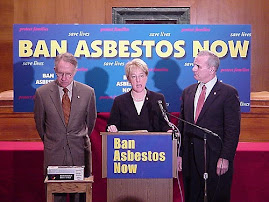
Protect Canadians from asbestos harm, PM Harper urged
“Asbestos is the number one cause of death due to occupational disease for Canadian workers,” says Larry Stoffman, Canadian Labour Congress, Lead, Workplace Hazardous Materials Current Issues Committee, “and it’s time for the Canadian government to stop ignoring this ongoing and preventable tragedy.”
Reports show that occupational cancers caused by exposure to asbestos account for 70% of all fatal occupational disease. In Quebec, the figure is 84%. Fatalities due to asbestos exposure are rising in all provinces.
“Asbestos goes on killing for decades,” says Dr Fernand Turcotte, Professor Emeritus of Public Health, Faculty of Medicine, Laval University. “It is urgent that the government take action on this critical public health hazard.”
Last spring, experts from UBC and Toronto confirmed that, in BC alone, there may be up to 500 excess cancer cases annually due to workers being exposed to asbestos.
Unions and environmental organizations have asked Prime Minister Harper to support the World Health Organization’s plan of action which calls on Canada to create a national audit and registry of where asbestos-containing materials are located and to remove those that represent a hazard. This would help protect construction workers and occupants of buildings where asbestos-containing materials are present.
“We have requested a meeting with PM Harper’s representatives on the urgent need for the government to take action to protect Canadians from this continuing tragedy of exposure to asbestos” said Wayne Peppard, Executive Director, BC & Yukon Building Trades Council.
Canada is the only country in the developed world continuing to support use of asbestos. PM Harper is the last national political leader supporting Canada’s asbestos trade. The last asbestos mine is located at Thetford Mines in Quebec.
“It’s time for the government to put the health of Canadians ahead of political games around asbestos,” said Kathleen Ruff of the Rideau Institute on International Affairs.
Tuesday, October 27, 2009

Tuesday, October 20, 2009
Asbestos case in Delhi High Court
On 21st October, 2009, Delhi High Court would hear the matter concerning the proposal for the Asbestos Cement Products (1,50,000 MTPA) and Fibre Reinforced Plastic Products (FRP 3,60,000 Metre, FRP Pipes and/other products) at Village Akbarpur Urd, Tehsil Laksar, District Haridwar, Uttranchal by M/s Aqua Infra Projects Ltd. Total land acquired for phase-I is 6.6110 ha. and 6 ha. land for phase II is yet to be acquired. Total project cost is Rs. 92.00 Crores. The palletized compact bags of asbestos fibres will be emptied in an enclosed automatic debagger. The shredded bags will be sent to fibre mill. The boiler will be coal fired and dust control devices will be installed. Bag filters will be provided to cement and ash silos and a dust collector will be attached to the fibre bag opening machine to arrest dust during loading and unloading. Total water requirement will be 140 m3/day. Tanks/ponds of adequate capacity will be developed for the collection and settlement of liquid effluent. Supernatant liquid will be recycled for making fresh slurry. ?Zero? discharge will be adopted. Domestic wastewater after treatment in septic tank will be used for green belt development. Solid waste will be ground/pulverized and recycled in the process as raw material. The Public Hearing / Consultation was held on 10th June 2008.
The Ministry of Environment and Forests hereby accords environmental clearance to the above unit under the EIA Notification dated 14th September, 2006 subject to the compliance of the terms and conditions
Project No: J-11011/1150/2007.-IA.II(I)
Project Name: Asbestos Cement Sheet Product
District:Hardwar
Village:Akbarpur Urd
Company:M/s Aqua Infra Projects Ltd
Project received on 19/06/2008 and approved on 09/04/2009 by Experts Appraisal Committee for environmental clearnce (EC)on industrial projects
Projects Granted EC (Projects received upto 30th April 2009)
Earlier, the project of a company named M/s Everest Industries Ltd.received on 05/09/2006 and approved on 22/02/2007 by Experts Appraisal Committee for environmental clearnce (EC)on industrial projects. Project No: J-11011/310/2006-IA.II(I), Project Name: Asbestos Cement Sheet Project District:Haridwar, Village:at Lakesari, Roorkee.
Notably, as of August 27, 2009, according to IBAS in the following countries there are National Asbestos Bans:1
Argentina
Australia
Austria
Belgium
Bulgaria
Chile
Croatia2
Cyprus*
Czech Republic*
Denmark
Egypt
Estonia*
Finland
France
Gabon
Germany
Greece*
Honduras
Hungary*
Iceland
Ireland
Italy
Japan [Major restrictions on asbestos use were introduced in October, 2004;
Japanese asbestos consumption has fallen by more than 90%.]3
Jordan4
South Korea
Kuwait
Latvia
Lithuania*
Luxembourg
Malta*
Netherlands
New Caledonia
Norway
Oman
Poland
Portugal*
Romania
Saudi Arabia
Seychelles
Slovakia*
Slovenia
South Africa
Spain
Sweden
Switzerland
United Kingdom (including England, Scotland, Wales and Northern Ireland)
Uruguay
_______
1 Exemptions for minor uses are permitted in some countries.
2Croatia banned asbestos as of January 1, 2006. Six weeks later, the Ministry of Economy, under political and commercial pressure, forced the Ministry of Health to reverse its position with the result that the manufacture of asbestos-containing products for export was permitted again.
3In July, 2005, the Japanese Government announced implementation of a total asbestos ban within 3 years.
4An immediate ban on amosite and crocidolite was imposed on August 16, 2005; a grace period of one year was allowed for the phasing out of the use of tremolite, chrysotile, anthophyllite and actinolite in friction products, brake linings and clutch pads. After August 16, 2006, all forms of asbestos will be banned for all uses.
* January 1, 2005 was the deadline for prohibiting the new use of chrysotile, other forms of asbestos having been banned previously, in all 25 Member States of the European Union; compliance with this directive has not been verified in countries with an asterisk (*). As of May 2009 there are 27 Member States, with Romania and Bulgaria joining the EU in 2007.
The Ministry of Environment and Forests hereby accords environmental clearance to the above unit under the EIA Notification dated 14th September, 2006 subject to the compliance of the terms and conditions
Project No: J-11011/1150/2007.-IA.II(I)
Project Name: Asbestos Cement Sheet Product
District:Hardwar
Village:Akbarpur Urd
Company:M/s Aqua Infra Projects Ltd
Project received on 19/06/2008 and approved on 09/04/2009 by Experts Appraisal Committee for environmental clearnce (EC)on industrial projects
Projects Granted EC (Projects received upto 30th April 2009)
Earlier, the project of a company named M/s Everest Industries Ltd.received on 05/09/2006 and approved on 22/02/2007 by Experts Appraisal Committee for environmental clearnce (EC)on industrial projects. Project No: J-11011/310/2006-IA.II(I), Project Name: Asbestos Cement Sheet Project District:Haridwar, Village:at Lakesari, Roorkee.
Notably, as of August 27, 2009, according to IBAS in the following countries there are National Asbestos Bans:1
Argentina
Australia
Austria
Belgium
Bulgaria
Chile
Croatia2
Cyprus*
Czech Republic*
Denmark
Egypt
Estonia*
Finland
France
Gabon
Germany
Greece*
Honduras
Hungary*
Iceland
Ireland
Italy
Japan [Major restrictions on asbestos use were introduced in October, 2004;
Japanese asbestos consumption has fallen by more than 90%.]3
Jordan4
South Korea
Kuwait
Latvia
Lithuania*
Luxembourg
Malta*
Netherlands
New Caledonia
Norway
Oman
Poland
Portugal*
Romania
Saudi Arabia
Seychelles
Slovakia*
Slovenia
South Africa
Spain
Sweden
Switzerland
United Kingdom (including England, Scotland, Wales and Northern Ireland)
Uruguay
_______
1 Exemptions for minor uses are permitted in some countries.
2Croatia banned asbestos as of January 1, 2006. Six weeks later, the Ministry of Economy, under political and commercial pressure, forced the Ministry of Health to reverse its position with the result that the manufacture of asbestos-containing products for export was permitted again.
3In July, 2005, the Japanese Government announced implementation of a total asbestos ban within 3 years.
4An immediate ban on amosite and crocidolite was imposed on August 16, 2005; a grace period of one year was allowed for the phasing out of the use of tremolite, chrysotile, anthophyllite and actinolite in friction products, brake linings and clutch pads. After August 16, 2006, all forms of asbestos will be banned for all uses.
* January 1, 2005 was the deadline for prohibiting the new use of chrysotile, other forms of asbestos having been banned previously, in all 25 Member States of the European Union; compliance with this directive has not been verified in countries with an asterisk (*). As of May 2009 there are 27 Member States, with Romania and Bulgaria joining the EU in 2007.
Thursday, October 15, 2009
Asbestos Cement Pipes, a Health Hazard?

Rajen Gohain, a Lok Sabha MP of Nawgong, Assam from Bhartiya Janta Party raised the issue of Use of Asbestos Cemented Pipes in Drinking Water Projects in the Lok Sabha saying, "Will the Minister of Health and Family Welfare be pleased to state: (a) whether the Asbestos Cemented (AC) pipes used for Drinking water projects is a health hazard; (b) if so, the details thereof and the reasons therefor; and (c) the corrective action taken by the Government in this regard? Mr Gohain raised the matter on July 15, 2009.
Banning Asbestos Trade
Banning asbestos exports: The value of tilting at windmills
It's easy to get demoralized these days with so much going wrong around the world. So it is incredibly encouraging to see a campaign for justice and workers' health and safety prevail against supposedly insurmountable odds.
That is how the "odds" would have been described a year and a half ago for anyone musing about taking on the asbestos industry in Quebec. It would be difficult to come up with an example of a more entrenched and powerful adversary. A year ago, the remnants of a once enormous asbestos mining industry had literally every powerful political and economic player in its corner: all the federal political parties, including the NDP and the Liberals; all of the provincial political parties in Quebec; all the business and corporate players provincial and federal; the entire Quebec union movement and the Canadian Labour Congress; and by their meek silence (with a couple of exceptions) the medical and academic scientists whose voices could have made an enormous difference.
A year later and the asbestos industry and its lethal product are literally on their last legs, assailed from (almost) all sides. One after the other the supporters of this dying/killing industry have changed sides, bowing finally to a relentless campaign backed up by indisputable science declaring asbestos -- all asbestos -- kills and maims. The latest news is out of Quebec, where the final battles are, of necessity, taking place.
It is instructive to all those who assess the prospects of certain struggles as impossible to win, to read that the Quebec Liberal government -- a centre-right, pro-business party -- is now considering abandoning the industry that just weeks ago it was pledging to give its undying support. A story in Monday's La Presse reported that: ".a high-level meeting took place last week between the three government stake-holders most affected by the issue: the Minister of Health, Yves Bolduc, the Minister delegated to Natural Resources, Serge Simard, as well as the president of the National Public Health Institute of Quebec (INSPQ), Luc Boileau."
Those at the meeting are declining comment about media speculation [1] that the government of Jean Charest is examining "the possibility of revising its position on asbestos between now and the end of the year." Such an examination was deemed inconceivable even four months ago. But the revelation the government is even thinking about changing position means it will be extremely difficult to put the genie back in the bottle. Its best strategy for maintaining the status quo would have been to say nothing at all. In the asbestos fight, once you talk about it, your fate is decided. Charest's office is denying that they are considering changing policy, but it is an enormous crack in the asbestos edifice that the meeting took place, no matter how they try to explain it away.
A victory for science and morality
Just ask Michael Ignatieff -- who came full circle last spring and summer, making the banning of asbestos Liberal Party policy. Ignatieff entered the debate off-guard -- drawn into it by an activist at a Victoria public meeting. His response was an unguarded, moral one: "Our export of this dangerous product overseas has got to stop." He tried to wriggle out of it -- after being pounded by his own party heavy weights and the Quebec media. But it was too late: the morality of the exports was the issue.
Ignatieff initially claimed the science wasn't clear. But that route was suddenly blocked by the coincidental release of two reports -- one by Health Canada (suppressed for a year) and another devastating study by the International Agency for Research on Cancer, the world's most respected cancer organization. Both confirmed chrysotile asbestos a deadly Class 1 carcinogen. To his credit, Ignatieff stuck to his original gut response: exporting this stuff was immoral.
The NDP had earlier been obliged to abandon its position -- just as it was making in-roads in Quebec -- faced with determined lobbying and the sheer weight of the moral argument. Ken Georgetti, president of the Canadian Labour Congress, too, took the risky step of alienating the CLC's Quebec wing by calling for a ban [2] after an emotional appeal on behalf of sick and dying workers by one of India's largest unions.
The role of science in this struggle is as gratifying as that of the moral imperative's victory over economics. Science has taken a severe beating in Canada and the US over the past fifteen years with governments all but abandoning the precautionary principle for the market's "risk assessment" approach. Whether it's tainted meat or climate change, the right's fierce attack on science has had the effect, amongst others, of intimidating many scientists whose role it is to protect society.
But the junk science produced by the asbestos lobby -- in particular the Chrysotile Institute (headed up by the former President of the Quebec Federation of Labour) -- has ironically put some steel in the spine of those assigned with the task of informing the public about health issues. Indeed, it's as if the dam had broken in Quebec and all the data and many of the scientists involved, suddenly flooded into the public realm.
Fifteen doctors, toxicologists, occupational hygienists and epidemiologists, several of them professors at the universities of Montreal, Laval and Sherbrooke, issued an extraordinarily powerful public statement calling for and end to Quebec's asbestos exports. The La Presse headline could not have been more clear: "It's time to stop the asbestos lies." This from a group not prone to dramatic statements -- and published by a paper [3] that for years was complicit in the silence.
Dr. Pierre Gosselin of Laval University's medical faculty said that Canada's conduct resembles "criminal negligence." The health experts declared that Canada's efforts to stop chrysotile asbestos being added to an international list of hazardous substances was an "indefensible infamy."
The shameful holdouts
The Chrysotile Institute's core argument has been that asbestos is not harmful if "used safely." But perhaps it was the lie about safe use in Quebec itself that has finally moved the media and the Quebec political elite, to reluctantly reconsider. Quebec's National Public Health Institute has issued a total of eleven reports proving that the claim of "safe controlled use" of asbestos in Quebec is a myth. The lethal cancers directly related to asbestos are increasing in Quebec by 4 per cent a year. And the province's definition of "safe levels" of exposure is ten times more lenient than most of Europe and the US and a 100 times more than the Netherlands, Germany and Switzerland.
There are still powerful holdouts on the asbestos front -- the most aggressive among them, Prime Minister Stephen Harper. "The Conservative Party is the only political party that can be trusted to defend the asbestos industry," stated Harper [4], claiming that the Liberals were being "duped and manipulated by extremist groups." That would be, I suppose, the Canadian Medical Association, the Canadian Cancer Society and the International Labour organization. Another holdout is Gilles Duceppe and the Bloc Quebecois. Most shameful of all is the entire Quebec labour movement, led (or bullied) by the Quebec Federation of Labour, which continues its complicity in the destruction of the lives of potentially thousands of Third World workers so it can maintain "solidarity" with the few hundred miners still working (at much reduced wages) in the sole remaining mine.
But even these final dominoes will fall, sooner or later. The relentless campaign against death and disease, rooted in a moral imperative and public science, and spearheaded by Kathleen Ruff, human rights advisor with the Rideau Institute (disclosure: I am also an advisor with the Rideau) has converted powerful individuals, political organizations and a major Quebec media outlet -- players no one dreamed would change their views.
We'll see who finds their moral compass next.
Murray Dobbin's State of the Nation column appears every two weeks in TheTyee and rabble.ca.
By derrick
October 8, 2009
Published on rabble.ca (http://rabble.ca)
It's easy to get demoralized these days with so much going wrong around the world. So it is incredibly encouraging to see a campaign for justice and workers' health and safety prevail against supposedly insurmountable odds.
That is how the "odds" would have been described a year and a half ago for anyone musing about taking on the asbestos industry in Quebec. It would be difficult to come up with an example of a more entrenched and powerful adversary. A year ago, the remnants of a once enormous asbestos mining industry had literally every powerful political and economic player in its corner: all the federal political parties, including the NDP and the Liberals; all of the provincial political parties in Quebec; all the business and corporate players provincial and federal; the entire Quebec union movement and the Canadian Labour Congress; and by their meek silence (with a couple of exceptions) the medical and academic scientists whose voices could have made an enormous difference.
A year later and the asbestos industry and its lethal product are literally on their last legs, assailed from (almost) all sides. One after the other the supporters of this dying/killing industry have changed sides, bowing finally to a relentless campaign backed up by indisputable science declaring asbestos -- all asbestos -- kills and maims. The latest news is out of Quebec, where the final battles are, of necessity, taking place.
It is instructive to all those who assess the prospects of certain struggles as impossible to win, to read that the Quebec Liberal government -- a centre-right, pro-business party -- is now considering abandoning the industry that just weeks ago it was pledging to give its undying support. A story in Monday's La Presse reported that: ".a high-level meeting took place last week between the three government stake-holders most affected by the issue: the Minister of Health, Yves Bolduc, the Minister delegated to Natural Resources, Serge Simard, as well as the president of the National Public Health Institute of Quebec (INSPQ), Luc Boileau."
Those at the meeting are declining comment about media speculation [1] that the government of Jean Charest is examining "the possibility of revising its position on asbestos between now and the end of the year." Such an examination was deemed inconceivable even four months ago. But the revelation the government is even thinking about changing position means it will be extremely difficult to put the genie back in the bottle. Its best strategy for maintaining the status quo would have been to say nothing at all. In the asbestos fight, once you talk about it, your fate is decided. Charest's office is denying that they are considering changing policy, but it is an enormous crack in the asbestos edifice that the meeting took place, no matter how they try to explain it away.
A victory for science and morality
Just ask Michael Ignatieff -- who came full circle last spring and summer, making the banning of asbestos Liberal Party policy. Ignatieff entered the debate off-guard -- drawn into it by an activist at a Victoria public meeting. His response was an unguarded, moral one: "Our export of this dangerous product overseas has got to stop." He tried to wriggle out of it -- after being pounded by his own party heavy weights and the Quebec media. But it was too late: the morality of the exports was the issue.
Ignatieff initially claimed the science wasn't clear. But that route was suddenly blocked by the coincidental release of two reports -- one by Health Canada (suppressed for a year) and another devastating study by the International Agency for Research on Cancer, the world's most respected cancer organization. Both confirmed chrysotile asbestos a deadly Class 1 carcinogen. To his credit, Ignatieff stuck to his original gut response: exporting this stuff was immoral.
The NDP had earlier been obliged to abandon its position -- just as it was making in-roads in Quebec -- faced with determined lobbying and the sheer weight of the moral argument. Ken Georgetti, president of the Canadian Labour Congress, too, took the risky step of alienating the CLC's Quebec wing by calling for a ban [2] after an emotional appeal on behalf of sick and dying workers by one of India's largest unions.
The role of science in this struggle is as gratifying as that of the moral imperative's victory over economics. Science has taken a severe beating in Canada and the US over the past fifteen years with governments all but abandoning the precautionary principle for the market's "risk assessment" approach. Whether it's tainted meat or climate change, the right's fierce attack on science has had the effect, amongst others, of intimidating many scientists whose role it is to protect society.
But the junk science produced by the asbestos lobby -- in particular the Chrysotile Institute (headed up by the former President of the Quebec Federation of Labour) -- has ironically put some steel in the spine of those assigned with the task of informing the public about health issues. Indeed, it's as if the dam had broken in Quebec and all the data and many of the scientists involved, suddenly flooded into the public realm.
Fifteen doctors, toxicologists, occupational hygienists and epidemiologists, several of them professors at the universities of Montreal, Laval and Sherbrooke, issued an extraordinarily powerful public statement calling for and end to Quebec's asbestos exports. The La Presse headline could not have been more clear: "It's time to stop the asbestos lies." This from a group not prone to dramatic statements -- and published by a paper [3] that for years was complicit in the silence.
Dr. Pierre Gosselin of Laval University's medical faculty said that Canada's conduct resembles "criminal negligence." The health experts declared that Canada's efforts to stop chrysotile asbestos being added to an international list of hazardous substances was an "indefensible infamy."
The shameful holdouts
The Chrysotile Institute's core argument has been that asbestos is not harmful if "used safely." But perhaps it was the lie about safe use in Quebec itself that has finally moved the media and the Quebec political elite, to reluctantly reconsider. Quebec's National Public Health Institute has issued a total of eleven reports proving that the claim of "safe controlled use" of asbestos in Quebec is a myth. The lethal cancers directly related to asbestos are increasing in Quebec by 4 per cent a year. And the province's definition of "safe levels" of exposure is ten times more lenient than most of Europe and the US and a 100 times more than the Netherlands, Germany and Switzerland.
There are still powerful holdouts on the asbestos front -- the most aggressive among them, Prime Minister Stephen Harper. "The Conservative Party is the only political party that can be trusted to defend the asbestos industry," stated Harper [4], claiming that the Liberals were being "duped and manipulated by extremist groups." That would be, I suppose, the Canadian Medical Association, the Canadian Cancer Society and the International Labour organization. Another holdout is Gilles Duceppe and the Bloc Quebecois. Most shameful of all is the entire Quebec labour movement, led (or bullied) by the Quebec Federation of Labour, which continues its complicity in the destruction of the lives of potentially thousands of Third World workers so it can maintain "solidarity" with the few hundred miners still working (at much reduced wages) in the sole remaining mine.
But even these final dominoes will fall, sooner or later. The relentless campaign against death and disease, rooted in a moral imperative and public science, and spearheaded by Kathleen Ruff, human rights advisor with the Rideau Institute (disclosure: I am also an advisor with the Rideau) has converted powerful individuals, political organizations and a major Quebec media outlet -- players no one dreamed would change their views.
We'll see who finds their moral compass next.
Murray Dobbin's State of the Nation column appears every two weeks in TheTyee and rabble.ca.
By derrick
October 8, 2009
Published on rabble.ca (http://rabble.ca)
Thursday, September 24, 2009
Govt urged to take lesson from S Africa and ban asbestos
Pointing out that South Africa has joined some 50 countries in banning the use of asbestos, the Ban Asbestos Network of India (BANI) has urged the government to follow suit.
The African country was the fifth largest supplier of chrysotile asbestos.
The NGO said it was sad that India was one of the largest consumers of chrysotile asbestos. A february 2008 Confederation of Indian Industry (CII) survey that tracks and records the performance of the manufacturing sector, rated asbestos cement in the high growth category among others.
"What is not being recorded is the high growth rate of asbestos victims in the country. This is being done in a studied manner as a classic case of Ostrich policy under the influence of Russia and Canadia amid reports of 10, 000 asbestos deaths per year in US and asbestos related disease epidemic in Europe," BANI said here.
The role of South African government in safeguarding the health of its citizens was commendable, but in contrast, India was quite noteworthy, it added.
The regulations to ban use of asbestos in that country were put into effect from yesterday. They form part of the South African Environment Conservation Act 1989.
BANI pointed out that in its 95th Session of the International Labour Conference on 14th June 2006, International Labour Organtisation adopted a resolution for the elimination of all forms of asbestos from future use as it was the only way forward for protecting workers.
The resolution said,all forms of asbestos, including chrysotile, are classified as known ‘carcinogens’ by the International Agency for Research on Cancer, a classification restated by the International Programme on Chemical Safety (a joint Programme of the International Labour Organization, the World Health Organization and the United Nations Environment Programme)".
BANI said out of several million workers exposed to asbestos in India, less than 30 had been compensated so far. The reasons for such a small number were: refusal by management sponsored studies to grant medical certifications to workers suffering from occupational diseases, lack of training for doctors in diagnosis of occupational lung diseases, deliberate misdiagnosis by doctors of asbestosis as either chronic bronchitis or tuberculosis.
The NGO appealed to the Government to take lessons from the countries like South Africa and said it was high time for prohibition of asbestos consumption and a announced that national register of asbestos products and its victims would be maintained by them.(UNI)
http://www.dailyexcelsior.com/
The African country was the fifth largest supplier of chrysotile asbestos.
The NGO said it was sad that India was one of the largest consumers of chrysotile asbestos. A february 2008 Confederation of Indian Industry (CII) survey that tracks and records the performance of the manufacturing sector, rated asbestos cement in the high growth category among others.
"What is not being recorded is the high growth rate of asbestos victims in the country. This is being done in a studied manner as a classic case of Ostrich policy under the influence of Russia and Canadia amid reports of 10, 000 asbestos deaths per year in US and asbestos related disease epidemic in Europe," BANI said here.
The role of South African government in safeguarding the health of its citizens was commendable, but in contrast, India was quite noteworthy, it added.
The regulations to ban use of asbestos in that country were put into effect from yesterday. They form part of the South African Environment Conservation Act 1989.
BANI pointed out that in its 95th Session of the International Labour Conference on 14th June 2006, International Labour Organtisation adopted a resolution for the elimination of all forms of asbestos from future use as it was the only way forward for protecting workers.
The resolution said,all forms of asbestos, including chrysotile, are classified as known ‘carcinogens’ by the International Agency for Research on Cancer, a classification restated by the International Programme on Chemical Safety (a joint Programme of the International Labour Organization, the World Health Organization and the United Nations Environment Programme)".
BANI said out of several million workers exposed to asbestos in India, less than 30 had been compensated so far. The reasons for such a small number were: refusal by management sponsored studies to grant medical certifications to workers suffering from occupational diseases, lack of training for doctors in diagnosis of occupational lung diseases, deliberate misdiagnosis by doctors of asbestosis as either chronic bronchitis or tuberculosis.
The NGO appealed to the Government to take lessons from the countries like South Africa and said it was high time for prohibition of asbestos consumption and a announced that national register of asbestos products and its victims would be maintained by them.(UNI)
http://www.dailyexcelsior.com/
Wednesday, September 23, 2009
Asarco, Sterlite & Asbestos Claims
Asarco, U.S. copper miner Asarco LLC sought bankruptcy protection in 2005 amid a strike and more than $1 billion in environmental damage and asbestos claims.
Grupo Mexico, the largest copper miner in Mexico, acquired Asarco in a buyout in 1999 but lacks board control because of the bankruptcy. Judge Richard Schmidt of the U.S Bankruptcy Court in Corpus Christi, Texas, had said Grupo Mexico's $2.48 billion plan was better than Sterlite's plan, as it would offer more recovery to creditors. Sterlite has contested that decision and earlier this month Sterlite raised its offer for Asarco to $2.57 billion.
Sterlite Industries, a Anil Agarwal-controlled company has raised its bid for acquiring Asarco, the third-largest copper company in the US, for the third time in two months. The Agarwal controlled company said that the revised bid would now include an all-cash offer of $2.56 billion (about Rs 12,300 crore at current exchange rates), compared with its earlier bid of $2.13 billion that was rejected by the Texas Bankruptcy Court, which had recommended rival Grupo Mexico’s offer instead.
After extensive discussions and review, in order to provide full cash payment to asbestos creditors and to allow late file claims and to provide for surplus cash... for the smooth operations of Asarco, Sterlite increased its offer,” Sterlite said in a statement to BSE.
The cases are In re: Asarco LLC, U.S. Bankruptcy Court, Southern District of Texas, No. 05-21207 and In re: Asarco LLC, U.S. District Court, Southern District of Texas, No. 09-00177.
On 21st September, Sterlite Industries Ltd said that it would release Grupo Mexico SAB de CV from a potential legal liability of nearly $8 billion if the Indian miner can win control of bankrupt U.S. copper miner Asarco LLC.
In a court document filed it said that if a federal court approves its plan to acquire Asarco over rival bidder Grupo Mexico's offer, it would not hold Grupo Mexico liable for more than about $900 million of liability related to the 2003 transfer of a Peruvian mine.
Grupo Mexico has been desperate to regain control of Asarco after a federal district judge found in April that Grupo Mexico had made a "fraudulent transfer" of Asarco's "crown jewel" stake in Peruvian miner Southern Copper Corp in 2003 and ordered Grupo Mexico to return the stake along with a cash payment.
Grupo Mexico is appealing the decision, but until now a central issue in the case has been that the judgment would disappear if Grupo Mexico wins, but would stand if Sterlite were to take over Asarco.
Sterlite said in court papers that it was willing to stipulate that the "net present value" of the judgment was $9.13 billion, and based on that value, it would agree to release Grupo Mexico from most of the obligation.
Sterlite said in the court papers that Grupo Mexico could still appeal the decision and may end up paying nothing to Asarco.
In August, 2009 a federal bankruptcy judge made a nonbinding recommendation that Mexican miner Grupo Mexico be allowed to take control of U.S. copper miner Asarco LLC as it emerges from bankruptcy.
Grupo Mexico, the largest copper miner in Mexico, acquired Asarco in a buyout in 1999 but lacks board control because of the bankruptcy. Judge Richard Schmidt of the U.S Bankruptcy Court in Corpus Christi, Texas, had said Grupo Mexico's $2.48 billion plan was better than Sterlite's plan, as it would offer more recovery to creditors. Sterlite has contested that decision and earlier this month Sterlite raised its offer for Asarco to $2.57 billion.
Sterlite Industries, a Anil Agarwal-controlled company has raised its bid for acquiring Asarco, the third-largest copper company in the US, for the third time in two months. The Agarwal controlled company said that the revised bid would now include an all-cash offer of $2.56 billion (about Rs 12,300 crore at current exchange rates), compared with its earlier bid of $2.13 billion that was rejected by the Texas Bankruptcy Court, which had recommended rival Grupo Mexico’s offer instead.
After extensive discussions and review, in order to provide full cash payment to asbestos creditors and to allow late file claims and to provide for surplus cash... for the smooth operations of Asarco, Sterlite increased its offer,” Sterlite said in a statement to BSE.
The cases are In re: Asarco LLC, U.S. Bankruptcy Court, Southern District of Texas, No. 05-21207 and In re: Asarco LLC, U.S. District Court, Southern District of Texas, No. 09-00177.
On 21st September, Sterlite Industries Ltd said that it would release Grupo Mexico SAB de CV from a potential legal liability of nearly $8 billion if the Indian miner can win control of bankrupt U.S. copper miner Asarco LLC.
In a court document filed it said that if a federal court approves its plan to acquire Asarco over rival bidder Grupo Mexico's offer, it would not hold Grupo Mexico liable for more than about $900 million of liability related to the 2003 transfer of a Peruvian mine.
Grupo Mexico has been desperate to regain control of Asarco after a federal district judge found in April that Grupo Mexico had made a "fraudulent transfer" of Asarco's "crown jewel" stake in Peruvian miner Southern Copper Corp in 2003 and ordered Grupo Mexico to return the stake along with a cash payment.
Grupo Mexico is appealing the decision, but until now a central issue in the case has been that the judgment would disappear if Grupo Mexico wins, but would stand if Sterlite were to take over Asarco.
Sterlite said in court papers that it was willing to stipulate that the "net present value" of the judgment was $9.13 billion, and based on that value, it would agree to release Grupo Mexico from most of the obligation.
Sterlite said in the court papers that Grupo Mexico could still appeal the decision and may end up paying nothing to Asarco.
In August, 2009 a federal bankruptcy judge made a nonbinding recommendation that Mexican miner Grupo Mexico be allowed to take control of U.S. copper miner Asarco LLC as it emerges from bankruptcy.
Canadian MP remains mum on asbestos issue
SARNIA -- The refusal by Sarnia-Lambton's MP to clarify her position on Canada's controversial asbestos exports is appalling, a prominent Liberal says.
"I'm appalled by (Pat Davidson) not taking a stand, especially considering the many families in this riding who have been devastated by asbestos and its effects," said Tim Fugard, who is seeking the federal Liberal party nomination in Sarnia-Lambton.
Fugard was responding to Davidson's repeated dodging of questions from media asking her to clarify her stance on asbestos exports.
"I don't have anything else to say on it," she said yesterday.
Asbestos, a known carcinogen, is no longer used in Canada but the federal government allows it to be sold in developing countries.
According to Statistics Canada, more than $100 million worth of asbestos was exported last year, much of it to India, Indonesia, Sri Lanka and Brazil.
The Conservatives currently hold the Quebec seat that is home to the last asbestos mine in Canada, and critics say Ottawa is afraid to reverse a policy that might anger Quebec voters.
"It shouldn't be a dollar issue," said Fugard. "(Davidson) should be standing up for Sarnia-Lambton and for all Canadians."
By TARA HAGAN, SUN MEDIA
The London Free Press
Sep 3, 2009
"I'm appalled by (Pat Davidson) not taking a stand, especially considering the many families in this riding who have been devastated by asbestos and its effects," said Tim Fugard, who is seeking the federal Liberal party nomination in Sarnia-Lambton.
Fugard was responding to Davidson's repeated dodging of questions from media asking her to clarify her stance on asbestos exports.
"I don't have anything else to say on it," she said yesterday.
Asbestos, a known carcinogen, is no longer used in Canada but the federal government allows it to be sold in developing countries.
According to Statistics Canada, more than $100 million worth of asbestos was exported last year, much of it to India, Indonesia, Sri Lanka and Brazil.
The Conservatives currently hold the Quebec seat that is home to the last asbestos mine in Canada, and critics say Ottawa is afraid to reverse a policy that might anger Quebec voters.
"It shouldn't be a dollar issue," said Fugard. "(Davidson) should be standing up for Sarnia-Lambton and for all Canadians."
By TARA HAGAN, SUN MEDIA
The London Free Press
Sep 3, 2009
Subscribe to:
Posts (Atom)