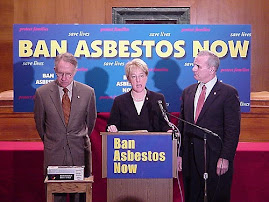
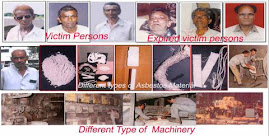
Most of the world, including the medical community, agrees that asbestos is desperately dangerous. The World Health Organization reports that more than 100,000 people die every year from lung cancer and other respiratory diseases due to asbestos exposure. And many more will die, because 125 million people are exposed to asbestos in their workplaces today and every day.
No surprise, then, that the stuff is effectively banned in Canada. And a surprise, to observers, that Canada exports it to other countries, most notoriously India, where public-health regimes are less vigorous than in Canada.
But that fact is no more mysterious than two forces that are as well known in India as they are in Canada. One is the power of supply and demand. The other is the vacuum of political indifference.
*********************************************************
The industry has seen better days. There are just two mines remaining in Quebec’s asbestos belt. The Jeffrey Mine in Asbestos is in semi-operational stasis while it awaits refinancing. According to some reports, the LAB Chrysotile mine in Thetford Mines will, by the time you read this, have stopped churning out the piles of tailings that define the town’s appearance. (“Chrysotile” is the recent rebranding of the white asbestos that the region produces.)
By any measure, it is weird geography. The huge open-pit mines were once the largest pits in the Western hemisphere. The massive rounded hills of tailings seem to have been dropped onto the landscape from above. Except for the trucks spiralling ever downward in the pits, you might figure you’re on the moon.
Over the years, the overburden of rock waste has acquired a rough patina of vegetation. But on the tailings, which is the fine gravel left after the rock has been crushed and the asbestos extracted, there is little sign of life. Some of the piles date from the first mines, more than a century ago.
Luc Berthold, the cheerful mayor of Thetford Mines, seems oblivious to the moonscape. In response to a recent report on local health risks posed by asbestos, the mayor said that no, the municipality would not fence off the tailings to stop young people from using them as an ATV playground. The mayor did concede, however, that the town would cease using the mine residue as a substitute for salt and sand on winter roads.
Defensive about his town’s reputation, Berthold told a Montreal reporter that the effect of asbestos dust on health pales compared to that of smog in Montreal. In the anteroom to Berthold’s office, piles of glossy flyers promote asbestos’s “safe and irreplaceable fibres,” with charts proving that tobacco and highway accidents are thousands of times more dangerous than asbestos in schools.
It’s hard to blame the place for this attitude. After all, it wouldn’t exist without the strange fibre that a farmer named Joseph Fecteau stumbled upon in 1876. He’d hit a rich vein of asbestos, long known in Europe as a miraculous substance that could not be burned or damaged by fire. Within a few years, the Thetford area was the asbestos capital of the world, and Quebeckers called the fibres white gold.
Asbestos was soon everywhere, in houses, in factories, in cars, in thousands upon thousands of industrial and household products—all kinds of insulation as well as everything from brake pads to paint, cement, siding, shingles, pipes, ceiling and floor tiles, clutch facings, even crayons.
For people in Thetford Mines, asbestos dust has been around forever and it’s hard to get excited about a disease that can take up to 40 years to have an effect. For those who live here, asbestos is just a fact of life.
Typical is Sylvain Gagné, who simply shrugs at the mention of asbestosis or cancer or mesothelioma. He is sitting on his veranda, facing a hillside of tailings across the street, contentedly eating a plateful of mashed potatoes. If there is any illness in Thetford Mines, it’s because of people drinking too much, he says, particularly young people who can’t get jobs.
Gagné hasn’t worked at the mine, but his father and grandfather, who is 87, both did, without apparent ill effect.
Gagné’s neighbour across the street, Sylvain Menard, has worked all over the country, much of the time on roofing jobs that called for handling asbestos shingles. Is he concerned? Not remotely. He moved to Thetford Mines only a few months ago and discovered, to his delight, that housing prices are low and the pace of life easy. He says that he could not care less about asbestos; rather, he should be more worried about cigarettes. With that, he lights another smoke with a defiant smile.
Menard’s arrival may be a sign of things to come. For a long time, there was a constant dark cloud over Thetford Mines. Like all one-industry towns, it’s vulnerable to fluctuations in resource markets. But the curse of asbestosis and other lung diseases made things worse. It was not surprising that people, especially youngsters, drifted away in search of work.
One person who stayed, Ritchie Harnish, has done every job there was to do in his more than 40 years in the mine, from bagging asbestos to the delicate task of grading the stuff by the length of the fibres. He worked in the open pit in the baking summer, underground in the bitter winter. For a time he was president of the United Steelworkers local.
Now 60, Harnish is a bridge between the old ways and the new. He remembers his grandfather coming back from the mine, sending off huge clouds of asbestos dust as he patted his jacket and pants. But nowadays they’re filtering the air six times an hour at the mine. The place is spotless.
Harnish, who retired a few months ago, is happy to see changes that might signal the survival of the town where he’s spent his entire life. In the schools, they are asking the kids what would persuade them to stay in Thetford Mines. And on the streets of town, he is meeting old friends he has not seen for 40 or 50 years: “They’re coming back. It’s really not a bad place to live!”
It may be that Harnish is on the sunny side of a generational divide when it comes to safety standards at the mine. Over in Asbestos, Donald Nicholls, who is 80, went to work at the Jeffrey Mine a few weeks after he finished high school in the summer of 1950, not long after the Asbestos Strike came to its bitter end. The momentous events weren’t particularly relevant to him. If you grew up in Asbestos, there really wasn’t anywhere else to work. It was a steady job for 2,500 people.
Nicholls will tell you he’s had a pretty good life. At least up to this point, he says, and a rueful smile flickers across his gaunt face. He and two friends who graduated from high school at the same time all went to work in the mill. One died of a heart attack, and one died from asbestosis, which leaves just Nicholls, and he too is suffering from asbestosis.
He moves slowly and breathes with difficulty because his lungs are scarred with asbestos fibre. There is no cure for asbestosis, so at the age of 80 the prognosis seems clear enough. Mine and mill operations may be much cleaner these days, but for more than a century asbestos dust in the air was as omnipresent as the air itself. If you left your shoes on the floor near an open window, they’d be outlined in dust when you picked them up in the morning.
There was nothing about asbestos that was seen as threatening for children. In fact, teachers and parents gave the kids asbestos to play with, as if it were Plasticine. Donald Nicholls smiles: “We used to make models all the time.” And outside, asbestos fibres were a handy ingredient if you wanted to throw a snowball at a scab during a strike.
*********************************************************
While Nicholls was at the mine, across the country young Chuck Strahl was working as a logger in the forests of British Columbia, running a machine known as a yarder. He had to sit two feet from masses of asbestos dust, breathing it in and out, nine or 10 hours a day.
Many years later, in 2005, Strahl was diagnosed with mesothelioma. This meant that the successful career he’d made for himself in federal politics would not go as far as it might have. And it meant that he was at loggerheads with his boss, Stephen Harper, on the issue of asbestos.
The problem was not the use of asbestos in Canada, which has practically been outlawed. Indeed, Harper’s government is paying millions of dollars to remove asbestos from the Parliament Buildings. Rather, the problem is what Canadian asbestos is doing in other countries.
Canada’s isolation was thrown into sharp contrast this year during debate at the United Nations over a proposal to include asbestos on the Rotterdam Convention watch list that warns trading countries of products’ potential toxicity. Importing countries have the option to refuse potentially hazardous materials. Canada, standing alone, blocked the measure.
Strahl’s appeal is simple and polite but unmistakably defiant. As he put it in The Globe and Mail earlier this year, “By listing chrysotile in the Rotterdam Convention as a product that deserves to be handled carefully and with proper warnings, safe use is more likely to occur. Workers from all countries will be grateful for that notification—if not today, then a generation from now.”
Having travelled alongside Harper from the early days of the Reform Party all the way to cabinet, Strahl must have had his doubts that the headstrong leader would change his mind. On the other hand, it cannot have been comfortable for Harper to be at odds with a respected veteran of his caucus. Strahl has not changed his mind about Canada approving the Rotterdam Convention: “I think it will. It’s just a matter of when.”
The former MP (whose cancer is in remission) discreetly says nothing about his dialogue with Harper about asbestos except that “people know my views....And obviously my views didn’t prevail.”
For root causes, Strahl points directly at the Quebec government and Ottawa’s reluctance to interfere in areas of provincial jurisdiction. But Harper’s calculus on the issue surely includes not just his reluctance to tread on Quebec’s turf but also his regional base in the province. One of his few stops in Quebec during this year’s election campaign was Asbestos, where he declared, “This government will not put Canadian industry in a position where it is discriminated against in a market where sale is permitted.”
In the end, of the five Conservatives elected in Quebec, four were in a belt of ridings beginning with that of Christian Paradis, whose home town is Thetford Mines. He is now the senior minister for Quebec in the Harper cabinet.
But Harper’s devotion to the asbestos industry is nothing new. A succession of Canadian governments have been nothing if not loyal to the industry. While other jurisdictions sounded warnings about asbestos, the Canadian and Quebec governments did their best to persuade the world that asbestos was just fine—not all kinds of asbestos, of course, but the asbestos that came from Canada.
The issue came to a head in the late ’90s, when France decided to ban asbestos. An unhappy Canada took the case to the World Trade Organization. It was embarrassing enough to be brawling with a G7 ally; more painful, it was a losing cause. The WTO rejected Canada’s appeal because, simply, “there is in fact a serious carcinogenic risk associated with the inhalation of chrysotile fibres.”
There is, however, a basis to Canada’s contention that chrysotile is less harmful than the blue and brown asbestos that came from other countries. But less harmful does not mean harmless. The World Health Organization says unequivocally that there is no safe level of exposure to asbestos. Yet a Natural Resources Canada fact sheet that appeared on the departmental website as recently as 2008 insisted that asbestos is not as dangerous as originally believed—“current knowledge and modern technology can successfully control the potential for health and environmental harm posed by chrysotile.” In another tack, the fact sheet pointed to alternatives that might compete against chrysotile, and warned that “there is no scientific proof that new alternatives are any safer.”
For both levels of government and the industry, the chosen instrument of pro-asbestos lobbying is the Chrysotile Institute, formerly the Asbestos Institute. Ottawa has contributed $250,000 every year to the institute since its foundation in 1984, with a similar amount coming from Quebec City. There was speculation last spring that Ottawa was backing away from its commitment to the institute. But its president, Clement Godbout, says he has heard nothing beyond an assurance that funding will continue until at least next spring—which is much the same kind of reassurance he has had every year. Godbout says there are no plans to give up on the institute’s intense lobbying activities at home and abroad.
What all the asbestos stakeholders—the towns, the industry, the provincial and federal governments, the Chrysotile Institute—share is a denial, reminiscent of the history of the tobacco industry, of some facts that have been around for almost a century. It was reported in a 1918 U.S. government study that “in the practice of American and Canadian life insurance companies, asbestos workers are generally declined on account of the assumed health-injurious conditions of the industry.” In the late 1970s, documents made public in American courts proved that asbestos industry officials had known of the dangers of asbestos since the 1930s but had concealed that knowledge.
Critics of the indulgent Canadian government policy toward the industry have amassed a list of what seems like every medical organization in the country—the Canadian Medical Association, the Canadian Cancer Society, the Canadian Lung Association, the Quebec Medical Association. Not even the World Health Organization tempers its judgment. As an official put it, “WHO’s position is extremely clear: that all forms of asbestos are carcinogenic to humans. WHO would be very happy to see as many countries as possible phase out asbestos. It has been clearly identified as a public health risk.” The respected British medical journal The Lancet said last year that “until recently, asbestos exportation was the elephant in the room in Canadian politics that no party was brave enough to take on, due to industry opposition.” This year, the Liberals got on board with an NDP motion to ban asbestos exports. It was defeated by the Conservatives, with the help of the Bloc Québécois, in November.
*******************************************************
For all the damage it has done to Canada’s reputation, asbestos is a small industry. In fact, by the time Ottawa gets around to banning the export of asbestos, there may be no asbestos industry left to argue about. There is still lots of asbestos fibre to be found in the 60-kilometre swath from Thetford Mines to Asbestos. But it’s expensive to mine when measured against the lower-cost and comparatively unconflicted industries in Russia, Brazil, Kazakhstan, China and Zimbabwe.
Thetford Mines was shaken last summer by a newspaper story that its LAB Chrysotile mine could run out of asbestos within the next year. Mine officials denied the forecast, but production at the mine has been declining sharply in recent years. Then came reports that the mine will be shut down indefinitely in November. (The company did not return calls.)
The Jeffrey Mine in Asbestos has been barely operational for the past eight years. The mine’s uncertain future is staked on the considerable talents and persuasion of a Montreal businessman who came to Canada in 1973 from his native India to study business. Three years later, Baljit Singh Chadha started his own company and teamed up with a Canadian asbestos firm that needed an agent in India or at least a Canadian who knew the Indian market. These days, his trading company annually ships about $100-million worth of nuts, dried fruit, wood and asbestos between India and Canada.
Chadha’s accomplishments, including his philanthropy, were recognized by former prime minister Jean Chrétien in 2003, when he appointed Chadha to both the Security Intelligence Review Committee and the Queen’s Privy Council for Canada. Chadha has had intimate ties to a succession of federal and provincial Liberal governments, most evident recently when he hosted fundraisers for former Liberal leader Michael Ignatieff and Premier Jean Charest and accompanied Charest on a trade mission to India.
For all that, Chadha was a low-profile figure until he made a bid to buy the Jeffrey Mine last year and started to champion the export of asbestos this year. The Quebec government is keeping the mine afloat with a $58-million loan guarantee, on the condition that Chadha find outside investors who will put $25 million into the project.
Both Chadha and provincial Economic Development Minister Clément Gignac have insisted that exporting asbestos to India is beneficial for the country’s impoverished millions. Chadha also told The Globe and Mail that WHO has set a safe threshold for chrysotile exposure. That statement was contradicted in a rare public rebuke from WHO.
“There is very little scientific evidence against us,” Chadha said subsequently. “In fact, there is none.”
*********************************************************
For 24 years, Durai Swami loaded and unloaded sacks of asbestos and piles of asbestos cement sheeting in Ahmedabad, the fast-growing hub of Gujarat state and India’s industrial capital.
Swami worked eight hours a day, six days a week. In return, the Shree Digvijay Cement Co. Ltd. each day dispensed 230 rupees ($5) and a 150-gram lump of dark, sticky cane sugar, called jaggery. His managers instructed him to suck on it through the day. “They told us if we ate it, all the dust that we breathed in would stick to it and move through our system and not hurt us,” he says.
That’s the sort of thing that passed for safety equipment at the factory, where Swami worked until recently. After 10 years of the sugar fix, the workers were given gloves, and cotton handkerchiefs to tie over their mouths. But for more than a decade, there has been nothing at all, Swami says.
India has a voracious market for asbestos, which is used to make a cement composite used in low-cost building products. Canada sent 69,575 tonnes of asbestos to India in 2010, according to the United Nations Commodity Trade Statistics Database, with a value of $39.1 million (U.S.). The leading supplier to the country, by far, is Russia. In 2010, Canada ranked third after that country and Brazil.
A small network of activists and aggrieved workers across India argue that there is no such thing as safe use in a country where there is no tradition or practice of occupational safety, no enforcement of regulations, no monitoring of workers’ health—and such severe poverty that Swami went on showing up for work for years, long after he was winded by a half-block walk and had been diagnosed with asbestosis. He knew full well his job was killing him. “In Canada you have all these safety measures,” he says. “In my country they’ve left us to carry it and die.”
Near-identical working conditions are described by current and former employees of the cement factory (now called the Gujarat Composite Co.) and Gujarat Electric Co., operator of a giant power plant whose asbestos-sheathed towers loom over the city. The industries are two of the most common sources of exposure to asbestos here, but there are plenty of others, ranging from chemical production to auto parts manufacturing to ship breaking.
At the factory and power plant, the men have worked with sacks of asbestos displaying a maple leaf (although the workers recognized the Canadian symbol, they could not read the English words, including those that list the “safe” conditions for use of the product inside). None of the men has an education past the third-grade level. Their safety equipment consisted of, at most, cloth tied over their faces; often, they say, they shaped asbestos rope or smeared asbestos slurry on to boiler parts as insulation, with bare hands, their faces uncovered, the dust so thick in the air it was difficult to see.
Many of them began to have trouble breathing more than a decade ago, but they had no information that asbestos presented any risk to their health. “We used to make it into balls and throw them at each other when we were fooling around,” Ragunath Manwar says with bitter amusement.
Manwar worked at the electric company for 37 years, until he was fired in 2002 after asking the company why so many of his colleagues were dying. He says he only learned that he was working with asbestos in 1998 when a lawyer helping his union with a workers’ compensation case asked him to bring her a small chunk of this white powder he worked with. “That was the first I ever heard it was dangerous.”
*********************************************************
Today Manwar, jovial, white-haired and apparently tireless—so far unaffected by the breathing troubles that afflict many of his former colleagues—runs a one-man accountability effort from a battered desk on the veranda of his small home, fighting the companies for compensation. But as he sees it, he has another opponent as well: his own government, which, he says, knows full well that asbestos is causing a massive incipient epidemic in India, but is so in the sway of industry that it dismisses the legitimacy of a tower of medical evidence and obstructs all efforts, domestic and international, to put a ban on its use.
When the connection between asbestos and lung disease became irrefutable and the First World market for asbestos began to collapse in the late 1970s, the industry went looking for greener fields. None has proved greener than India, where economic growth has averaged 9% a year of late and the construction industry is growing at breathtaking speed. And as the Canadian industry made clear as it began to target the developing world, a country such as India would pose no messy problems with occupational health: Daniel Perlstein, then president of the asbestos company Société Nationale de l’Amiante, was quoted in The Globe in 1982 explaining that the question of health did not appear to be a concern “in some countries where life expectancy is only 35...most people die by age 35 of other causes than old age or of a cancer that takes 35 to 40 years to grow.”
Companies such as Gujarat Composite combine cement with fly ash and asbestos (at about 9% of the mixture) to create a durable sheet; the asbestos acts as a binder that prevents brittleness. “Canadian fibres are among the best in the world—that is why most companies prefer Canadian fibres first,” says John Nicodemus, an executive director of the Asbestos Cement Products Manufacturers Association of India. He says that the asbestos cement industry produced 4.4 million tonnes of product last year (mostly roof sheets, but also some pipes); the industry has grown by about 14% year on year for the past decade and is currently worth about $1 billion annually. It uses about 90% of the asbestos imports to India.
Asbestos cement sheets are not just durable, they’re cheap—as little as $7 a sheet, and less than half the price of roofing made with galvanized steel or tin, with at least twice the lifespan. So, increasingly, asbestos is the material of choice for low-cost construction, and it has become a cornerstone of the numerous building upgrades in rural areas. “Asbestos is in every school and every train station and every hospital in this country,” says Gopal Krishna, India co-ordinator of the international Ban Asbestos Network.
But Nicodemus says there is no risk: “Governments do their own studies, and they are satisfied that there is no problem—there is no problem under pollution controls,” he says. He adds cheerfully, “I am living proof to this: I worked for 40 years with factories. I am an educated person—if I had sensed any problem, I would have left the industry a long time back and gone somewhere else.”
The industry has a showpiece asbestos factory in the south, Hyderabad Industries Ltd.; this is where the industry association likes to take journalists. There, automatic bag-opening equipment keeps sacks of asbestos in a pressure-controlled area away from workers, and an automated process mixes dry asbestos into slurry, so that the fibres do not become airborne. Contaminant levels in the air are monitored routinely and are well below the Indian government limits (although these are 10 times higher than those in the U.S.).
But the Ahmedabad workers tell a different story—that a “dry process” is still used routinely in their factory, that bags split open all the time, that the men leave the factory coated in white dust. The manager of the factory, D.K. Dutta, and the director of personnel, S.G. Shekawat, refused to allow a visit to the facility to investigate the workers’ allegations, or to answer any questions, in person, by phone or e-mail. In 2010 and 2011, the company was repeatedly cited, and nearly shut down by the pollution control authorities, for using the dry process.
Nicodemus insists in one breath that the dry process is not used anywhere in India any more and then admits in another that his association has no way to prove that. “As far as the Asbestos Cement Products Manufacturers Association is concerned, we have tried our best to identify even small-scale producers so that we can educate them. Governmental regulations are there…and if people are not following, if enforcement is not there, what can we do? We tried our best to bring them [to follow the standards]. I do not know—they are not interested.”
Yet while the cement industry gets—and dodges—the scrutiny, its workers are only part of India’s asbestos exposure story. “The primary exposure is not factory workers; it’s the construction workers, the masons, the plumbers, the electricians, who cut through pipes and sheets and tiles all day—this is where maximum exposure happens,” says Tushar Kant Joshi, a doctor who is director of the independent Centre for Occupational and Environmental Health in New Delhi. The World Health Organization says that the greatest exposure to asbestos fibre happens when sheets and roofing are cut with abrasive tools; the only way to reduce the risk is to do the cutting under water.
Joshi says that rarely ever happens. India has four different laws covering occupational safety—but they apply only to organized, “formal-sector” workers, who are, at most, 10% of the workforce. The great bulk of work in the country’s roaring construction industry is done by day labourers, picked up from vast labour markets in the early morning and paid a dollar or two for a day of work on the high-rise towers of Mumbai and the new shopping malls of Delhi. The occupational safety laws lay out minimum requirements for ventilation, safety equipment, air quality and medical monitoring of workers. But, in practice, none of this ever happens, Joshi says, both because of lack of will and because the Ministry of Labour department tasked with the job has scant resources. Asbestos-related lung cancer is not a reportable illness here; neither, outside mining, is mesothelioma. So there are no statistics on whether they are increasing; and there are no independent epidemiological studies on affected populations in India. Asbestos products are sold without hazard warnings; there is no monitoring of what happens to asbestos sheets or pipes once they leave the point of sale. “They don’t even monitor the organized sector, forget unorganized,” says Joshi. The worker in a factory gets a mask, and ventilation—the person drilling a hole gets nothing.”
The worker drilling holes in asbestos cement sheets goes home at the end of the day in dusty clothes, and his wife or children wash them. “When I would wash the clothes, the smell and the dust would make me gag,” says Savita Mehra, whose husband, Narrayanprasad, made asbestos into fibre ropes at Gujarat Electric Co. for 22 years. “I would say to him, “Look at this, at this dust—you must leave that job.’ But he would say, ‘How can I? How else will I get a permanent job?’” Today Savita, 67, is breathless; when the family can afford steroids, she can move slowly around their two-room house; when they can’t, she stays in bed. Her husband has been diagnosed with occupational asthma. No one has ever investigated Savita’s asbestos exposure. Her husband says he developed breathing trouble after about 10 years at the factory; he went to the factory doctor and was told he had tuberculosis. He took TB treatment for seven years. Today he receives a pension of 300 rupees, or $6, a month—about a fifth of what the family spends on medical care for their breathing problems.
*********************************************************
Immediately outside the gates of the sprawling Gujarat Composite factory is a clump of about 300 small houses called Kali Gaon—Black Village—although the houses are mostly painted blue. Every roof is made of corrugated asbestos cement sheets, which are sold from vast stacks at the gate of the factory. “It is the most ideal roof for the Indian people,” enthuses Nicodemus.
But many of the sheets are broken; breakage releases fibres. Heat causes the sheets to break down—and every family cooks on wood or charcoal inside their low-slung houses. Broken pieces are taken home from the factory by workers who use them to make jerry-rigged fences.
Until recently, the factory also supplied water to workers from a well inside its walls. “You could see dust in the water, floating in it,” says C.R. Singh, who grew up in Kali Gaon and whose father still works in the factory. “I had no idea there was a risk—it’s just what people have done their whole life. Now I wonder what I drank for my first 25 years.”
His father, who has repeatedly been diagnosed with asbestosis, inventories bags of chrysotile in a storeroom. The elder Singh says the bags, which occasionally split on their own, are disgorged in the open instead of inside a sealed container, and that there has never been a way to vacuum the dust from his uniform before he leaves for home. All of these circumstances have been identified by the Canadian industry as unsafe. And if anyone has ever checked the particulate level in the factory, they’ve never shared the results with him. Nor the results of his infrequent health exams.
He was, however, given jaggery for years.
“The company was making a fool of these people,” says Ragunath Manwar. He hardly expects better of the employers. Canada is another story. “Doesn’t your government feel a moral responsibility that what they are doing is killing us?”
Whatever Canada’s government may feel, the Indian one apparently has no qualms: It has approved 10 new sites for asbestos cement factories to open next year. That’s no surprise, says Joshi, who—shades of Canada—describes a “close nexus of interests between the business and politicians.” There is, for example, an asbestos cement factory in the constituency of Sonia Gandhi, leader of the ruling All India National Congress. Another huge factory in Hyderabad is headed by Gaddam Vivekanand, a member of the Lok Sabha, the lower house of parliament. He continues to sit as vice-chairman on the company’s board of directors. The industry assiduously courts political favour, reminding politicians that it employs 100,000 people directly, and another 300,000 indirectly. A bill to ban asbestos pushed by activists has sat in the upper house of parliament for years. “The political will is not there. To ban it, to reduce consumption, to restrict use is a political decision,” says Joshi.
Manwar goes further than that. “It’s corruption: The industry buys out the labour department,” he says. No such complaint has been brought against the asbestos cement industry formally, but such practices, while common in India, are rarely investigated. The aging activist sits in the shadow of the cement factory, holding a tattered file of medical records from the men he once worked with, each one ending with a doctor’s scrawl of “asbestosis.”
“We have no power,” he says. “We have nothing.”
John Gray and Stephanie Nolen - The Globe and Mail
21 Nov 2011