
Some 70 schools in the Australian Capital Territory (ACT) closed in the last week of November 2025 after coloured play sand used in playgrounds and classrooms was recalled because some samples were found to contain asbestos, according to BBC News. ACT Education Minister Yvette Berry said inspections were continuing and that early air tests were “negative to airborne asbestos” at all schools. The government said people who have touched the sand do not need medical checks. Several ACT schools were already closed after a warning about sand sold by Officeworks. Schools in New Zealand were also shut, with more expected to close for testing. The recalled products were used more widely across ACT schools, and staff and emergency workers have been checking classrooms and “mapping all coloured sand they see”.
Asbestos is a carcinogenic mineral once used widely in buildings. If disturbed, it can release tiny fibres that can stay in the lungs for many years. Long-term exposure causes mesothelioma, a rare and aggressive cancer affecting the lining of the lungs or abdomen, lung cancer and asbestosis – scarring of the lungs that causes breathlessness and long-term breathing problems. Australia and New Zealand have banned asbestos and any products containing it. Some 70 countries have banned it. WHO has recommended its elimination.
In, India mining and trade in asbestos waste (dust and fibers) is banned but its trade in raw white chrysotile asbestos. Government of India has banned the use of asbestos in construction or refurbishment of Kendriya Vidyalayas (KVs) and Jawahar Navodaya Vidyalayas (JNV) across the country. Its education ministry asked the KVs and JNVs to stop using asbestos in 2025. Minister of State for Education, Jayant Singh Chaudhary said that the ministry has issued guidelines to ban the use of asbestos in any new construction or refurbishment of school infrastructure in all the KVs and JNVs across India. He said, "I hope this starts a movement to gradually phase out asbestos use throughout the country and we build a healthier and cancer-free nation for our children".
Meanwhile, Occupational Safety, Health and Working Conditions Code, 2020 in India was notified in November, 2025. The Code consolidates and updates laws regarding hazardous substances, including asbestos. It acknowledges hazardous nature asbestos but falls short of banning it.
National Human Rights Commission (NHRC) missed chance to recommend ban on asbestos
India came closer to totally banning asbestos across the country when National Human Rights Commission (NHRC) took cognisance of a complaint alleging that about fifty thousand people die every year in the country due to asbestos-related cancer. Toxics Watch Alliance (TWA), the complainant had sought the Commission's intervention for a ban on the use of Chrysotile Asbestos (White Asbestos), which is hazardous for the health of people and causes various incurable diseases. The white Asbestos is a fibrous material used for building roofs and walls, and various other forms.
Citing the contradictory position of the Government on the issue, it had alleged that though the mining of asbestos has been technically banned by the government, it allows its import and that too from the countries which do not prefer its domestic use.
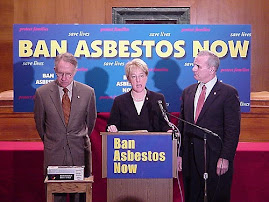
ToxicsWatch Alliance calls for total ban on asbestos in India
Toxics Watch Alliance (TWA), a member of Ban Asbestos Network of India (BANI) said, "Despite several countries like Brazil, Hungary, Poland and South Africa banning asbestos, India is still running an asbestos business." It added: "the Brazilian Supreme Court passed a judgment, saying the use of asbestos is unconstitutional in their country. "However, they are selling asbestos to India. In 1995, the Supreme Court (SC) gave a judgment which established that the right to health is equal to the right to life (Article 21). SC's gave directions in this regard but none of the directives have been complied with. According to the International Labour Organisation (ILO), the only way to eliminate asbestos-related disease is to ban all asbestos-related work.
Indian Ministry of Education has taken a step in the right direction. It shows that the government is sensitive to the health of students. Not only that over 7000 railway platforms across India have been made asbestos-free. ToxicsWatch said, “The process to make the railway stations asbestos-free is going on, barring a few places, asbestos roofs have been removed from most of the railway stations." "The Centre should be appreciated for banning the mining of asbestos. However, asbestos-based products are manufactured here and they are getting exported. India is also importing asbestos because there is no ban on the import and export of asbestos. India has neither banned manufacturing and use of asbestos. The governments in India should prepare a register to note down all asbestos-based products. If the government keeps such a register, such asbestos-based products can be decontaminated later" said ToxicsWatch.
Notably, India was not able to set up an Indian Cultural Centre in Washington D.C due to the asbestos issue. Minister of External Affairs Dr S Jaishankar has earlier informed in the Parliament that there were asbestos concerns “with regard to Indian property in Washington D.C. Asbestos posed a challenge in preparing it for use as an Indian Cultural Centre.” Replying to a query raised by Mohammed Nadimul Haque in February 2023, Jaishankar has said that in the case of the property in Washington, it was acquired in 2013. "Typically, when properties are acquired, not built Greenfield, they need to be modified for use. There was a modification required to make it ready for use. In the case of Washington property, what happened was that after the acquisition of the property, a certain set of issues came up while the matter was being processed. There were waterproofing issues. There were asbestos concerns," Jaishnakar said.
NGT's verdict paves way for asbestos free India
National Green Tribunal (NGT) in early November 2025 directed the Union Ministry of Environment, Forest and Climate Change (MoEF&CC) to review all scientific material and global best practices within six months and take an appropriate policy decision regarding the permitting of asbestos-cement roofing sheets and other asbestos-based materials used in schools, residential houses, and other buildings. A Bench comprising Justice Arun Kumar Tyagi (Judicial Member) and Dr. Afroz Ahmad (Expert Member) asked the Ministry to prepare guidelines covering the manufacturing, installation, maintenance, dismantling, and disposal of asbestos products, and to formulate an action plan with clear timelines for their safe management and disposal, in line with the Ministry's Vision Statement on Environment and Human Health.
The Tribunal observed that the health of children must be given paramount importance, and that the government should follow the precautionary principle under Section 20 of the NGT Act, 2010 while making decisions on asbestos use. However, the Bench made it clear that, in the absence of specific scientific evidence, an order for immediate discontinuance or replacement of asbestos roofing across the country was “not warranted at this stage.” The NGT directed the MoEF&CC, in consultation with the Central Pollution Control Board (CPCB) and the Ministry of Education, to frame Standard Operating Procedures (SOPs) for safe handling and disposal of asbestos materials and to issue advisories to schools on the proper upkeep of existing asbestos-cement roofs.
"Children are a vulnerable group. In the face of scientific uncertainty, the benefit of doubt must go to public health," the Tribunal observed, while emphasising the need for precautionary regulation rather than abrupt prohibition.
Advertisement
The Fibre Cement Products Manufacturers' Association (FCPMA), representing the asbestos-cement industry attempted to mislead the Tribunal that asbestos-cement sheets by claiming that asbestos is safe during normal use because the fibres are bound within cement and not released into the air under ordinary conditions. It claimed that its members comply with all environmental and occupational safety standards, including those prescribed under the Factories Act, 1948, the Air (Prevention and Control of Pollution) Act, 1981, and relevant Bureau of Indian Standards (BIS) specifications. Asbestos-cement products are economically viable, durable, and widely used in rural and semi-urban housing, and that any abrupt restrictions could adversely impact employment and small-scale manufacturing units dependent on the material.
NGT directed the MoEF&CC to undertake an evidence-based review of global practices and domestic data and then decide on policies that are scientifically sound and socially practical. It also asked the CPCB to develop a Standard Operating Procedure for the safe disposal of asbestos waste to prevent re-entrainment of fibres, and directed the Ministry of Education to advise schools to maintain existing asbestos-cement roofs in good condition with protective coating, Follow BIS standards during any installation or maintenance work, and Ensure disposal of asbestos waste only at authorised facilities in accordance with the Hazardous and Other Wastes (Management and Transboundary Movement) Rules, 2016.




No comments:
Post a Comment