To
Shri Bhartruhari Mahtab
Parliamentary Standing Committee on Labour
Parliament of India
New Delhi
Through Shri K. G. Sidhartha, Deputy Secretary, Lok Sabha Secretariat
Date: 18/11/2021
Subject: Probe into asbestos-related incurable diseases and deaths among workers and their families including doctors, defense workers, teachers and mechanics
Sir,
With reference to the incurable diseases and deaths caused by carcinogenic asbestos mineral fibers, we wish to draw your attention towards the investigation by a UK parliamentary committee on the hazards of asbestos in schools and hospitals, amidst the finding that a total of 305 teachers were confirmed to have died from mesothelioma, a cancer caused by exposure to asbestos, between 2001 and 2016. (Source: https://www.independent.co.uk/news/health/asbestos-deaths-inquiry-schools-hospitals-b1958949.html)
We submit that this situation creates a compelling logic for the Indian parliamentary committee to undertake similar probe given the fact that India has one of the worst asbestos legacies in the world, and it continues to import, manufacture, procure and use white chrysotile asbestos mineral fiber despite having banned it's mining.
We submit that the fact that no public and private building in India is free of carcinogenic asbestos mineral fibers. India allows toxic materials to sit in the walls of public and private buildings as they decay and grow increasingly dangerous for enviro-occupational health.
Unlike in some other countries, India does not have a central register of asbestos in public buildings. This must be changed for public safety.
We submit that more than 50,000 lives a year could be saved if the committee can recommend urgent measures.
We submit that in a asbestos related development, "the murder trial against Swiss asbestos billionaire Stephan Schmidheiny continues in Novara, Italy. On November. 15, 2021, pneumologists testified that numerous experts had examined the evidence and concluded that all 392 victims died from mesothelioma. Sixty-two were Eternit workers, 330 had environmental and/or domestic (household) asbestos exposure" according to a report by Silvava Mossano, a noted Italian journalist. The murder trial of the Swiss asbestos tycoon is linked to the abject lack of effort by Eternit management to protect or warn workers and the people in the community surrounding the plant prevailed during the 80 years of plant operation until the plant was padlocked and declared bankrupt in 1986. The terror imposed on the community, with so many dying from asbestos, year after year, is expressed in the testimonies of the victims has been recorded by former La Stampa journalist Silvana Mossano.
We submit that there is considerable indignation in the US about Johnson & Johnson (J&J), US firm using a Texas law created to enable giant corporations and billionaires to avoid facing their victims in court and delay and minimize compensation payments. J&J is using a bankruptcy maneuver to block lawsuits over baby powder cancer claims. (Source:https://www.krwg.org/post/jj-using-bankruptcy-maneuver-block-lawsuits-over-baby-powder-cancer-claims)
Johnson & Johnson is drawing criticism after using a controversial bankruptcy maneuver to block roughly 38,000 lawsuits linked to claims that its talc baby powder was contaminated with cancer-causing asbestos. The health products giant used a quirk of Texas state law to spin off a new company called LTL, then dumped all its asbestos-related liabilities — including the avalanche of lawsuits — into the new firm. LTL filed for bankruptcy last week in a federal court in Charlotte, N.C., a move designed to sharply limit efforts to recover damages for those who say they were harmed by J&J's baby powder. "Johnson & Johnson doesn't have this liability anymore. They pushed all of it into the company they created just to file for bankruptcy," said Lindsey Simon, a bankruptcy expert at the University of Georgia School of Law.
We submit that this company has stopped sale of talcum powder in North America but in a clear case of environmental racism it continues to sale it in India endangering almost every present and future Indians.
J&J has made use of a law in Texas to split off its Johnson Baby Powder (JBP) unit and then have that unit file for bankruptcy, thereby halting all lawsuits over cancer from JBP and erecting a legal barrier to protect the rest of the corporation from liability over the talc-containing product (while avoiding a bankruptcy filing by the parent corporation). A similar use of this outrageous law was used by Georgia-Pacific in 2017 to stop lawsuits over its drywall patching compounds sold in the US before they were banned in 1977, says Barry Castleman, author of "Asbestos: Medical and Legal Aspects", the most authoritative book on asbestos industry.
We submit that Hon’ble Calcutta High Court’s order on carcinogenic-asbestos that has been used for roofing in the Hon’ble Court’s main building. This creates a compelling logic for our country to be made asbestos free.
We submit that in Writ Petition (Civil). No. 14729 (W) of 2016, the Division Bench of Acting Chief Justice Nishita Mhatre and Justice Tapabrata Chakraborty has passed an order observing, “The High Court main building is undergoing repairs with the assistance of the Public Works Department (PWD) of the Government of West Bengal and other Authorities. When the entire renovation is undertaken, it is expected that the High Court and the PWD or, any other body entrusted with the renovation will ensure that the asbestos-sheets, which have been used for roofing, would be replaced by any other materials which are non-carcinogenic.” This creates a need for central and state legislatures to be made asbestos free as well besides the residences of the legislators.
We submit that prior to the Hon'ble High Court's order, the Union Railway Ministry had ordered removal of asbestos roofs from all railway buildings. It is noteworthy that the ministry invited offers for “Procurement of Non-Asbestos “K” Type Composition Brake Blocks”. The offer was been issued by Director, Railway Stores (W) or and on behalf of Hon’ble President of India. More than 7, 000 railway platforms are at various stages of asbestos decontamination but sadly asbestos waste is not being disposed in a scientific and safe manner. This initiative merits your attention.
We submit that as per Environmental Impact Assessment Manual for Asbestos Based Industries, Union Ministry of Environment & Forests, type and quantity of solid waste generated during the construction and operational stages is to be quantified. In case of expansion of the unit, the solid waste generated category wise should be furnished. For disposing asbestos waste mate rial the norms notified under Hazardous Waste (Management, Handling and Transboundary Movement) Rules, 2008 and the recommendations as per IS: 11768 – 1986 (Reaffirmed 2005) is required to be followed. "All asbestos waste must be kept in closed containers before its transportation to the disposal point so that no asbestos dust is emitted into the environment during transportation. Final covering of asbestos waste, other than high-density waste, shall be to a minimum depth of 2m and the asbestos waste including the used bag filters should be disposed at an approved TSDF." It must be noted that there is no mention of Hazardous Waste Treatment, Storage and Disposal Facilities (TSDFs) for the waste generated from the asbestos factories of four companies in the State. These factories are operating violation of general and specific conditions laid down on the environmental clearance unmindful of the fatal risk to workers, their families, the residents in the vicinity of these units and the consumers.
We submit that it has been estimated that one person dies from mesothelioma for every 170 tons of asbestos consumed. WHO estimates we have107,000 deaths worldwide per year from occupational exposure to asbestos.If non occupational exposure is added it reaches a figure of about 120,000deaths. Average world consumption/year 30-60 years ago was -- looks like 3/2 of what it is now (2 million metric tons/year). Give India its share of that based on its share of global consumption. At 300,000 tons in 2013, that's about 18,000 deaths (15% of 120,000). Asbestos diseases have a very long incubation period. So if you are exposed today to an asbestos fibre, you are likely to get the disease in next 10-35 years. Asbestos is like a time bomb to the lungs and Indians will suffer the most. If it is banned today that does not mean people will not suffer. Because of past usage people will continue to suffer from these diseases.
We submit that the Hon’ble Calcutta High Court has recorded that “there is sufficient study material indicating that asbestos sheets used for roofing could cause cancer” and “various documents, issued by the World Health Organization (WHO), and other materials obtained from the Internet, that the exposure to asbestos including chrysotile causes lung cancer, mesothelioma and asbestosis.” It was contended by the petitioner that “the High Court should not continue to use these materials for roofing, especially after legislation in different parts of the world has been enacted on recognizing the potential health risk of asbestos to the citizens at large. Even in India several Acts recognized the fact that asbestos is a health-hazard.”
We submit that the directions of the Hon’ble Supreme Court dated January 27, 1995 in the Writ Petition (Civil) No. 206 of 1986 asked both central and State Governments to incorporate fresh resolution of ILO in their rules and regulations. Government has not incorporated the ILO resolution dated June 14, 2006.
We submit that there is hardly any building in our country which is asbestos free. It is high time efforts are initiated to decontaminate asbestos laden public and private buildings.
We submit that prior to Hon’ble Calcutta High Court’s order, Kerala State Human Rights Commission recommended ban on use of asbestos roofs for schools and hospitals in its order dated n 31st January, 2009.
We submit that National Human Rights Commission (NHRC) has passed an order in Case No: 693/30/97-98 recommending that the asbestos sheets roofing should be replaced with roofing made up of some other material that would not be harmful.
We submit that globally asbestos industry is on trial. Countries after countries are passing verdicts against it. They are banning future use of the cancer causing mineral fiber of asbestos. Government of India is publicly revealing that it does not favour new asbestos plants in the country any more. There is a compelling logic emerging for pre-existing asbestos based plants to shift to non-asbestos based building materials. It is not surprising that "The Government of India is considering the ban on use of chrysotile asbestos in India to protect the workers and the general population against primary and secondary exposure to Chrysotile form of Asbestos." It has noted that "Asbestosis is yet another occupational disease of the Lungs which is on an increase under similar circumstances warranting concerted efforts of all stake holders to evolve strategies to curb this menace". A concept paper by Union Ministry of Labour revealed this at the two-day 5th India-EU Joint Seminar on “Occupational Safety and Health” on 19th and 20th September, 2011. (Reference: http://www.labour.nic.in/lc/Background%20note.pdf)
We submit that the Annual Report of NHRC 2003-2004 refers to a Report entitled “Asbestos – Health and Environment – an in-depth Study “submitted by the Institute of Public Health Engineers, India. The study underlines that safe and controlled use of asbestos is not possible.
We submit that taking lessons from the industrial disaster of Bhopal, asbestos industry should ne made to pay heed to the way asbestos companies have gone bankrupt in the Western countries. They should be persuaded to join hands and create a compensation fund for victims. Dow Chemicals Company which refuses to own the liability for Bhopal disaster caused by Union Carbide Corporation (UCC) in India has owned the UCC’s asbestos related liabilities and announced a compensation fund of 2.2 billion dollars for the victims. In Europe, tycoons and ministers are facing criminal charges and imprisonment for their act of knowing subjecting unsuspecting people to killer fibers of asbestos. The future is no different for Indian culprits.
We submit that while India has technically banned mining of asbestos due deleterious impact on health, it is quite ironical that Union Government allows import of white chrysotile asbestos from countries like Russia, Brazil, Zimbabwe, Kazakhstan and others. Government should not allow itself to be misled by asbestos producers like Russia in this regard now that Canada has rightly stopped mining of white chrysotile asbestos almost like India due its “deleterious” impact on health.
We wish to draw your attention towards the verdict of five judges of Japan’s Supreme Court of February 17, 2015 that has upheld a ruling that found asbestos used at a plant of Kubota Corporation caused fatal mesothelioma in a man who lived near the plant and ordered the company to pay ¥31.9 million in damages to his relatives. The petitioners were relatives of Kojiro Yamauchi, who died at age 80 after working for two decades about 200 meters from the Kubota plant in Amagasaki, Hyogo Prefecture. His relatives and those of Ayako Yasui, who died at age 85 having lived about 1 km from the plant, sought damages from both Kubota and the government. In October, 2014 the Supreme Court ruled that the government was responsible for failing to protect workers from exposure at asbestos factories in Sennan, Osaka Prefecture. Reference: http://www.japantimes.co.jp/news/2015/02/19/national/crime-legal/top-court-upholds-kubotas-liability-in-asbestos-death-case/#.VO3inSw8RkQ
It is noteworthy that Japan has banned asbestos of all kinds including white chrysotile asbestos.
We also wish to draw your attention towards the fact that our neighbour Nepal has become the first country in South Asia which going in the direction of banning asbestos
We submit that in January 1995, while passing the judgment for the asbestos case file by the Consumer Education & Research Centre (CERC) (case details: http://indiankanoon.org/doc/1657323/), Hon’ble Supreme Court of India directed all asbestos factories to keep the health records of their workers for 40 years and/or 15 years after their retirement.
We submit that the second significant direction was the GoI and the state governments have to mend their rules and regulation as per the ILO resolution (International Labour Organisation). The ILO says eliminate asbestos of all kinds for elimination of asbestos related-diseases. Controlled use is not possible. It has not been possible for all the countries which have banned it and this is impossible in India too.
We submit that Navy officials have rightly objected to presence of asbestos in aircraft carrier Admiral Gorshkov which was inducted into the Indian Navy as INS Vikramaditya after asbestos decontamination.
We submit that Union of India’s Budget 2011-12 had made reference to asbestos related diseases by including it under the Rashtriya Swasthya Bima Yojana to cover ‘unorganized sector workers in hazardous mining and associated industries like asbestos etc”. During Emergency, the ruling party and its acolytes had proposed to put opposition leaders in jails which had asbestos roofs.
We submit that there are fibre substitutes that have been evaluated by WHO are listed in the Summary Consensus Report of WHO Workshop on Mechanisms of Fibre Carcinogenesis and Assessment of Chrysotile Asbestos Substitutes.
Reference: http://www.who.int/ipcs/publications/new_issues/summary_report.pdf
We submit that sooner or later, the asbestos industry will go bankrupt because they will have to pay huge amount of money in compensation. For every injury in the law there is a remedy. The present and the future generation will make sure they get remedy.
We submit that the rate of consumption of growth which they are enjoying today does not mean it will continue. In western countries, the rate picked at one time and today it is zero. This is the peak of Asbestos industry in India and now, the downfall will start.
We submit that the industry must be persuaded to phase out in two phases. In the first phase the goal is to eliminate use of chrysotile asbestos and the number of exposed workers and consumers in the country. In the second phase, the goal is to create incentives for the use of safer materials, ensure, create a registry of asbestos laden buildings and victims of asbestos-related diseases and ensure decontamination of the former and compensation for the latter. There is an immediate need to conduct an audit of the current status of the victims of asbestos related diseases from the government hospital records in the country and make it mandatory for medical colleges to provide training for doctors so that they can diagnose diseases caused by occupational, non-occupational and environmental exposures to killer fibers and substances.
We submit that meanwhile, while an Advisory Committee of Union Ministry of Labour has been set up to implement Hon’ble Supreme Court order issued 15 years ago on January 27, 1995 and repeated on January 23, 2012. Although several years have passed but the Advisory Committee headed by Joint Secretary, Union Ministry of Labour is yet to submit its report to incorporate specific directions of the Court with regard to fresh ILO’s Resolution of June 14, 2006 introducing a ban on all mining, manufacture, recycling and use of all forms of asbestos.
We submit that even early industry-funded studies showed a causal relationship between asbestos exposure and cancer. Had this been made known to the public it could have prevented countless deaths but the asbestos industry made the conscious decision to protect their profits instead and choose to keep this information hidden from the public. India’s asbestos industry is following the same path. As a consequence, although millions of Indian lives are being lost and millions are being exposed to the killer fibers of white chrysotile asbestos, no government agency or company is being held liable due to political patronage.
While on a visit to New Delhi, Dr Alec Farquhar, as the Managing Director, Occupational Health Clinics for Ontario Workers, Canada said, “We now have around 500 asbestos cancer cases every year in Ontario from a population of 13 million. If you (India) continue on your current path, you will multiply our death count by 100 times. That would be 50, 000 Indian workers dying every year from asbestos. In Ontario, we learned that safe use of asbestos is impossible. I urge you from the bottom of my heart, please do not make the same mistake as we made in Canada. Stop using asbestos and use a safe alternative.” It is clear that lack of documentation and lack of environmental and occupational health infrastructure does not mean lack of victims of asbestos related diseases.
It is sad that a killer fiber like asbestos which is banned in some 70 countries is being used to manufacture asbestos cement sheets disregarding the fatal health impact for present and future generations. Such plants and products should be stopped to save residents from incurable lung cancer like diseases.
We submit that asbestos death toll has surpassed traffic fatalities in Australia. In US, every year 10, 000 people are dying because of asbestos related disease. There is an epidemic of asbestos diseases in Europe. In India, a silent Bhopal disaster is happening every year. The rate of consumption of asbestos in India is rising at an alarming rate due to budgetary support. Nearly all of India's asbestos is mixed with cement to form roofing sheets. Bolstered by asbestos import tariffs that have been reduced from 78% in the mid-1990s to 15% by 2004, the country's asbestos-cement industry is increasing by roughly 10% every year.
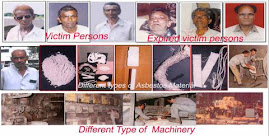
We submit that some typical asbestos-based materials include sound insulation infill, thermal insulation lagging, tape, rope, felts, blankets, mattresses, asbestos boards, gaskets and washers, drive belts/ conveyor belts, roofing sheets and slates, drain and flue pipes, rainwater goods, fascia boards, bath panels, ceiling tiles, toilet seats, cisterns, bitumen damp proof course, lining to walls, lab bench tops, extraction hoods and fume cupboards, brakes and clutches, cooling tower elements and others.
We submit that the health consequences are already apparent, but the scale of the problem is not clear because there is no documentation of disease caused by environmental and occupational factors. “The Government of India has a very poor, almost non-existent, system to record death and disease”, explains Arthur Frank from Drexel University, Philadelphia , PA , USA who is a regular visitor to India. Besides, cancer is not a notifiable disease. Prof. Frank cited a hospital in Mumbai which sees a dozen cases of mesothelioma every year. Studies have shown high rates of asbestosis among workers in the industry, including in those whose exposure to the material has spanned less than 5 years. There has been no real assessment of [asbestos-related disease] to the point that you can get accurate figures.
We submit that the verdict even by the World Trade Organization (WTO)’s Appellate Body (AB) validated the rights of Member States to prohibit the import and use of goods which contain carcinogenic substances such as chrysotile asbestos (white asbestos) is noteworthy. On March 12, 2001 the WTO's Appellate Body (AB) issued its ruling in the case of Canada vs. the European Communities Measures Affecting Asbestos and Asbestos-Containing Products. It noted that safe and controlled use of chrysotile asbestos is impossible.
We submit that India is the largest importer of asbestos, according to the UN Commodity Trade Statistics Database. Most of it goes into making corrugated roofing sheets as building material.
In our country, it has been estimated by a Canadian jurist that approximately 50, 000 people die every year due to asbestos related cancer. But so far Government of India and state governments have failed to take a pro-people’s health position and a scientifically consistent stand on the import of chrysotile asbestos whose mining is technically banned in India.
In such a context, we appeal to you to take note of:
· Hon’ble Calcutta High Court’s order;
· Resolutions of WHO and ILO (2005 and 2006 seeking elimination of future use of asbestos including chrysotile asbestos worldwide;
· Need to announce the compensation package for present and future victims of asbestos diseases as it has done in the case of Silicosis and make the asbestos companies criminally liable for knowingly exposing citizens and consumers of asbestos products;
· The fact that every international health agency of repute including the World Health Organization, the International Labor Organization, International Agency for Research on Cancer, Occupational Safety and Health Administration, National Institute for Occupational Safety and Health, and the American Cancer Society agree there is no safe level of asbestos exposure. Most recently, the International Agency for Research on Cancer (IARC) reconfirmed that all commercial asbestos fibers - including chrysotile, the most commercially used form of asbestos - cause lung cancer and mesothelioma. In addition, IARC newly confirmed that there is sufficient evidence that asbestos causes ovarian cancer and reconfirmed asbestos causes laryngeal cancer;
· The World Health Organisation estimates that asbestos already claims 107,000 lives a year. Even that conservative estimate means every five minutes around the clock a person dies of asbestos related disease. The ongoing use of the asbestos fibre kills at least 300 people every day;
· World Bank's Asbestos Good Practice Guidelines. These Guidelines, as well as its earlier Environmental, Health & Safety General Guidelines, require that the use of asbestos must be avoided in new construction in projects funded by the World Bank around the world. The Guidelines also provide information on available safer alternatives to asbestos;
· Human biology is same everywhere if the asbestos is deemed hazardous in the developed countries; it must be deemed so in India too;
In view of the incontrovertible adverse health effects asbestos based plants and products should be phased out to protect the lives of present and future generations.
We take this opportunity to draw your immediate attention towards the fact that asbestos related diseases are also incurable despite this environmental clearances are still being given by the central environment ministry.
In such a backdrop, it is germane to ask Union of India and the States to stop manufacturing, procurement and use of all forms of asbestos including white asbestos.
It is your solemn duty to protect fellow citizens and residents from the exposure of fibers of chrysotile asbestos.
It is unbecoming of the India’s scientific stature to take untruthful and unscientific position displaying unpardonable callousness towards concerns of consumers, public health, workers, environment and human rights. India should learn from countries that have banned asbestos of all kinds including white chrysotile asbestos. These countries are: 1) Algeria, 2) Argentina, 3) Australia, 4) Austria, 5) Bahrain, 6) Belgium, 7) Brunei, 8) Bulgaria, 9) Chile, 10) Croatia, 11) Cyprus, 12) Czech Republic, 13) Denmark, 14) Egypt, 15) Estonia, 16) Finland, 17) France, 18) Gabon, 19) Greece, 20) Germany, 21) Gibraltar, 22) Hungary, 23) Honduras, 24) Iceland, 25) Iraq, 26) Ireland, 27) Israel, 28) Italy, 29) Japan, 30) Jordan, 31) Kuwait, 32) Latvia, 33) Luxembourg, 34) Lithuania, 35) Mauritius, 36) Mozambique, 37) Malta, 38) Netherlands, 39) New Caledonia, 40) New Zealand, 41) Norway, 42) Oman, 43) Portugal, 44) Poland, 45) Qatar, 46) Romania, 47) Saudi Arabia, 48) Sweden, 49) Switzerland, 50) Serbia, 51) Seychelles, 52) Slovakia, 53) Slovenia, 54) South Africa, 55) South Korea, 56) Spain, 57) Turkey, 58) Uruguay, 59) United Kingdom and 60) Ukraine. Besides these countries, 10 more countries have banned asbestos of all kinds.
Although domestic laws in India recognize white chrysotile asbestos as hazardous, the Union Government has been taking inconsistent position in this regard in UN meetings. Hon'ble High Court may recommend to the Government to take steps to rectify the blunder it has committed by immorally and illegitimately denying right to know about hazardous substances to present and future Indians. It should factor in views of health and environment ministers to pave the way for creating a future which is free of incurable hazardous asbestos related diseases. Indian laws include asbestos in the list of hazardous substances but tremendous influence of commercial interests has forced the Indian delegation to take a position which is diametrically opposite of domestic laws.
We submit that UN’s Rotterdam Convention on the prior informed consent procedure for certain hazardous chemicals and pesticides in international trade and the Chemical Review Committee of this UN Convention has recommended listing of white chrysotile asbestos in the UN list of hazardous substances for better protection of public health and environment. It is consistent with our domestic law.
We wish to draw your urgent attention towards a paper titled "Pleuroperitoneal Mesothelioma: A Rare Entity on 18F-FDG PET/CT" published in Indian Journal of Nuclear Medicine, authored by researchers from Department of Nuclear Medicine, All India Institute of Medical Sciences (AIIMS), New Delhi and Department of Radiodiagnosis, AIIMS in the 2017 Jan-Mar; 32(1): 75–76 issue. This paper authored by Dr Shamim Ahmed Shamim et al provides credible information about a asbestos related disease of a 40-year-old-female without any history of occupational asbestos exposure presented with histologically proven malignant pleural mesothelioma. Malignant mesothelioma is a rare tumor that originates from the cells lining the mesothelial surfaces, including the pleura, peritoneum, pericardium, and tunica vaginalis.(The other co-authors of the paper are Dr Manas Kumar Sahoo, Dr Anirban Mukherjee, Dr Girish, Dr Kumar Parida, Dr Krishan Kant Agarwal, Dr Chandrasekhar Bal, Dr Madhavi Tripathi and Dr Chandan Jyoti Das).
It is noteworthy that both workers and consumers are at fatal risk from the killer asbestos fibers through the life cycle of the asbestos based products.
According to World Health Organisation (WHO), Elimination of asbestos-related diseases should take place through the following public health actions:
-recognizing that the most efficient way to eliminate asbestos-related diseases is to stop the use of all types of asbestos;
-replacing asbestos with safer substitutes and developing economic and technological mechanisms to stimulate its replacement;
-taking measures to prevent exposure to asbestos in place and during asbestos removal (abatement), and;
-improving early diagnosis, treatment, social and medical rehabilitation of asbestos-related diseases and establishing registries of people with past and/or current exposures to asbestos.
As per WHO, " All types of asbestos cause lung cancer, mesothelioma, cancer of the larynx and ovary, and asbestosis (fibrosis of the lungs). Exposure to asbestos occurs through inhalation of fibres in air in the working environment, ambient air in the vicinity of point sources such as factories handling asbestos, or indoor air in housing and buildings containing friable (crumbly) asbestos materials." It underlines that several thousands of deaths can be attributed to other asbestos-related diseases, as well as to non-occupational exposures to asbestos.
We wish to draw your attention towards the interview of Dr. Frank, Professor of Public Health and Chair Emeritus of the Department of Environmental and Occupational Health at the Drexel University School of Public Health, about the international research on asbestos he’s championed since the early 1990s. He asserts, “The people who do treatment research are oncologists and radiotherapists and surgeons, so they’re not always as concerned with identifying what the cause was. That’s what I do. I identify the cause of things.” The interview is available at https://www.mesothelioma.com/blog/authors/staff/asbestos-around-the-world-an-interview-with-dr-arthur-frank.htm
It may be noted that in our country, the government does not record cases of mesothelioma, and thus proclaims no one in the country develops the disease. Dr. Frank asserts, “a lack of data does not mean a lack of disease.” In fact, when speaking to a doctor from a major cancer hospital in Mumbai, Dr. Frank learnt that, in just one year, there were 32 cases of mesothelioma in that hospital alone. “A lot of the asbestos cement factories — a major use of asbestos in India — are owned by members of parliament,” he said. “You can draw your own conclusions.” Dr. Frank has been visiting Delhi to conduct lung disease with focus on silicosis, and asbestos related disease. You may consult him for the protection of public health.
We submit that to begin with you may seek a report on compliance with six specific directions given by Hon'ble Supreme Court in CERC v Union of India on 27 January, 1995. You may seek a report from all the hospitals about asbestos related victims attended by them and consider issuing an order preparing a list of asbestos laden public buildings in Odisha, West Bengal, Bihar and Jharkhand. You may also seek a report from all the medical colleges and hospitals of Eastern India, Southern India, Western India and North India in this regard. A database of victims of asbestos related diseases, asbestos laden buildings, an inventory of asbestos based products, a database of hospitals which can diagnose the disease and a database of agencies which are competent to decontaminate asbestos from existing buildings will be helpful for the present and future generation of Indians and residents.
Therefore, we request you to take cognisance of the findings of WHO, AIIMS and Prof. Frank in order to recommend action to deal with asbestos related diseases of present and future generations in right earnest. We will be happy to submit more information in this regard.
Thanking you
Warm Regards
Gopal Krishna, LL.M., Ph.D
ToxicsWatch
E-mail-krishnagreen@gmail.com
Web: www.toxicswatch.org
Cc
Hon'ble Chairman, Parliamentary Standing Committee on Labour
Hon'ble Members, Parliamentary Standing Committee on Labour